Repair Chevrolet Repair Toyota Repair Honda Repair AvtoVAZ Repair Mercedes-Benz Repair BMW Repair Opel
Home  |  Contacts  |  Sitemap  |    
English Русский
Български
Беларускі
Український
Српски
Hrvatski
Română
Polski
Slovenský
Magyar
AudiManual.ru


  • AUDI 80
  • AUDI 100
  • AUDI A3
  • AUDI A4
  • AUDI A6
  • AUDI A8
  • AUDI Q
  • OTHER
  • ARTICLES
B8 (2007-2015) B7 (2004-2008) B6 (2000-2006) B6 (2000-2006, petrol) B5 (1994-2001) B5 (1994-2001, petrol)

Fuel pump and fuel level indicator sensor unit (Audi A4 B5)

  • Home
  • Audi A4
  • B5 (1994-2001)
  • Power unit
  • Fuel injection (gasoline)
  • Fuel pump and fuel level indicator sensor unit
            0
Table of contents: Removal ↓ Installation ↓
Note: Before starting work, read the warnings contained in paragraph 7. A special Audi/VAG tool is required to remove the inner section of the damper housing.


Removal


1. The pump and sensor are combined into one unit installed in the fuel tank. Access to it is possible through a hatch in the floor of the luggage compartment. Removal implies contact of the tank contents with the atmosphere - take special fire safety measures. The surrounding area around the car should be well ventilated so that fuel vapors do not accumulate. If possible, remove the unit with the tank as empty as possible or pump out the fuel into a suitable canister.

2. Relieve the pressure in the fuel system as described in paragraph 9.

3. Position the vehicle horizontally. Disconnect the ground cable from the battery as described in chapter 5A.

4. As described in chapter 11, remove the trim from the luggage compartment floor.

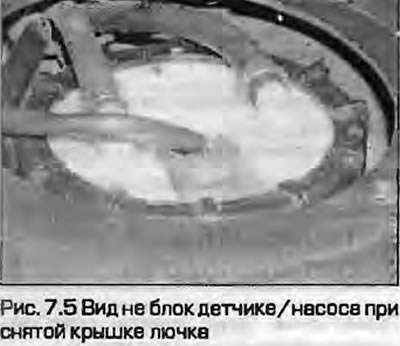
5. Loosen the screws securing the hatch and remove it from the floor (Fig. 7.5).
5. Loosen the screws securing the hatch and remove it from the floor (Fig. 7.5).


6. Disconnect the electrical connector from the pump/sensor assembly (Fig. 7.6).
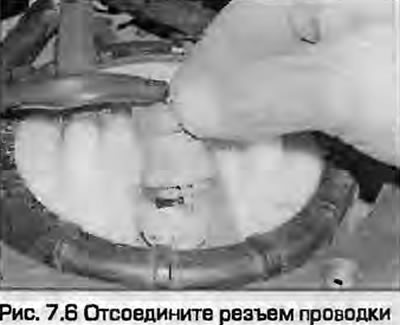


6. Disconnect the electrical connector from the pump/sensor assembly (Fig. 7.6).


7. Place a rag under the fuel collection hoses. Loosen the clamps and remove the feed and return hoses (Fig. 7.7). Label the hoses to avoid confusion during installation. Release the tubes from the fasteners on the support ring.
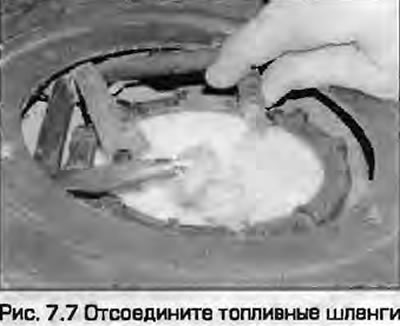
7. Place a rag under the fuel collection hoses. Loosen the clamps and remove the feed and return…


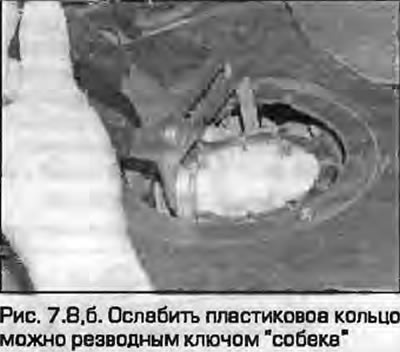
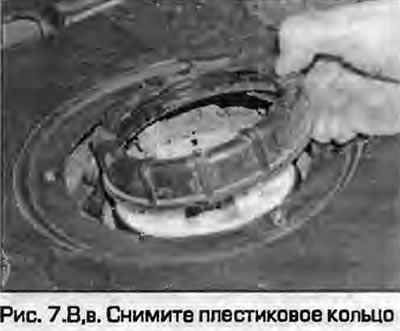
8. Remember the direction of the arrows and the ring, unscrew the plastic ring of the block fastening in the back. For this operation, Audi/VAG mechanics have a special tool. However, for this it is enough to insert two screwdrivers into the slots of the ring and cross them. You can use a large adjustable wrench "dog" (fig. 7.8, a, b).
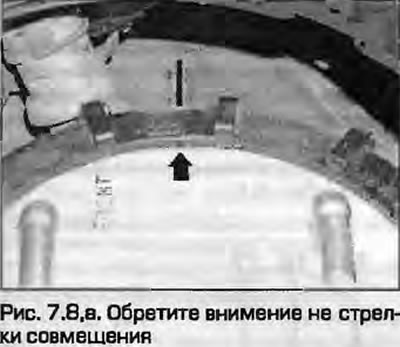
8. Remember the direction of the arrows and the ring, unscrew the plastic ring of the block…

8. Remember the direction of the arrows and the ring, unscrew the plastic ring of the block…


9. Remove the flange and seal from the opening in the tank.


10. Disconnect the sensor wiring and release it from the flange (Fig. 7.10).
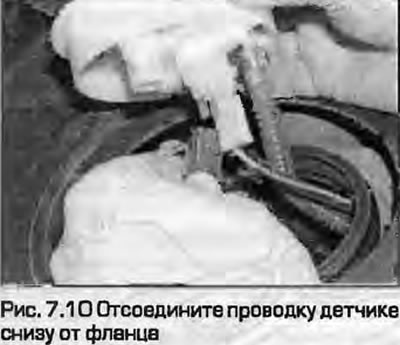
10. Disconnect the sensor wiring and release it from the flange (Fig. 7.10).


11. Pull off the casing, disconnect the return fuel pipe from the bottom of the flange (Fig. 7.11).
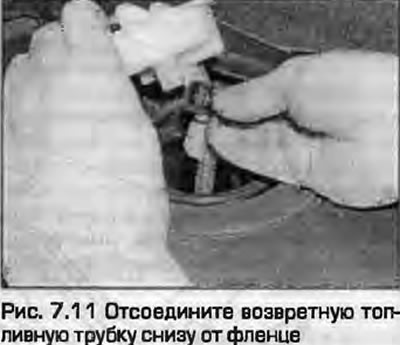
11. Pull off the casing, disconnect the return fuel pipe from the bottom of the flange (Fig. 7.11).


12. Turn the inner section of the damper housing counterclockwise by approximately 15° and remove it together with the fuel pump (Fig. 7.12). Audi mechanics use a special tool for this, aligning it with the cutouts on the top of the pump - it is strongly recommended to use it. You can also make a homemade one, but the plastic is very fragile - it can be broken. If the pump is to be replaced, drain all the fuel from the old block. The flange can be removed from the pump by loosening the clamp and disconnecting the intermediate feed pipe. Remember the way it is installed in order to reassemble everything correctly.
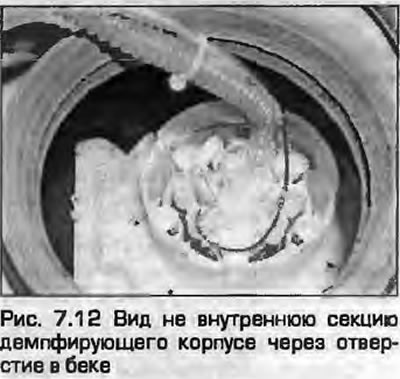


12. Turn the inner section of the damper housing counterclockwise by approximately 15° and remove…


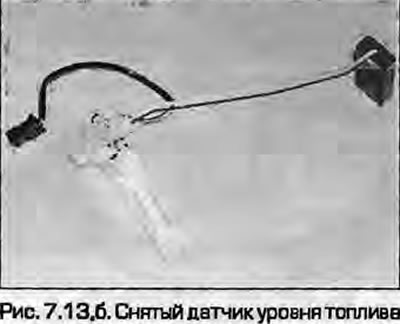
13. To remove the sensor, press the latch on the side of the damper housing inside the tank. Carefully remove the sensor (fig. 7.13, a, b).
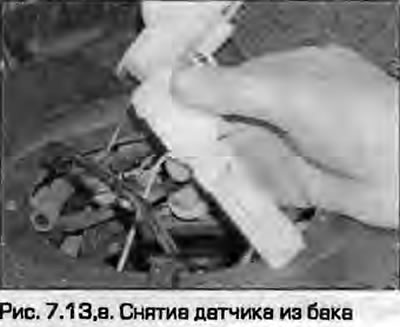
13. To remove the sensor, press the latch on the side of the damper housing inside the tank.…

14. Inspect the sensor float - there should be no holes in it and there should be no fuel gurgling in it. Replace a damaged float. A damaged seal of the hole in the tank should also be replaced. Inspect the runner and rheostat of the sensor - there should be no breaks in the conductor. Remove any possible dirt from the rheostat


Installation


15. Insert the sensor into the damping housing, press until the lock snaps into place.

16. If the flange was removed from the pump, attach the intermediate feed pipe and tighten the clamp (Fig. 7.16).
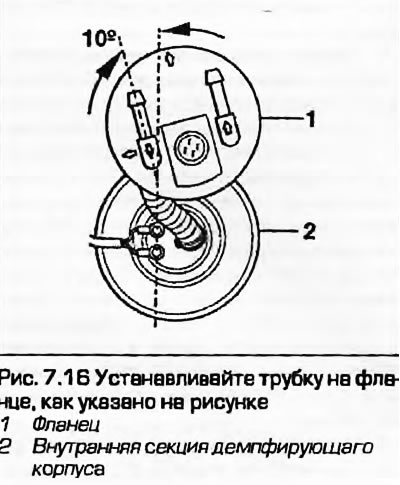
16. If the flange was removed from the pump, attach the intermediate feed pipe and tighten the…


17. Insert the inner damping housing with the pump into the outer housing so that the protrusion on the upper edge aligns with the first mark on the housing. Using an open-end wrench, push the pump housing down and turn it clockwise until it aligns with the second mark on the housing.

18. Attach the fuel return pipe to the bottom of the flange.

19. Attach the fuel sensor wiring to the inside of the flange and attach it to the bottom of the flange. The wiring should be wrapped once around the fuel return line.

20. Lubricate the new rubber seal with clean fuel, install it on the flange, install the flange into the fuel tank hole.

21. Install the support ring, then screw and tighten the plastic one. To ensure that the arrows align when tightening the ring, turn the flange slightly counterclockwise while tightening the ring.

22. Connect the fuel hoses and tighten the clamps.

23. Connect the wiring connector to the pump/sensor unit.


24. Install the hatch and tighten the screws that secure it.

25. Install the trim on the luggage compartment floor.

26. Connect the battery as described in chapter 5A.
The article was checked by auto expert Timur Bazhenov
This article is available at russian, bulgarian, belarusian, ukrainian, serbian, croatian, romanian, polish, slovak, hungarian

Share information:
Previous articles
Audi A4 B5: Fuel injection (gasoline)
Next articles

Fuel filter — replacement
Simos injection control system components
Bosch Motronic Fuel Injection Control System Components
Accelerator cable — removal, installation and adjustment
Fuel tank — removal and installation
Fuel injection system — pressure relief
Intake manifold — removal and installation
Fuel injection system — checking and adjustment


Similar articles on other Audi car models:
Fuel level indicator sensor Audi 80 B3 (1986-1991)
Mono-Motronic injection system control unit, fuel pump relay,… Audi 100 C4 (1990-1994, petrol)
Removal and installation the fuel pump / fuel level sensor Audi A3 Type 8L (1996-2003)
Electrical diagram of the control unit Motronic, fuel pump… Audi A6 C5 (1997-2004)
Fuel pump / fuel level sensor Audi A8 D2 (1994-2002)
Fuel level sensor, fuel lift pump, instrument cluster control… Audi Q5 Type 8R (2008-2017)
Fuel pumping unit and fuel level indicator sensor Audi A2 (1999-2005)
Link to this page in different formats


Visitor comments

No comments yet


How much will 15 + 50 =


A4(B8, 2007-2015) 
  • General information
  • Operating instructions
  • Power unit
  • Petrol engines 1.8 l
  • Petrol engines 1.8/2.0 l
  • Petrol engines 3.0 l
  • Petrol engines 3.2 l
  • Fuel system (petrol)
  • Diesel engines 2.0 l (CA*)
  • Diesel engines 2.0 l (CJCB)
  • Diesel engines 2.7/3.0 l
  • Diesel engines 3.0 l
  • Fuel system (diesel)
  • Transmission
  • Manual gearbox 0B1
  • Manual gearbox 0B2
  • Manual gearbox 0B3
  • Manual gearbox 0B4
  • Automatic transmission 0B5
  • Automatic transmission 0B6
  • Automatic transmission 0AW
  • All-wheel drive system
  • Chassis
  • Front suspension
  • Rear suspension
  • Brake system
  • Steering system
  • Body
  • Exterior
  • Interior
  • Seats
  • Doors, locks and windows
  • Security system
  • Heating and air conditioning
  • Electrical equipment
  • Audio system
  • Power devices
  • Equipment and devices
  • Lighting and lamps
  • Electrical circuits
 
A4(B7, 2004-2008) 
  • General information
  • Introduction to manual
  • Troubleshooting
  • Operating instructions
  • Maintenance
  • Power unit
  • Petrol engines 2.0 (ALT)
  • Petrol engines 2.0 (TFSI)
  • Petrol engines 1.8 (MPI)
  • Diesel engines
  • Cooling system
  • Air conditioner
  • Fuel and exhaust system
  • Ignition system
  • Starting and charging
  • Transmission
  • Clutch
  • Manual gearbox
  • Automatic gearbox
  • Drive shafts
  • Chassis
  • Brake system
  • Front suspension
  • Rear suspension
  • Steering
  • Body
  • Exterior
  • Interior
  • Electrical equipment
  • Equipment and devices
  • Lighting and signaling
  • Windscreen wipers and washers
  • Electrical diagrams
  • Electrical diagrams (since 2007)
 
A4(B6, 2000-2006) 
  • General information
  • Vehicle Description
  • User manual
  • Maintenance
  • Power unit
  • Gasoline engine
  • Diesel engine
  • Lubrication system
  • Cooling system
  • Supply system
  • Injection system
  • Exhaust system
  • Ignition and control
  • Transmission
  • Gear box
  • Clutch and drive shafts
  • Chassis
  • Brake system
  • Car suspension
  • Steering
  • Body
  • Heating and ventilation
  • Exterior (external elements)
  • Interior (internal elements)
  • Electrical equipment
  • Power devices
  • Lighting and appliances
  • Electrical circuits
 
A4(B6, 2000-2006, petrol) 
  • General information
  • Introduction to the guide
  • Car care
  • Power unit
  • Engine repair
  • Lubrication system
  • Cooling system
  • Injection and control system
  • Ignition system
  • Power and exhaust system
  • Transmission
  • Clutch and drive shafts
  • Car gearbox
  • Chassis
  • Suspension and wheels
  • Steering
  • Brake system
  • Body
  • Interior
  • Exterior
  • Electrical equipment
  • Equipment and devices
  • Lighting and signaling
  • Power devices
  • Electrical circuits
 
A4(B5, 1994-2001) 
  • General information
  • Introduction to the guide
  • Car care
  • Maintenance (gasoline)
  • Maintenance (diesel)
  • Power unit
  • Gasoline engines
  • Diesel engines
  • Engine overhaul
  • Cooling system
  • Fuel injection (gasoline)
  • Fuel system (diesel)
  • Exhaust system
  • Ignition system
  • Transmission
  • Clutch
  • Mechanical gearbox
  • Automatic gearbox
  • Drive shafts
  • Chassis
  • Brake system
  • Car suspension
  • Steering
  • Body
  • Exterior
  • Interior
  • Doors, locks and windows
  • Heating and ventilation
  • Electrical equipment
  • Power devices
  • Equipment and devices
  • Electrical circuits
 
A4(B5, 1994-2001, petrol) 
  • General information
  • Vehicle description
  • Maintenance
  • Power unit
  • Engine repair
  • Turbocharging
  • Exhaust system
  • Cooling system
  • Ignition system
  • Fuel system
  • Motronic injection system
  • MPI and MPFI injection system
  • Transmission
  • Clutch
  • Gearbox and shafts
  • Chassis
  • Steering
  • Car suspension
  • Brake system
  • Wheels and tires
  • Body
  • Heating and ventilation
  • Body parts
  • Electrical equipment
  • Fuses and relays
  • Power devices
  • Lighting and lamps
  • Tools and devices
  • Electrical circuits
 
AudiManual.ru © 2017-2026 · Mobile version · Feedback · Sitemap: EN BG BY UA RS HR RO PL SK HU · Site search · News and articles
80 B2 · 80 B3 petrol · 80 B3 · 80 B4 · 100 C3 diesel · 100 C3 petrol · 100 C3 · 100 C4 petrol · 100 C4 · A3 Type 8L · A4 B5 petrol · A4 B5 · A4 B6 petrol · A4 B6 · A4 B7 · A4 B8 · A6 C4 · A6 C5 · A6 C5 Allroad · A8 D2 · Q5 Type 8R · Q7 Typ 4L · Audi A2 ·
This site uses cookies 🍪. Click the button to accept this fact.