
Repair Chevrolet Repair Toyota Repair Honda Repair AvtoVAZ Repair Mercedes-Benz Repair BMW Repair Opel
Home  |  Contacts  |  Sitemap  |    
English Русский
Български
Беларускі
Український
Српски
Hrvatski
Română
Polski
Slovenský
Magyar
AudiManual.ru


  • AUDI 80
  • AUDI 100
  • AUDI A3
  • AUDI A4
  • AUDI A6
  • AUDI A8
  • AUDI Q
  • OTHER
  • ARTICLES
B8 (2007-2015) B7 (2004-2008) B6 (2000-2006) B6 (2000-2006, petrol) B5 (1994-2001) B5 (1994-2001, petrol)

Wheel replacement (Audi A4 B5)

  • Home
  • Audi A4
  • B5 (1994-2001)
  • General information
  • Introduction to the guide
  • Wheel replacement
            0
Warning! Do not change a tire if there is a risk of being hit by a passing car. On roads with heavy traffic, try to stop on the side of the road or in a "pocket". Beware of passing cars - they are easy to miss when you are busy with work.


Preparation


If you get a flat tire, stop as soon as possible.

Stop the vehicle on firm ground, if possible, and away from passing traffic.

If necessary, turn on the hazard warning lights.

If you have a warning triangle, install it to warn other drivers of your accident.

Engage first or reverse gear (on models with automatic transmission, set the gearshift lever to the "PARK" position) and apply the parking brake.

Wedge the wheel on the other side of the car diagonally to the one being replaced. Suitable stones can be used for this.

On soft ground, you need to place a board under the jack.

1. The spare wheel, jack and wheel brace are stored under the floor of the luggage compartment.
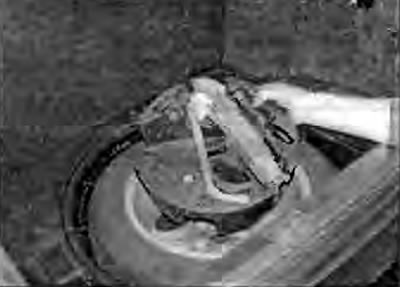
1. The spare wheel, jack and wheel brace are stored under the floor of the luggage compartment.


2. Using the hook from the tool kit, remove the wheel trim.
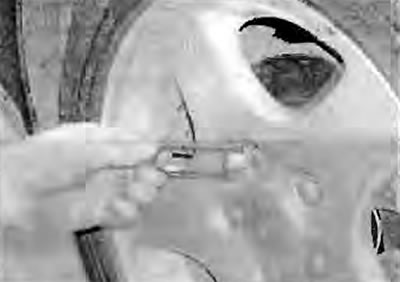
2. Using the hook from the tool kit, remove the wheel trim.


3. Loosen the wheel mounting bolts by half a turn each. For safety, place a wedge under the opposite wheel - a couple of decent stones will do the trick.
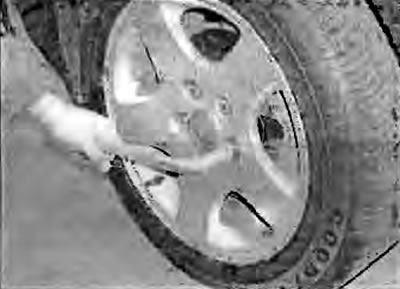


3. Loosen the wheel mounting bolts by half a turn each. For safety, place a wedge under the…


4. Place the jack under the threshold reinforcement closest to the wheel being replaced (you can't put a jack under other points of the threshold), resting it on a hard road surface. Rotate the jack handle clockwise until the wheel is lifted off the road.
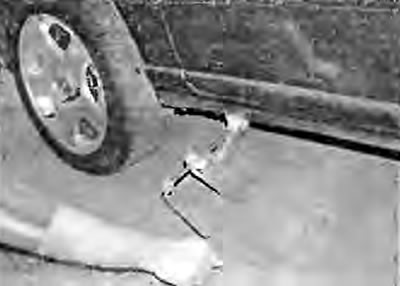
4. Place the jack under the threshold reinforcement closest to the wheel being replaced (you can't…


5. Loosen the wheel mounting bolts and remove the wheel. After removing the first bolt, tighten the guide pin to facilitate installation of the spare wheel. Place the removed wheel under the threshold for insurance in case the jack breaks.
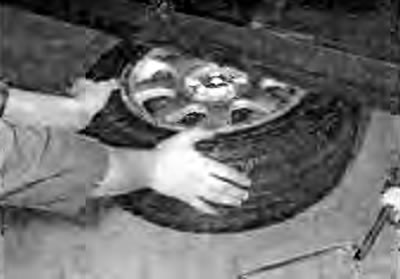
5. Loosen the wheel mounting bolts and remove the wheel. After removing the first bolt, tighten the…


6 Fit the spare wheel and tighten the bolts. Lightly tighten the bolts with the 'wheel' wrench and lower the car. Tighten the bolts securely in the sequence shown on the decorative hubcap. Place the damaged wheel in the spare wheel compartment. Please note that the wheel bolts should be checked at the earliest opportunity to ensure that they are tightened to the specified torques.
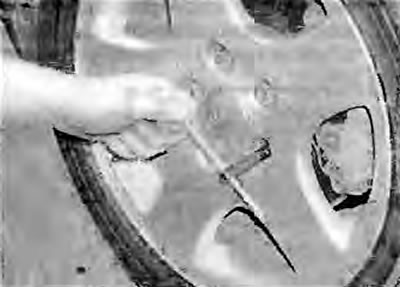


6 Fit the spare wheel and tighten the bolts. Lightly tighten the bolts with the 'wheel' wrench and…


Remove the chocks from under the vehicle wheels.

Place the jack and tools in their places.

Check the pressure in the installed wheel. If it is too low and you do not have a pump or compressor with you, drive at minimum speed to the nearest garage to pump the wheel up to the required pressure.

Repair the damaged wheel as soon as possible.

Note: The use of a special spare wheel of reduced size ("dokatka") requires compliance with certain conditions. A wheel of this type is intended for use in case of emergency and must not be used for its intended purpose further than the nearest tire service. If a wheel of this type is used, the vehicle speed must not exceed 100 km/h. Also avoid sudden acceleration, turns and braking. In addition to the fact that a spare wheel of this type is narrower than a regular one, it also has a smaller diameter, so when driving on bumpy roads, take into account the reduced ground clearance.
The article was checked by auto expert Timur Bazhenov
This article is available at russian, bulgarian, belarusian, ukrainian, serbian, croatian, romanian, polish, slovak, hungarian

Share information:
Previous articles
Audi A4 B5: Introduction to the guide
Next articles

Starting the engine from an external battery
If the engine does not start
Main types of danger when servicing a car
You and your first generation Audi A4
What do the smudges mean?
Towing a car


Similar articles on other Audi car models:
Driving with all-wheel drive Audi 80 B3 (1986-1991, petrol)
Rear wheel cylinder — removal, overhaul and installation Audi 100 C3 (1982-1990, diesel)
Spare wheel Audi A3 Type 8L (1996-2003)
Multifunctional steering wheel Audi A6 C5 (1997-2004)
General information about all-wheel drive Audi A8 D2 (1994-2002)
Lifting the wheel support of an unloaded vehicle with screw… Audi Q5 Type 8R (2008-2017)
Removal and installation driver's airbag (sports steering wheel) Audi A2 (1999-2005)
Link to this page in different formats


Visitor comments

No comments yet


How much will 32 + 13 =


A4(B8, 2007-2015) 
  • General information
  • Operating instructions
  • Power unit
  • Petrol engines 1.8 l
  • Petrol engines 1.8/2.0 l
  • Petrol engines 3.0 l
  • Petrol engines 3.2 l
  • Fuel system (petrol)
  • Diesel engines 2.0 l (CA*)
  • Diesel engines 2.0 l (CJCB)
  • Diesel engines 2.7/3.0 l
  • Diesel engines 3.0 l
  • Fuel system (diesel)
  • Transmission
  • Manual gearbox 0B1
  • Manual gearbox 0B2
  • Manual gearbox 0B3
  • Manual gearbox 0B4
  • Automatic transmission 0B5
  • Automatic transmission 0B6
  • Automatic transmission 0AW
  • All-wheel drive system
  • Chassis
  • Front suspension
  • Rear suspension
  • Brake system
  • Steering system
  • Body
  • Exterior
  • Interior
  • Seats
  • Doors, locks and windows
  • Security system
  • Heating and air conditioning
  • Electrical equipment
  • Audio system
  • Power devices
  • Equipment and devices
  • Lighting and lamps
  • Electrical circuits
 
A4(B7, 2004-2008) 
  • General information
  • Introduction to manual
  • Troubleshooting
  • Operating instructions
  • Maintenance
  • Power unit
  • Petrol engines 2.0 (ALT)
  • Petrol engines 2.0 (TFSI)
  • Petrol engines 1.8 (MPI)
  • Diesel engines
  • Cooling system
  • Air conditioner
  • Fuel and exhaust system
  • Ignition system
  • Starting and charging
  • Transmission
  • Clutch
  • Manual gearbox
  • Automatic gearbox
  • Drive shafts
  • Chassis
  • Brake system
  • Front suspension
  • Rear suspension
  • Steering
  • Body
  • Exterior
  • Interior
  • Electrical equipment
  • Equipment and devices
  • Lighting and signaling
  • Windscreen wipers and washers
  • Electrical diagrams
  • Electrical diagrams (since 2007)
 
A4(B6, 2000-2006) 
  • General information
  • Vehicle Description
  • User manual
  • Maintenance
  • Power unit
  • Gasoline engine
  • Diesel engine
  • Lubrication system
  • Cooling system
  • Supply system
  • Injection system
  • Exhaust system
  • Ignition and control
  • Transmission
  • Gear box
  • Clutch and drive shafts
  • Chassis
  • Brake system
  • Car suspension
  • Steering
  • Body
  • Heating and ventilation
  • Exterior (external elements)
  • Interior (internal elements)
  • Electrical equipment
  • Power devices
  • Lighting and appliances
  • Electrical circuits
 
A4(B6, 2000-2006, petrol) 
  • General information
  • Introduction to the guide
  • Car care
  • Power unit
  • Engine repair
  • Lubrication system
  • Cooling system
  • Injection and control system
  • Ignition system
  • Power and exhaust system
  • Transmission
  • Clutch and drive shafts
  • Car gearbox
  • Chassis
  • Suspension and wheels
  • Steering
  • Brake system
  • Body
  • Interior
  • Exterior
  • Electrical equipment
  • Equipment and devices
  • Lighting and signaling
  • Power devices
  • Electrical circuits
 
A4(B5, 1994-2001) 
  • General information
  • Introduction to the guide
  • Car care
  • Maintenance (gasoline)
  • Maintenance (diesel)
  • Power unit
  • Gasoline engines
  • Diesel engines
  • Engine overhaul
  • Cooling system
  • Fuel injection (gasoline)
  • Fuel system (diesel)
  • Exhaust system
  • Ignition system
  • Transmission
  • Clutch
  • Mechanical gearbox
  • Automatic gearbox
  • Drive shafts
  • Chassis
  • Brake system
  • Car suspension
  • Steering
  • Body
  • Exterior
  • Interior
  • Doors, locks and windows
  • Heating and ventilation
  • Electrical equipment
  • Power devices
  • Equipment and devices
  • Electrical circuits
 
A4(B5, 1994-2001, petrol) 
  • General information
  • Vehicle description
  • Maintenance
  • Power unit
  • Engine repair
  • Turbocharging
  • Exhaust system
  • Cooling system
  • Ignition system
  • Fuel system
  • Motronic injection system
  • MPI and MPFI injection system
  • Transmission
  • Clutch
  • Gearbox and shafts
  • Chassis
  • Steering
  • Car suspension
  • Brake system
  • Wheels and tires
  • Body
  • Heating and ventilation
  • Body parts
  • Electrical equipment
  • Fuses and relays
  • Power devices
  • Lighting and lamps
  • Tools and devices
  • Electrical circuits
 
AudiManual.ru © 2017-2026 · Mobile version · Feedback · Sitemap: EN BG BY UA RS HR RO PL SK HU · Site search · News and articles
80 B2 · 80 B3 petrol · 80 B3 · 80 B4 · 100 C3 diesel · 100 C3 petrol · 100 C3 · 100 C4 petrol · 100 C4 · A3 Type 8L · A4 B5 petrol · A4 B5 · A4 B6 petrol · A4 B6 · A4 B7 · A4 B8 · A6 C4 · A6 C5 · A6 C5 Allroad · A8 D2 · Q5 Type 8R · Q7 Typ 4L · Audi A2 ·
This site uses cookies 🍪. Click the button to accept this fact.