
Repair Chevrolet Repair Toyota Repair Honda Repair AvtoVAZ Repair Mercedes-Benz Repair BMW Repair Opel
Home  |  Contacts  |  Sitemap  |    
English Русский
Български
Беларускі
Український
Српски
Hrvatski
Română
Polski
Slovenský
Magyar
AudiManual.ru


  • AUDI 80
  • AUDI 100
  • AUDI A3
  • AUDI A4
  • AUDI A6
  • AUDI A8
  • AUDI Q
  • OTHER
  • ARTICLES
B8 (2007-2015) B7 (2004-2008) B6 (2000-2006) B6 (2000-2006, petrol) B5 (1994-2001) B5 (1994-2001, petrol)

The most important components of the injection system (Audi A4 B5)

  • Home
  • Audi A4
  • B5 (1994-2001, petrol)
  • Power unit
  • Motronic injection system
  • The most important components of the injection system
            0
Table of contents: Electronic control unit ↓ Throttle control unit ↓ Pressure regulator ↓ Injection valves ↓ Intake air temperature sensor ↓ Coolant temperature sensor ↓ Fresh air flow meter ↓

Electronic control unit


The control unit in the electronic box receives information via a multi-pin connector:
  • starter, terminal 50 start and end of the starting process;
  • throttle potentiometer, its current position;
  • hall sensor of the ignition system for regulating the engine speed;
  • lambda probe in a catalytic converter for measuring the residual oxygen content in exhaust gases;
  • intake air flow meter;
  • intake air temperature sensor (only in 110 kW turbo engine);
  • coolant temperature sensor in the coolant supply pipe behind the cylinder head;
  • knock sensor I on the engine block during "knock" combustion;
  • knock sensor II (only in engines with a working volume of 1.8 l) also on the engine block for precise localization of detonation combustion.

Based on the information on the engine speed and the pressure in the intake manifold, the control unit calculates the duration of the opening of the electromagnetically actuated injectors and, accordingly, the amount of fuel to be injected. For this purpose, the control unit is provided with engine data, which is a collection of data on all conceivable engine situations, the amount of fuel required for each situation and the corresponding ignition timing. The control unit can also vary the data after receiving so-called correction signals (for example, intake air and coolant temperature).


Throttle control unit
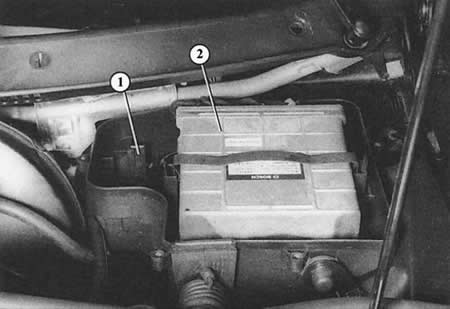


Throttle control unit


The ignition/injection system control unit (2) is located in the electronic box on the left rear of the engine compartment (in the so-called humidification tank). In the bracket (1) next to the control unit there is a place for the height sensor for the turbo engine.
The ignition/injection system control unit (2) is located in the electronic box on the left rear of…


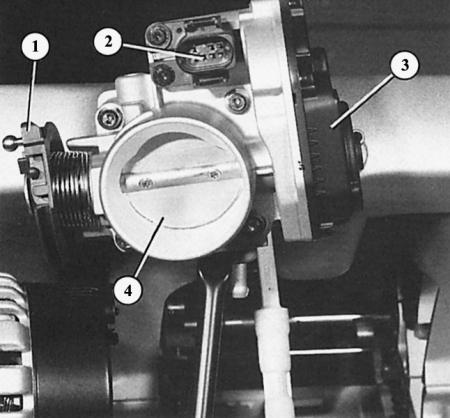
Throttle control unit in a turbo engine with a working volume of 1.8 l: 1 - throttle lever; 2 – connection unit for the power supply of the control unit (3) of the throttle valve; 4 – throttle valve.
Throttle control unit in a turbo engine with a working volume of 1.8 l: 1 - throttle lever; 2 –…


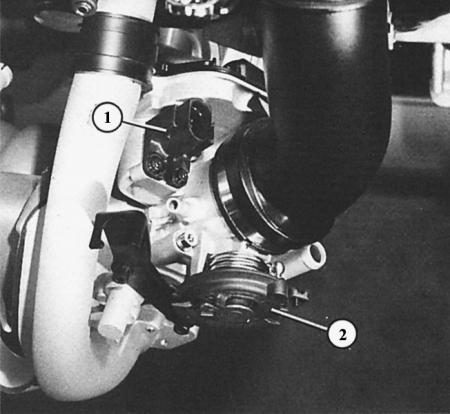
The throttle control unit in the 1.6L engine is basically identical to the 1.8L engine unit, although its mounting position is different. The numbers indicate: 1 – power supply connection unit; 2 – throttle lever.


The so-called throttle control unit combines three separate units, known from other injection systems as functional units.

Throttle valve. It is connected by a cable to the pedal in the cabin and doses the flow of fresh air into the engine. The more the gas pedal is pressed, the more the throttle valve opens; at full throttle it is completely open.

Throttle Potentiometer The throttle potentiometer determines the current throttle position in the range from idle (throttle valve closed) to full throttle (throttle valve is fully open). Based on its information, the idle speed stabilization valve, also integrated into the throttle valve pipe, is activated, the traction is cut off or the mixture is enriched at full load.

Idle speed stabilization valve. It lets in a metered additional amount of air into the intake ducts behind the throttle valve during the engine warm-up stage, when the servo control is fully turned, when the air conditioning system is running or the automatic transmission stage is set. The increased air flow in the direction of the intake manifold is detected by the fresh air flow meter and, as a result, causes an increased fuel supply. This reduces the increased friction in a cold engine or under increased engine load due to the servo pump, air conditioning compressor or automatic transmission, which take power from the engine.

Pressure regulator
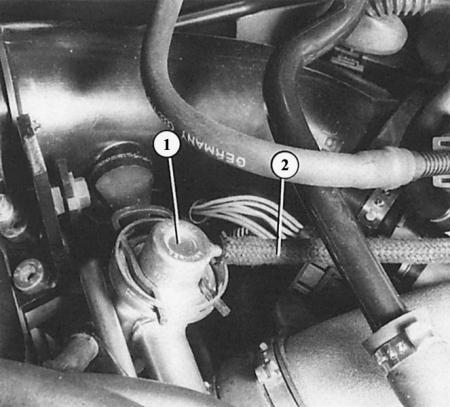


Pressure regulator


The fuel pressure regulator (1) is connected to the throttle valve pipe via a vacuum hose (2). It regulates the pressure in the system by increasing or decreasing the fuel recirculation.


It is located in the fuel distributor and regulates its pressure on the injectors. To do this, it is given information about the level of low pressure in the intake manifold. At idle, with the throttle valve closed and very low pressure, it maintains a lower pressure. As the pressure drops under increased engine load, the pressure regulator increases the fuel pressure. The fuel pump creates a much higher operating pressure, but the return of gasoline to the fuel tank is increased or decreased accordingly by means of the pressure regulator.

Injection valves
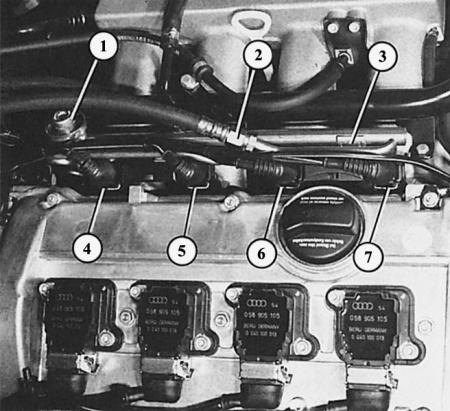


Injection valves


The injection valves (4–7) are located in the direction of travel on the left side of the cylinder head in the intake manifold. The following numbers indicate: 1 – fuel pressure regulator; 2 – fuel supply line; 3 – fuel distribution pipe.
The injection valves (4–7) are located in the direction of travel on the left side of the cylinder…


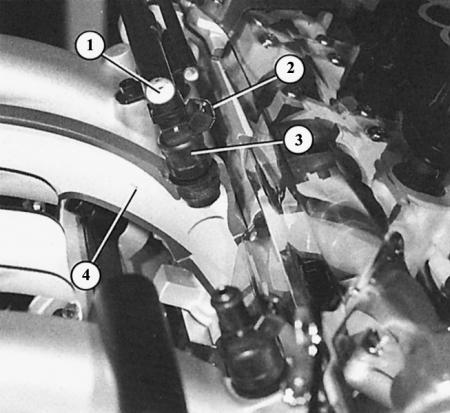
In this model, in section, it is visible that each injection valve (3) injects into the intake pipe (4). Fuel is supplied to it from the distribution pipe (1), the signals for injection go through the cable connection (2) to the control unit.


At each revolution of the crankshaft, they inject gasoline into the suction channel in front of the inlet valve of the corresponding cylinder - the duration is determined by the control unit.

Intake air temperature sensor


In the case of a 110 kW turbo engine, it is located in the air intake hose and can accurately measure the temperature of the air supplied by the turbocharger. The temperature information is sent to the control unit as a resistance value. It is used for optimal fuel dosing. A hot turbocharger, depending on the operating state, strongly heats the intake air.

Coolant temperature sensor


Coolant temperature is used to control several injection functions: enrichment of the fuel-air mixture during cold engine start, post-start enrichment (across the entire temperature range), when enriched during acceleration and when the traction is switched off. Information about the coolant temperature is also transmitted to the control unit in the form of a resistance value. It calculates the correct injection time, which in a warm engine is from 2 to 8 ms. This value can increase by almost 70% when the temperature drops to the arctic level of -25°C.

Fresh air flow meter


In the flow of the intake air there is an electrically conductive plate, which is heated electrically. Depending on the amount of intake air, its flow changes, which cools the plate more or less. The change in temperature causes a change in the electrical resistance of the conductor. This measured value is used by the control unit.


In the flow of the intake air there is an electrically conductive plate, which is heated…


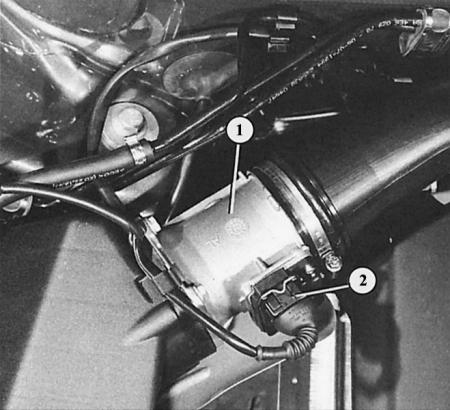
At the rear right in the engine compartment of the naturally aspirated engine with a displacement of 1.6 and 1.8 liters, there is a fresh air flow meter (1), flanged to the air filter housing. The number "2" shows the connection connector. In the turbo engine with a displacement of 1.8 liters, the fresh air flow meter is located inside the air filter housing.
The article was checked by auto expert Georgy Rodionov
This article is available at russian, bulgarian, belarusian, ukrainian, serbian, croatian, romanian, polish, slovak, hungarian

Share information:
Previous articles
Audi A4 B5: Motronic injection system
Next articles

This is how the Motronic injection system works
Motronic malfunctions and self-diagnosis
Self-help with injection
Visual inspection of the Motronic injection system


Similar articles on other Audi car models:
Electrical connection diagram of the fuel injection system… Audi 80 B3 (1986-1991, petrol)
Troubleshooting individual components of the KE-Motronic… Audi 100 C4 (1990-1994)
Fuel injection system device (petrol) Audi A3 Type 8L (1996-2003)
Fuel injection system components Audi A6 C4 (1994-1997)
General information about the ignition and fuel injection system Audi A8 D2 (1994-2002)
Injection system Audi Q5 Type 8R (2008-2017)
General information about the fuel injection system Audi A2 (1999-2005)
Link to this page in different formats


Visitor comments

No comments yet


How much will 48 + 29 =


A4(B8, 2007-2015) 
  • General information
  • Operating instructions
  • Power unit
  • Petrol engines 1.8 l
  • Petrol engines 1.8/2.0 l
  • Petrol engines 3.0 l
  • Petrol engines 3.2 l
  • Fuel system (petrol)
  • Diesel engines 2.0 l (CA*)
  • Diesel engines 2.0 l (CJCB)
  • Diesel engines 2.7/3.0 l
  • Diesel engines 3.0 l
  • Fuel system (diesel)
  • Transmission
  • Manual gearbox 0B1
  • Manual gearbox 0B2
  • Manual gearbox 0B3
  • Manual gearbox 0B4
  • Automatic transmission 0B5
  • Automatic transmission 0B6
  • Automatic transmission 0AW
  • All-wheel drive system
  • Chassis
  • Front suspension
  • Rear suspension
  • Brake system
  • Steering system
  • Body
  • Exterior
  • Interior
  • Seats
  • Doors, locks and windows
  • Security system
  • Heating and air conditioning
  • Electrical equipment
  • Audio system
  • Power devices
  • Equipment and devices
  • Lighting and lamps
  • Electrical circuits
 
A4(B7, 2004-2008) 
  • General information
  • Introduction to manual
  • Troubleshooting
  • Operating instructions
  • Maintenance
  • Power unit
  • Petrol engines 2.0 (ALT)
  • Petrol engines 2.0 (TFSI)
  • Petrol engines 1.8 (MPI)
  • Diesel engines
  • Cooling system
  • Air conditioner
  • Fuel and exhaust system
  • Ignition system
  • Starting and charging
  • Transmission
  • Clutch
  • Manual gearbox
  • Automatic gearbox
  • Drive shafts
  • Chassis
  • Brake system
  • Front suspension
  • Rear suspension
  • Steering
  • Body
  • Exterior
  • Interior
  • Electrical equipment
  • Equipment and devices
  • Lighting and signaling
  • Windscreen wipers and washers
  • Electrical diagrams
  • Electrical diagrams (since 2007)
 
A4(B6, 2000-2006) 
  • General information
  • Vehicle Description
  • User manual
  • Maintenance
  • Power unit
  • Gasoline engine
  • Diesel engine
  • Lubrication system
  • Cooling system
  • Supply system
  • Injection system
  • Exhaust system
  • Ignition and control
  • Transmission
  • Gear box
  • Clutch and drive shafts
  • Chassis
  • Brake system
  • Car suspension
  • Steering
  • Body
  • Heating and ventilation
  • Exterior (external elements)
  • Interior (internal elements)
  • Electrical equipment
  • Power devices
  • Lighting and appliances
  • Electrical circuits
 
A4(B6, 2000-2006, petrol) 
  • General information
  • Introduction to the guide
  • Car care
  • Power unit
  • Engine repair
  • Lubrication system
  • Cooling system
  • Injection and control system
  • Ignition system
  • Power and exhaust system
  • Transmission
  • Clutch and drive shafts
  • Car gearbox
  • Chassis
  • Suspension and wheels
  • Steering
  • Brake system
  • Body
  • Interior
  • Exterior
  • Electrical equipment
  • Equipment and devices
  • Lighting and signaling
  • Power devices
  • Electrical circuits
 
A4(B5, 1994-2001) 
  • General information
  • Introduction to the guide
  • Car care
  • Maintenance (gasoline)
  • Maintenance (diesel)
  • Power unit
  • Gasoline engines
  • Diesel engines
  • Engine overhaul
  • Cooling system
  • Fuel injection (gasoline)
  • Fuel system (diesel)
  • Exhaust system
  • Ignition system
  • Transmission
  • Clutch
  • Mechanical gearbox
  • Automatic gearbox
  • Drive shafts
  • Chassis
  • Brake system
  • Car suspension
  • Steering
  • Body
  • Exterior
  • Interior
  • Doors, locks and windows
  • Heating and ventilation
  • Electrical equipment
  • Power devices
  • Equipment and devices
  • Electrical circuits
 
A4(B5, 1994-2001, petrol) 
  • General information
  • Vehicle description
  • Maintenance
  • Power unit
  • Engine repair
  • Turbocharging
  • Exhaust system
  • Cooling system
  • Ignition system
  • Fuel system
  • Motronic injection system
  • MPI and MPFI injection system
  • Transmission
  • Clutch
  • Gearbox and shafts
  • Chassis
  • Steering
  • Car suspension
  • Brake system
  • Wheels and tires
  • Body
  • Heating and ventilation
  • Body parts
  • Electrical equipment
  • Fuses and relays
  • Power devices
  • Lighting and lamps
  • Tools and devices
  • Electrical circuits
 
AudiManual.ru © 2017-2026 · Mobile version · Feedback · Sitemap: EN BG BY UA RS HR RO PL SK HU · Site search · News and articles
80 B2 · 80 B3 petrol · 80 B3 · 80 B4 · 100 C3 diesel · 100 C3 petrol · 100 C3 · 100 C4 petrol · 100 C4 · A3 Type 8L · A4 B5 petrol · A4 B5 · A4 B6 petrol · A4 B6 · A4 B7 · A4 B8 · A6 C4 · A6 C5 · A6 C5 Allroad · A8 D2 · Q5 Type 8R · Q7 Typ 4L · Audi A2 ·
This site uses cookies 🍪. Click the button to accept this fact.