



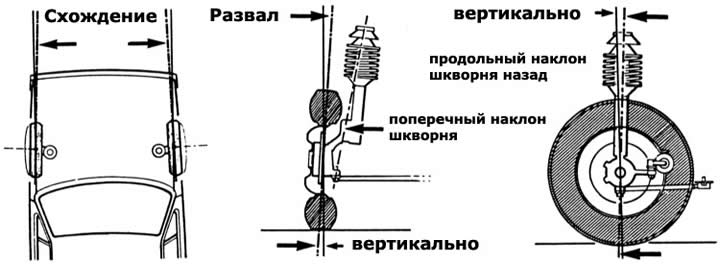
The front wheels must be positioned at a certain angle in the lateral and longitudinal directions to ensure reliable vehicle behavior. To give you some idea of what "steering geometry" means, here is an explanation of the concepts:
Track width: in the Audi A4, the front wheels are slightly more toe-in than the rear wheels when stationary. This is called "positive track width" or "toe-in". The friction between the wheel and the road pushes the left wheel to the left and the right wheel to the right. This is somewhat balanced by the front-wheel drive forces, which tend to bring the front wheels closer together. When the car turns, the toe-in of the front wheels changes to "toe-out". This is achieved by the trapezoidal arrangement of the steering rods: the inner wheel in relation to the turn turns more than the outer wheel. This is also necessary, since the inner wheels describe a smaller circle when turning than the outer ones.
Collapse: this is the name for the slight tilt of the front wheels to the outside – at the top of the Audi A4 wheel well, there is less distance between them than at the bottom near the ground. In the language of professionals, this is called "negative" camber.
Transverse slope: it has to do with camber. Lateral inclination is a slight tilt of the axle around which the wheels and suspension turn when the car is steered. Both transverse axles have a smaller distance at the top than at the bottom.
Longitudinal tilt: this refers to the inclined position of the steering axles in the longitudinal direction of the vehicle. It also helps stabilize rectilinear movement and prevents the front wheels from oscillating.