



The cooling system works on the following principle. When the engine is cold, the thermostat is closed and the water pump forces water through the internal passages, the bypass hose and the heater circuit back to the pump inlet. As the water circulates through the small circuit, the cylinders, the surface of the combustion chambers and the valve seats are cooled. When the coolant reaches a certain temperature, the thermostat begins to open. The water now passes through the upper hose to the top of the radiator. As it passes through the radiator core, it is cooled by the air passing through the radiator when the car is moving. If necessary, the fan is turned on, increasing the cooling effect.
Water returns to the water pump through the lower radiator hose and the open thermostat.
The fan is controlled by a thermal switch located at the bottom of the radiator. In addition, some 4-cylinder injection engines have another thermal switch located next to the fuel injectors in the cylinder head. The water temperature is measured by a sensor located in the cylinder head.
Note: The electric fan will start to operate when the water level in the radiator reaches (and on some models in the cylinder head) a certain temperature regardless of whether the ignition is on or not. Therefore, when working with a hot engine, be careful not to get close to the fan blades.
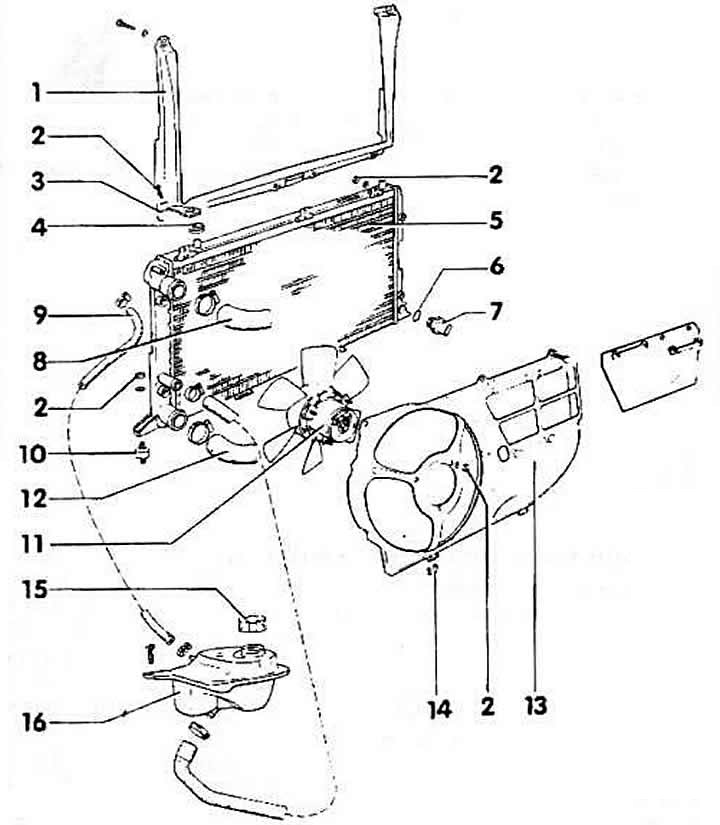
1 - air guide
2 - nut, 10 Nm
3 - holder
4 - rubber bushing
5 - radiator
6 - sealing ring
7 - thermal switch, 25 Nm
For electric fan
8 - Upper hose of the cooling system
9 - air hose
10 - rubber-metal shock absorber, 10 Nm
11 - radiator fan
12 - lower hose of the cooling system
13 - fan casing
14 - spring clamps
15 - cork
Test pressure 1.2-1.5 bar
16 - expansion tank
Note: Coolant hoses are secured either with spring tape or screw clamps. In case of repair, the tape can be replaced with clamps. Suitable pliers, such as HAZET 798-5, are required for installing the clamps.