



The starter consists of a drive housing and a pole and collector housing. The anchor and collector, as well as the brush holder, are located in the pole and collector housing. Carbon brushes are installed in the brush holder, which are wearing parts that wear out slowly but constantly. If the brushes are heavily worn, the starter stops working normally.
The front housing of the drive contains a gear drive. When voltage is supplied to the starter through the ignition switch, the gear moves along the thread to the toothed ring of the flywheel using a traction relay located on the housing of the drive. As soon as the gear reaches the stop of the threaded shaft, it engages with the flywheel. Now the transfer of torque from the starter to the engine is ensured to develop the required number of revolutions. When the engine starts, the gear receives acceleration from it, that is, for a short time it rotates faster than the engine and disengages, due to which the connection of the starter with the engine is broken.
Since a high current is required to start the combustion engine, it is necessary to ensure that the wires are connected perfectly during maintenance. Corroded contacts should be coated with a protective paste.
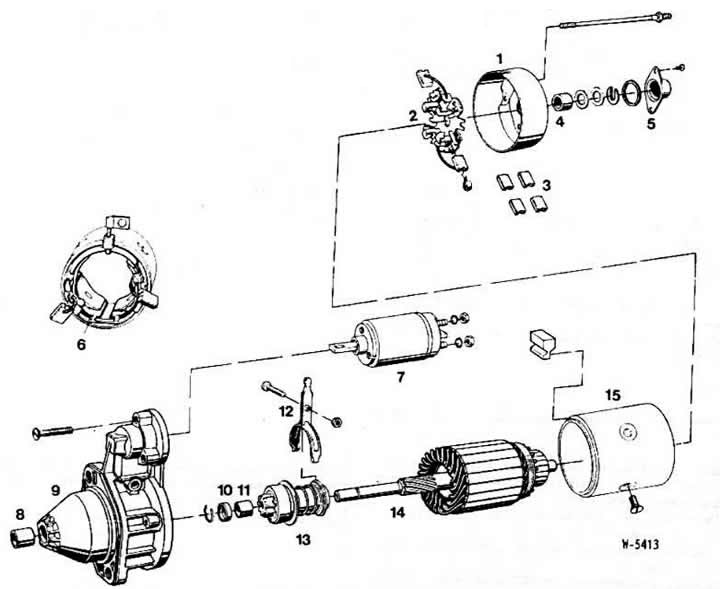
1 - collector body
2 - brush holder
3 - set of carbon brushes
4 - metal-ceramic bushing
5 - casing
6 - excitation winding
7 - magnetic starter
8 - metal-ceramic bushing
9 - drive housing
10 - thrust ring
11 - metal-ceramic bushing
12 - gear lever
13 - gear
14 - anchor
15 - pole housing