



Table of contents: Gasoline engine ↓ Additional adjustment on cars with… ↓
Gasoline engine
Note: Diesel vehicles do not have an accelerator cable. Instead, they have an accelerator pedal position sensor that controls the fuel pump.
Caution. The accelerator cable is sensitive to bending, so it must be handled with particular care during installation. A single small bend can lead to subsequent breakage during operation. Therefore, cables that have been bent can no longer be installed on vehicles.
Press the accelerator pedal all the way down and hold it in this position or have an assistant hold it.
Check that the throttle lever is against the maximum load limiter. If not, adjust the accelerator cable.
Remove the retaining clip securing the accelerator cable housing to the bracket (see fig. 4A.12).
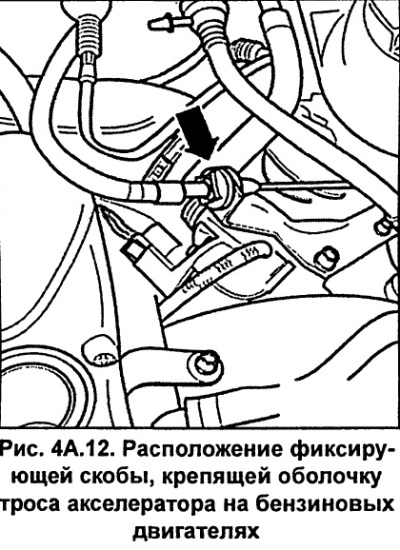
Move the accelerator cable housing on the bracket until the throttle lever touches the maximum load limiter. In this position of the accelerator cable, secure the cable housing with the locking bracket.
Release the accelerator pedal.
Additional adjustment on cars with automatic transmission
Disconnect the two-pin electrical connector from the forced downshift switch (kick-down), located at the front of the engine compartment.
Connect an ohmmeter to the contacts of the electrical connector of the kick-down switch and measure the resistance, which should be equal to infinity (see Fig. 4A.13).
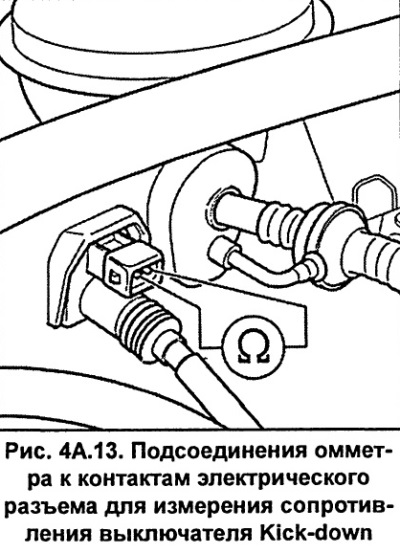
Slowly press the accelerator pedal. As the accelerator pedal approaches the stop, the resistance on the Kick-down switch contacts should suddenly decrease to 0 Ohm.
Otherwise, readjust the accelerator cable or replace the faulty forced downshift switch (kick-down).
Recheck the accelerator cable adjustment and adjust if necessary.