



Table of contents: Longlife engine oil ↓ Oil consumption ↓
The engine is lubricated with all-season oil, which does not require seasonal oil change (summer/winter). All-season oils are based on low-viscosity seasonal oil (for example, 10 W) and are stabilized in a hot state by means of a "viscosity stabilizer". This ensures the possibility of lubricating both cold and hot engines.
The SAE designation characterizes the viscosity of the engine oil.
Example: SAE 10 W 40:
- 10 — Viscosity of the oil when cold. The lower the number, the lower the viscosity of the oil.
- W — Oil is suitable for winter use.
- 40 — Viscosity of oil when hot. The higher the number, the lower the viscosity of the hot oil.
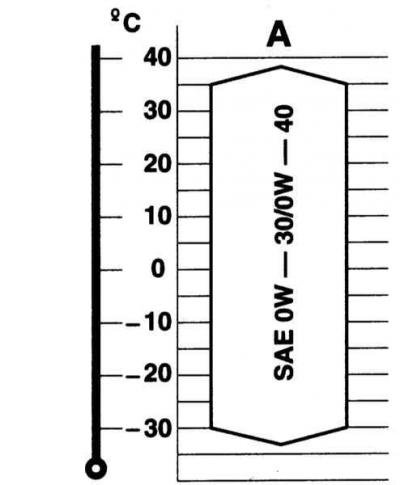
Viscosity of oils used for a "flexible" maintenance schedule
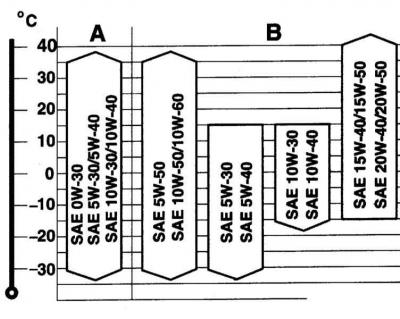
Viscosity of all-season oils used for a "strict" maintenance schedule
Petrol engines
- A - VW 500 00 with a date not later than 10.97 and VW 502 00 (turbocharged models)
- B - VW 501 00 with a date no later than 10.97
Diesel engines
- A - VW 500 00 together with VW 505 00 with a date not later than 10.97
- B — VW 505 00, VW 505 01 with a date not later than 10.97
Longlife engine oil
AUDI A4 engines are filled with special Longlife oil at the factory. When using Longlife oil according to VW standards, a two-year service interval is ensured.
Conventional engine oil according to VW standards can also be used. However, in this case the service interval should be reduced to 12 months/15,000 km.
Types of oils are listed in Specifications.
Warning: If there is no Longlife oil to fill the lubrication system, you can fill 0.5 l of engine oil according to VW 502 00 standard (gasoline engine) or according to standard 505 00/505 01 (diesel engine), without moving the service time indicator to the position "nicht flexibel" ("not flexible").
Oil consumption
In internal combustion engines, oil consumption is the amount of oil consumed as a result of the combustion process. Oil consumption should not be confused with oil loss due to leaks in the oil pan, cylinder head cover, etc.
Normal oil consumption occurs due to the combustion of a small amount of oil in the cylinders, due to removal with combustion products and wear products. In addition, oil is lost due to the high combustion temperatures and high pressures that occur during engine operation. Oil consumption is also affected by external operating conditions, such as driving style, as well as manufacturing tolerances of engine parts. Oil consumption should not exceed 0.8 l/1000 km.
Warning: Never fill the oil above the Max mark. If too much oil has been added, it must be removed. Otherwise, the catalytic converter may be damaged because unburned oil enters the exhaust system.
The original publication in its entirety is posted on the website AUDIMANUAL