



Table of contents: Oil viscosity ↓ All-season oils ↓ Viscosity grades and operating… ↓ Engine oil quality ↓
Petrol engines
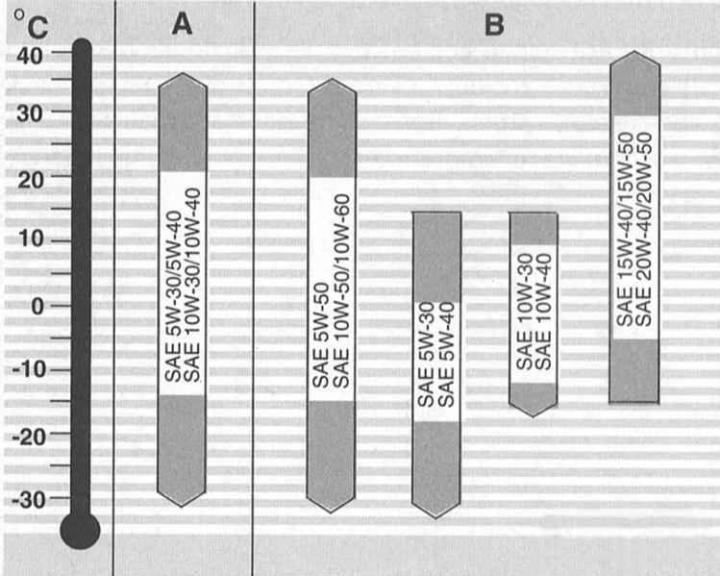
A – all-season light oils with improved antifriction properties, specification VW–500 00
B – all-season oils, specification VW–501 01, or specification API–SF or SG
Turbodiesel
B – all-season oils, specification VW–505 00
Oil viscosity
Viscosity characterizes the fluidity of the oil. Depending on the temperature, the oil tends to decrease in fluidity. As the temperature increases, the oil becomes more fluid. This worsens the adhesion of the oil and resistance to high pressure. When cooling, the oil thickens, fluidity decreases and internal friction increases. Because of this property, it is necessary to use engine oil with a viscosity that changes with temperature within the smallest possible limits.
When starting a cold engine, the oil must be sufficiently liquid to avoid overloading the engine and to allow the oil to quickly penetrate all areas where lubrication is needed after starting.
Oil fluidity is equivalent to its internal friction and is designated by SAE units (Society of Automotive Engineers), for example SAE 30, SAE 10. A high SAE value means that the oil is thick, a low value characterizes liquid oil. However, oil viscosity does not fully characterize the lubricating properties of the oil.
All-season oils
All-season oils are used in Audi A3 engines. The advantage of all-season oils is that they do not need to be selected depending on the season. They are made on the basis of liquid seasonal oil (type 10W). When heated, this oil is thickened by the so-called "viscosity stabilizer", which ensures the appropriate lubricating properties of the oil at all temperatures. When using all-season oil, modern grades with a wide temperature range of viscosity should be used, for example 10W-40, 15W-50.
10 the viscosity of the oil when cold. The lower the number, the thinner the oil when cold.
W (winter – winter) the oil is suitable for use in winter
40 viscosity of the oil when hot. The higher the number, the thicker the oil when hot.
Light oils can also be used (high power oils). They are all-season oils, in which friction coefficient reducers are introduced as additives along with others. Light oils use so-called synthetic oils as a base.
Viscosity grades and operating temperature range of oils
Since the range of use of adjacent SAE classes overlaps, short-term temperature fluctuations can be ignored. Mixing oils of different viscosity classes is allowed if oil top-up is required and the ambient temperature no longer corresponds to the viscosity class of the oil poured into the engine.
Warning: The use of SAE 5W-30 multigrade oil requires avoiding prolonged high speed and high load conditions. This restriction does not apply to multigrade light oil.
Warning: CD engine oils, which the manufacturer designates as oils for diesel engines, are not suitable for gasoline engines. There are oils that can be used in two types of engines, in which case both designations are indicated on the oil container, for example SG/CD.
Warning: Do not add additional lubricating additives of any kind to either fuel or oil.
Engine oil quality
For modern engines, only HD oils should be used. HD oils are oils with increased lubricating properties, improved by various additives. These additives provide better anti-corrosion protection, more favorable conditions against oxidation, the least tendency to form slags, the best change in viscosity, cleaning and dissolving properties. Cleaning and dissolving additives not only reduce the formation of residues in the engine, but also have the ability to dissolve these residues and all other contaminants in the engine oil and keep them in a suspended state so that when changing the oil, these contaminants are removed along with the drained oil.
The quality of HD oils is determined by the API system (American Petroleum Institut). European manufacturers also adhere to this system.
The oil grade is designated by two letters. The first letter characterizes the area of application: S – Service, intended for carburetor engines; C – Commercial, designed for diesel engines.
The second letter identifies the grade of oil in alphabetical order.
The highest grade oils according to API classification are SJ for gasoline engines and CF for diesel engines.
European manufacturers classify their oils according to the ACEA (Association des Constucteurs Europeens de l'Automobile) specification, which takes into account, first of all, European engine production technology. According to the ACEA specification, oils for gasoline engines of passenger cars have quality classes from A1–96 to A3–96, diesel engines have classes from B1–96 to B3–96, with A3 and B3 representing the highest quality class.
Since the year 2000 (MJ00), new VW/AUDI engine oil standards have been applied as part of the extended service intervals (Long Live Service) and for the 154 kW engine in AUDI S3 vehicles.
If the required oil is not available, ACEA-A2/A3 or API-SF/SG engine oil may be used temporarily on vehicles without Long-Live-Service with petrol engines. API-CD specification oil may be used in this case on turbodiesels.