



Table of contents: Removal ↓ Installation ↓
Oil pan, oil pump, oil filter
The design is the same for all 4-cylinder engines. The illustration shows a 1.8 L engine without a turbocharger. Diesel engines, unlike the illustration, have a vertical oil filter.
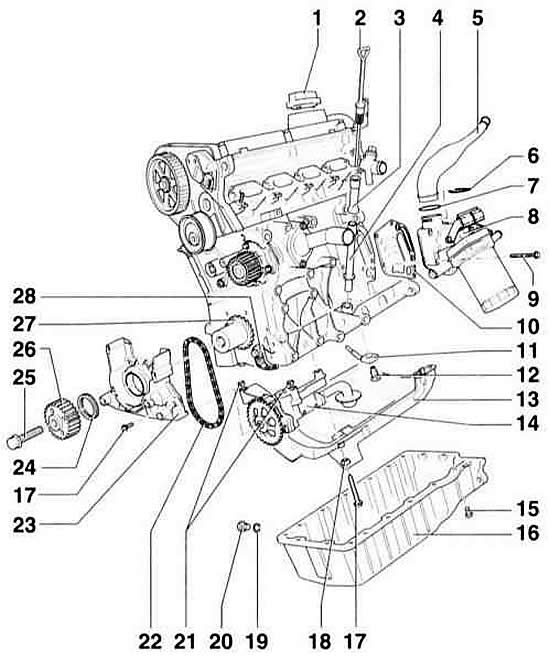
- 1 cover. Replace the seal if damaged.
- 2 oil level indicator
- 3 funnel. Remove to suck out oil.
- 4 guide pipe
- 5 Connecting pipe. For suction hose, only for 1.8L engines.
- 6 clamp
- 7 sealing ring. Replace if damaged.
- 8 Oil filter holder with oil cooler and oil filter
Please pay attention to the filter installation instructions indicated on the filter. Attach manually
- 9 bolt, 25 Nm
- 10 seal with flow sheet. Replace in accordance with the installation position.
- 11 pressure reducing valve, 27 Nm. Opening pressure: 2.5–3.2 bar.
- 12 oil nozzle. For piston cooling.
- 13 flow sheet. 14 oil pump with sprocket
- 15 bolt, 15 Nm
It is unscrewed with a crank wrench, for example, AUDI–3185 or HAZET 2528–10.
- 16 oil pan
Note: The oil pan does not have a sealing gasket. Liquid silicone sealant is applied for sealing "K 176 404 A2".
- 17 bolt, 15 Nm
- 18 spacer sleeve
- 19 sealing ring. Be sure to replace.
- 20 Oil drain plug, 30 Nm
- 21 guide bushing. For centering the oil pump/cylinder block
- 22 Oil pump drive chain. Before removing, mark the direction of rotation.
- 23 sealing flange front
- 24 sealing ring
- 25 central bolt. Be sure to replace, torque 90 Nm + 90° (1/4 turn). The service station uses a tool for holding the AUDI–3099, which is secured to the toothed belt pulley with two intermediate washers.
- 26 Crankshaft timing belt wheel. Installation is possible in only one position.
- 27 sprocket. Oil pump drive.
- 28 chain tensioner with bar, 25 Nm. If the spring breaks, replace the tensioner as a set.
Removal
Warning: Lifting and installing the vehicle on stands is dangerous! Therefore, before carrying out the operation, read the subsection Jacking up a car.
1. Raise and support the vehicle. Drain the engine oil, refer to subsection Changing engine oil and oil filter.
Warning: Do not harm the environment. Never throw away used oil or pour it out with household waste. Oil sales points accept the appropriate amount of used oil free of charge. Therefore, when buying oil, keep the receipt and the oil canister for the possibility of later handing in the used oil!
2. Replace the oil drain plug with a new sealing ring.
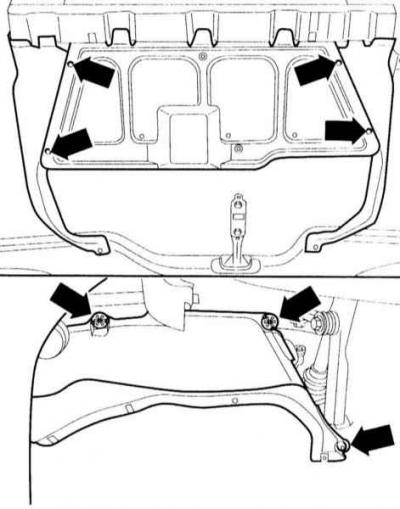
3. Loosen the mounting bolts and remove the lower and side covers on the right and left of the engine compartment (arrows). The accompanying illustration shows the version for a gasoline engine. Remove the lower cover of the engine compartment for a diesel engine.
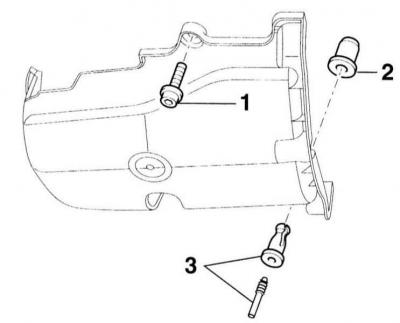
4. Diesel engine: Remove the engine oil pan noise cover. To do this, unscrew bolt –1–. Press in the rivet pin –3– with wire. Remove the rivet. Rubber bushing –2– should remain in the cylinder block.
5. Loosen the oil pan mounting bolts with a crankcase wrench, such as HAZET 2528–10, and remove. If necessary, use a rubber hammer to separate the oil pan.
Installation
6. Carefully remove any remaining sealant from the cylinder block using a scraper.
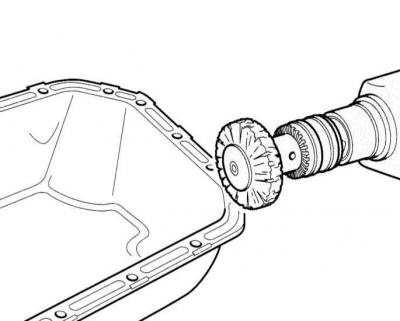
7. Remove any remaining sealant from the oil pan using a rotating brush, such as a hand-held machine.
Warning: When doing this, use safety glasses. There is a risk of injury from the remains of the sealant being removed.
8. Clean the sealing surfaces. They must be free of oil and grease.
9. The oil pan can be installed more accurately by screwing two M6 pins into the cylinder block flange for guidance.
10. When purchasing AUDI–D176404 A2 sealant, you need to check its expiration date. The tip of the tube must be cut off so that a hole with a diameter of 3 mm is formed.
Warning: The oil pan must be installed within 5 minutes after applying the silicone sealant. After installing the crankcase, the sealant must dry for at least 30 minutes. Only then can oil be poured into the crankcase.
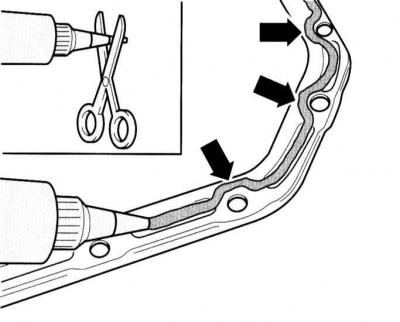
11. Apply silicone sealant to clean sealing surfaces. The bead of sealant should be 2-3 mm thick and should run along the inside in the area of the bolt holes.
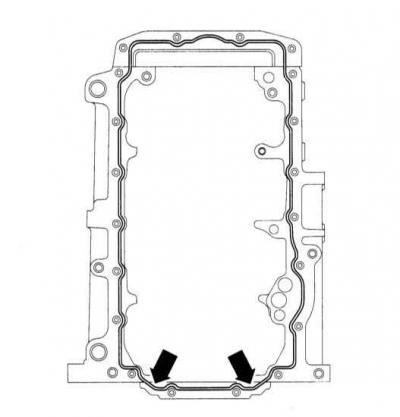
12. The illustration shows the position of the sealant bead on the cylinder block. The sealant is applied only to the sealing surface of the oil pan. The sealant should be applied especially carefully at the transition to the rear flange.
Warning: The bead of sealant must not be too thick, otherwise excess of it will enter the oil circuit and clog the screen in the suction pipe of the oil pump.
13. Immediately install and evenly press the oil pan onto the cylinder block with a torque of 5 Nm.
14. Tighten the 3 engine-gearbox connecting bolts in the oil pan area to a torque of 45 Nm.
Warning: When installing the oil pan on a removed engine, position the oil pan so that it is flush with the cylinder block on the transmission side.
15. Tighten the cylinder block mounting bolts crosswise to a torque of 10 Nm, then tighten all bolts in two stages to a torque of 15 Nm.
16. Diesel engine: Install the oil pan noise cover on the engine and secure it. To do this, remove the pin from the rivet. Insert the rivet and, pressing the pin, secure it. Screw in bolt –1– with a torque of 20 Nm.
17. Fill the system with engine oil, referring to the subsection Changing engine oil and oil filter.
18. Install and secure the lower and side left and right engine compartment covers.