



Table of contents: Gear ratios to ensure adequate… ↓ The clutch interrupts the power flow ↓ Purpose of the main gear ↓
The power transmission consists of a gearbox, clutch and final drive. To ensure that all of its components interact well with each other and transmit the engine power to the drive wheels, they are connected by means of joints, shafts and gears.
How much power the wheels actually need depends on what you want to achieve from your car while driving. The engine can only produce usable power in a certain range of revolutions. In order for the car to still have sufficient traction during acceleration and on an incline, a gearbox is needed. A gearbox, which is equipped with different gears, provides a gear ratio that suits the specific conditions.
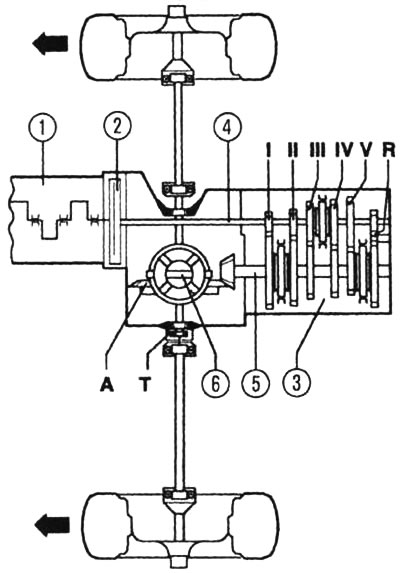
Power transmission with front-wheel drive: 1 - engine, 2 - clutch, 3 - gearbox, 4 - primary shaft, 5 - pinion (secondary shaft), 6 - differential (arrows show the direction of movement). I - 1st gear, II - 2nd gear, III - 3rd gear, IV - 4th gear, V - 5th gear, R - reverse gear, A - final drive, T - speedometer drive.
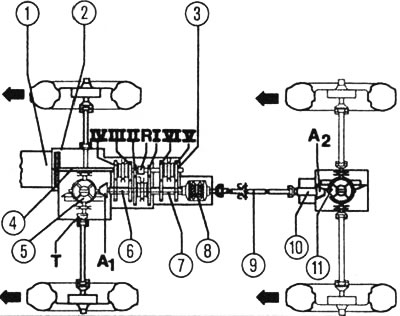
Power transmission with all-wheel drive: 1 - engine, 2 - clutch, 3 - gearbox, 4 - primary shaft, 5 - front differential, 6 - front pinion (secondary shaft), 7 - hollow shaft, 8 - differential gear, 9 - cardan shaft, 10 - rear pinion gear, 11 - rear differential (arrows show the direction of movement). I - 1st gear, II - 2nd gear, III - 3rd gear, IV - 4th gear, V - 5th gear, VI - 6th gear, R - reverse gear, A1 - front final drive, A2 - rear final drive, T - speedometer drive.
Gear ratios to ensure adequate traction
When accelerating, the drive wheels require a lot of torque, while a slow-revving engine produces little torque. When first gear is engaged, the ratio between the engine speed and the drive wheel speed increases. On the highway, when fifth gear is engaged, on the contrary, this ratio decreases. Thus, the gearbox matches the engine speed to the wheel speed.
The clutch interrupts the power flow
In addition, the direct power flow from the engine to the gearbox must be interrupted. This is necessary, for example, when you start off, stand at a traffic light with the engine running, or intend to change gear.
In cars with a step-by-step gearbox, the power flow is interrupted by a clutch. In addition, the clutch ensures acceleration without jerks, since it equalizes the different rotational speeds of the crankshaft and the primary shaft of the gearbox.
The situation is more complicated in the case of an automatic transmission, especially since Audi installs a small technical miracle in its cars - the Multitronic transmission. The electronic control unit selects the most rational gear taking into account the operating mode and the driver's intentions. Based on the speed at which the driver presses the accelerator pedal, the control unit determines the driving style: sporty or economical. The adjustment of the gear shift moment is carried out taking into account the resistance to movement (moving uphill or downhill), operation with a trailer, headwind. In the case of the Tiptronic automatic transmission, gears can also be changed manually. When the driver touches the gear selector, a signal is sent to the control unit, and the control unit immediately gives the gearbox the appropriate command.
Repair of complex automatic transmissions is only possible in specialized workshops.
Purpose of the main gear
The main gear is the last intermediate mechanism by which the torque produced by the engine is transmitted to the wheels. Its task is to reduce the number of revolutions coming from the gearbox, increase the torque and transmit it evenly to the drive wheels.