



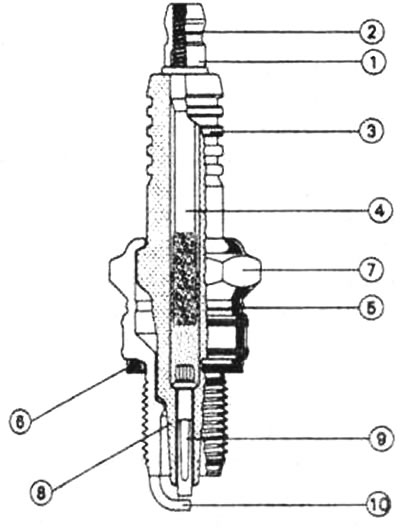
The most important parts of a spark plug: 1 and 2 - threaded contact nut, 3 - ceramic insulator with ribs to prevent leakage currents, 4 - contact rod, 5 - crimping and heat shrinkage zone, 6 - sealing ring, 7 - spark plug housing, 8 - insulator thermal cone, 9 - middle electrode, 10 - side electrode.
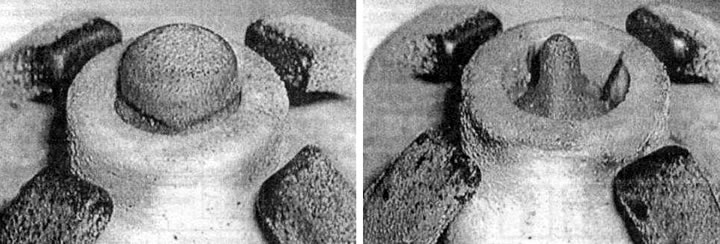
Minor wear after 90 thousand km: New nickel-yttrium alloy (top) survives significantly better than regular nickel (bottom)
Heat rating
For the spark plug to work accurately, it must heat up to the self-cleaning temperature of approximately 400 degrees immediately after starting the engine, otherwise combustion products will settle on the insulator's thermal cone. At full load, the temperature should not exceed approximately 800 degrees. Of course, the conditions in which spark plugs operate in different engines are not the same. The only way to determine whether spark plugs and a specific engine are compatible is by looking at the heat rating. For example, if you use spark plugs with a heat rating that is too high, the insulator's thermal cone may become very hot. This may lead to uncontrolled glow ignitions, which may even destroy the engine. On the contrary, if you select spark plugs with a heat rating that is too low, the spark plugs will not reach the self-cleaning temperature, and the insulator's thermal cone will become dirty. The heat rating is set by the vehicle manufacturer.