



Table of contents: Ignition control ↓ Optimal ignition timing ↓ Ignition and combustion ↓ Detonation combustion ↓
In a gasoline engine, the ignition system ignites the fuel-air mixture in the combustion chambers of the cylinders. This starts the combustion of the mixture. Ignition is produced by an electric spark, that is, a short-term arc discharge that occurs between the electrodes of the spark plugs.
The optimum effect of the fuel-air mixture is only achieved if the mixture is ignited at the right moment. Furthermore, reliable ignition under all conditions is a prerequisite for the flawless operation of the catalytic converter. If misfires occur, the catalytic converter can be damaged or even completely destroyed due to overheating during the afterburning of the unburned mixture.
The ignition process is a complex process. For example, if your A4 engine rotates at 3000 rpm, then about 50 sparks are distributed to individual cylinders with great precision per second. Not only the time, but also the energy of ignition of the combustible mixture must be appropriate: at least 0.2 mJ per ignition with a favorable ratio between air and fuel and more than 0.3 mJ in the case of a rich or lean mixture. If there is not enough energy, the combustible mixture does not ignite, and fatal misfires occur.
Ignition control
From ignition to complete combustion of the mixture takes two milliseconds. With an unchanged mixture composition, this time remains constant. For this reason, the ignition spark must occur in a timely manner so that the optimum combustion pressure is ensured in any engine operating mode.
The task of determining the exact ignition moment lies with the control unit, which also monitors the operation of the ignition system. The processor is programmed for different ignition moments for different engine operating modes. In order for the appropriate ignition moment to be selected from memory, data on the engine operating mode is sent to the control unit. The control unit evaluates the data received from individual sensors, such as data on engine temperature and speed, as well as the position of the throttle valve and camshaft.
Optimal ignition timing
The ignition timing must be selected in such a way that the following four requirements are met:
- maximum engine power,
- economical fuel consumption,
- preventing engine knocking,
- the cleanest possible exhaust gases.
For example, when pressing the accelerator pedal lightly (partial load) the mixture in the combustion chambers burns more slowly. In this case, in order to ensure that the fuel energy is used fully, the control device starts the ignition earlier. The best values are set when the fuel-air mixture ignites at the moment of greatest compression. In a four-stroke engine, this is the moment when the piston begins to move from an upward motion (compression stroke) to move down (working stroke).
Ignition and combustion
However, the ignition moment does not exactly coincide with the top dead center, since the fuel particles need three thousandths of a second to ignite. Therefore, the ignition spark begins its work already during the upward movement of the piston (early ignition). In contrast, combustion pressure is established immediately after the piston passes top dead center. Since the same amount of time is always required to ignite the fuel-air mixture, ignition occurs earlier as the engine speed increases.
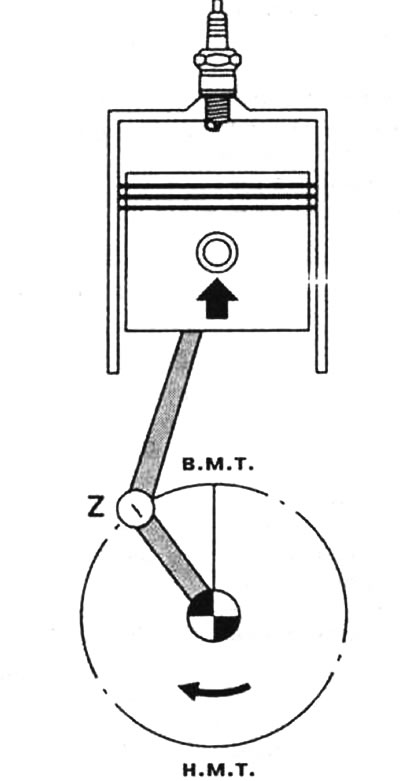
Position of the crankshaft and piston at the moment of ignition with early ignition Z
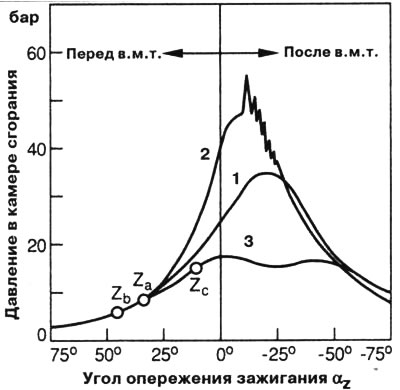
Change in combustion chamber pressure:
1. Zt: ignition at the appropriate time,
2. ZB: ignition too early (detonation combustion),
3. Zc: ignition timing too late.
Detonation combustion
In positive-ignition engines, abnormal combustion processes may occur under certain conditions. These processes limit the increase in power and efficiency. This undesirable combustion process is called detonation combustion. It occurs as an instantaneous combustion of mixture particles that have not yet been engulfed by the flame front. In this case, the ignition timing is too far in the direction of early ignition.
In this case, the flame propagation speed can reach 2000 m/sec, while during normal combustion the flame speed is only 30 m/sec. If flash combustion with too much pressure increase continues for a long time, the cylinder head gasket, pistons, bearings and spark plugs can be damaged.
Knock sensors register fluctuations in uneven combustion, and the control device shifts the ignition timing toward late ignition. Thanks to anti-knock control, an engine that was designed for "Super" class gasoline can be operated for some time with regular gasoline.
(Material republished from the website audimanual.ru)