



Table of contents: Sedan on a completely new base ↓ Safety is one of the most important… ↓ Quattro is still a respectable car ↓ Avant: beautiful station wagons ↓ "Emotional Peak" of the Series ↓ Wide range of engines: from 1.6 to… ↓ Development of the Audi A4 model ↓
The AUDI A4, which was initially mocked and called a car for respectable officials, has now become a star of the upper segment of middle-class cars. This sedan creates strong competition for the BMW 3-series, Mercedes C-class, and VW Passat.
The new AUDI A4 was presented to the general public for the first time in October 2000 in Berlin. With its cutting-edge technology and "drive architecture", the Ingolstadt manufacturer set the direction for the upper mid-size segment. Six years later, after around one million units had been produced, the completely redesigned successor to the A4 rolled off the assembly line. The cards had been reshuffled in the mid-size segment. The test of the General German Automobile Club showed that the new AUDI A4 2.0 slightly outperformed its competitors, the Ford Mondeo 2.0, the Mercedes C 200 and the VW Passat 1.8 5VTurbo. In a comparative test conducted with the BMW 318i and the VW Passat 2.0 by the German automobile magazine "Auto Motor und Sport", the new A4 with a four-cylinder engine producing 130 hp also showed its superiority.
Sedan on a completely new base
As a representative of the new generation of cars that appeared in 2000 and 2001, the Audi A4 was constructed on a new basis. While the A4 and VW Passat previously shared the same platform, the new generation A4 is now built on a completely new base. The new A4 is the quintessence of the Audi advertising slogan, which reads: "Advantage through technology". Thanks to the body, which was increased in all dimensions, a noticeable increase in free space was achieved.
For the first time in a car of this class, a continuously variable automatic transmission Multitronic was installed - a drive variant that has no analogues in the world. Audi created a transmission that is free from the shortcomings of previous transmissions of a similar design, and at the same time has all the advantages of a system that ensures an optimal gear shifting strategy. The Multitronic transmission for the first time made it possible to achieve driving comfort without losing dynamics and efficiency.
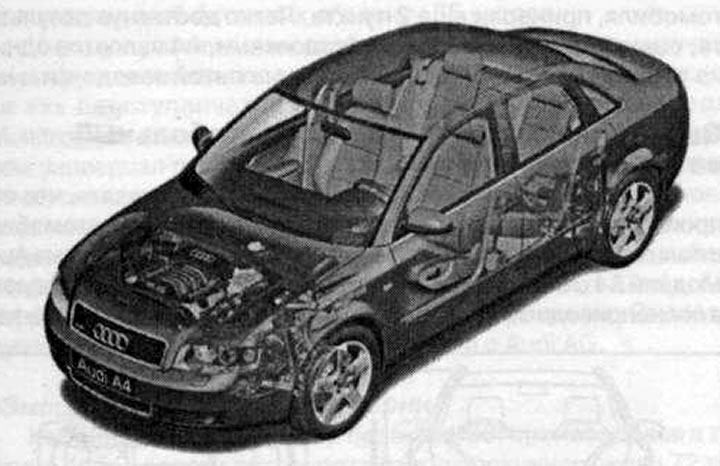
The lightweight aluminium chassis ensures exemplary driving dynamics thanks to its low unsprung masses
The aluminium chassis, which is constructed from lightweight elements, also shows new perspectives. Thanks to the low unsprung masses, it offers exemplary driving dynamics. The excellent suspension is complemented by high precision steering and handling. All production models are equipped with the electronic stability control system ESP. This means that you have an experienced and alert driver next to you, helping you with braking. The comfortable standard equipment also includes an automatic air conditioning system, which operates depending on the intensity of solar radiation.
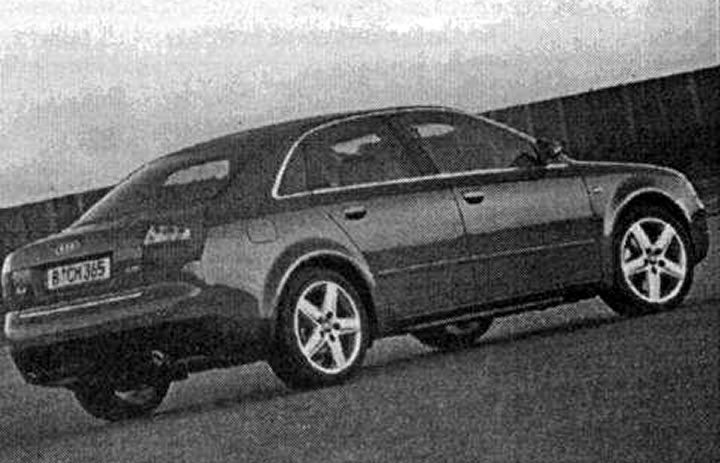
The A4 with a 3.0-liter engine has a top speed of 245 km/h, powered by a V6 engine with an aluminum cylinder block. This engine is also used in the new A6
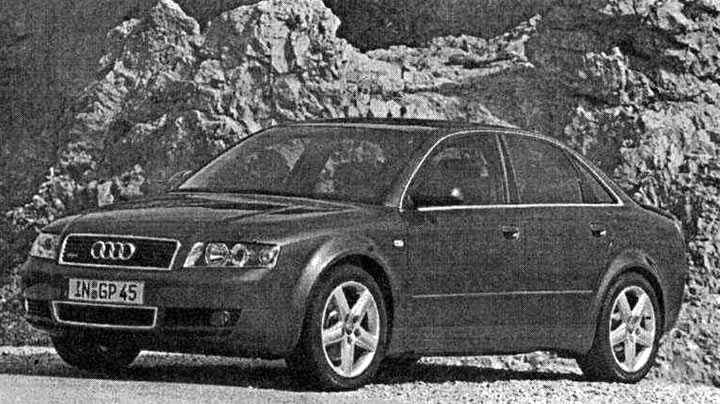
The A4 body is distinguished by a low drag coefficient (0.28) and unusual torsional rigidity for this class. The radiator grille emphasizes that this car belongs to the modern Audi design line
Safety is one of the most important goals of the new development
One of the most important goals in developing the new A4 model was safety. The basic equipment includes Sideguard, a head airbag system developed by Audi. This system covers almost the entire side surface of the windows from the A-pillar to the rear seat. In order for the control unit to be able to determine with even greater reliability the moment when the airbags should deploy, impact sensors are installed in the front of the car. Passenger safety is increased by further increasing the strength of the body in a collision with an obstacle, as well as by reducing deformation of the passenger compartment.
During the NCAP stationary obstacle collision test (an association for conducting such tests, which includes automobile manufacturers), in which a special installation of the General German Automobile Club was used, the A4 proved to be a very safe car. In a frontal collision with a deformable barrier at a speed of 64 km/h and an overlap of 40%, the A4 received 12 points out of 16, and in a side impact at a speed of 50 km/h - 16 points (maximum number). Successful results in the 29 km/h pole test, which is taken into account when assessing the safety of the car, brought in another two points. Having easily achieved a result rated at four stars, the A4 is one of the first contenders for a fifth star.
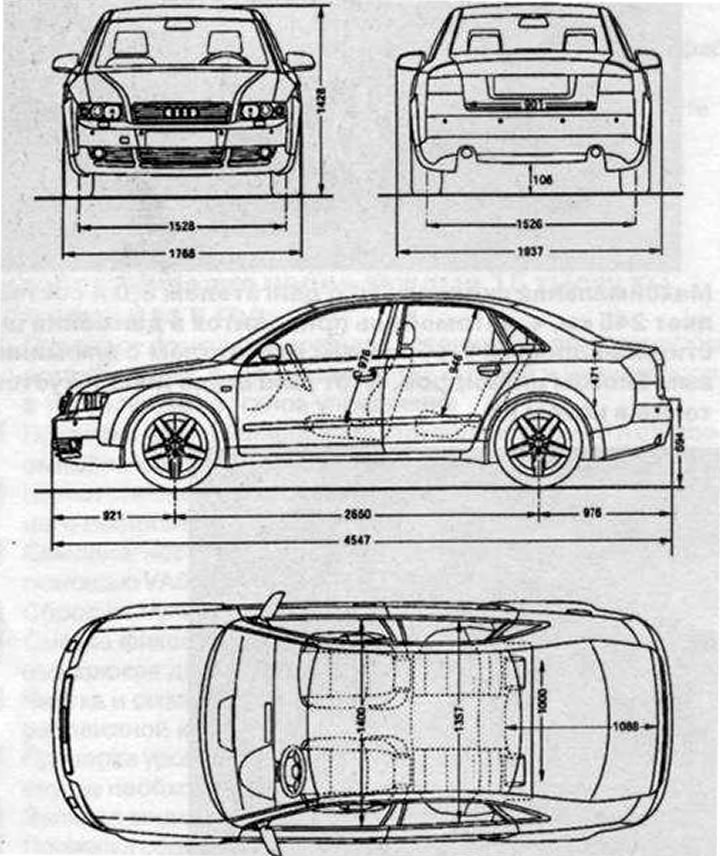
Thanks to the body, which has been increased in all dimensions, a noticeable increase in free space has been achieved compared to the previous model. Interior length of the body: plus 32 mm. Free space in front of the knees of rear passengers: plus 43 mm. Headroom of front passengers: plus 15 mm, headroom of rear passengers: plus 14 mm. Interior width of the car body at shoulder level of front passengers: plus 11 mm, at elbow level of front passengers: plus 17 mm, at elbow level of rear passengers: plus 29 mm
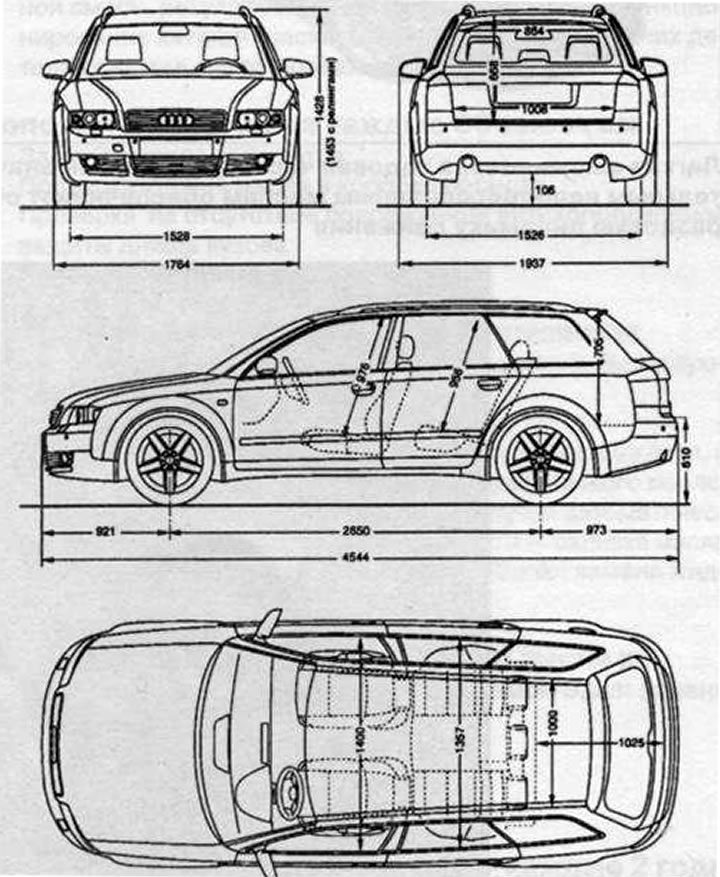
The dimensions of the new A4 Avant alone prove that it belongs to a new generation. The overall length is now 454 cm, the wheelbase has increased by 33 mm compared to the previous model
Quattro is still a respectable car
If any company can be said to produce respectable serial passenger cars with all-wheel drive, then this certainly applies to the Audi company. The A4 models with a gasoline engine (3.0 and 1, in T) there are also all-wheel drive versions. Their prototype can be considered the all-terrain vehicle "litis", which was developed by Audi for the parent company Volkswagen and supplied by order of the Bundeswehr.
During winter testing in northern Sweden, it was this car with a weak engine that outperformed much more powerful and faster front-wheel drive Audi models. This is how the idea of creating an all-wheel drive production car with a powerful engine was born. While the all-terrain vehicle was equipped with a switchable all-wheel drive, the Audi's all-wheel drive works continuously.
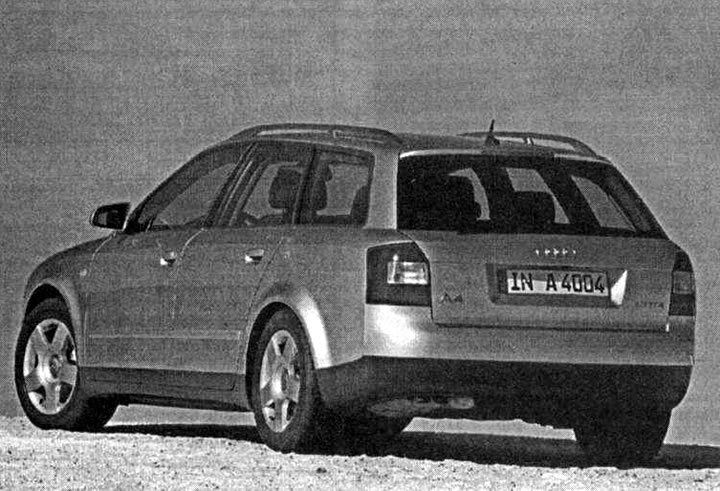
The Avant's boot capacity (442 l) is larger than that of its predecessor (390 l)
Avant: beautiful station wagons
The new A4 Avant was announced in 2001, when the model update was completed. Since 1996, its predecessor has sold 300,000 units in Western Europe alone, becoming synonymous with a compact, noble estate car. "Beautiful estate cars are called Avant" is the advertising slogan of the Ingolstadt manufacturers, who have increased the Avant's share of the total A4 production volume to 44 percent. Like the saloon, the estate car has also "grown up". Passengers feel more comfortable in it, in particular, the space in front of the knees of rear passengers has increased by 43 mm, and the interior width of the body at elbow level by 29 mm. The boot capacity has increased by 52 litres, and there is also an additional boot with a capacity of 65 litres.
In addition to the increased space and improved functionality, the technical highlights such as the continuously variable Muititronic transmission and the aluminum chassis are impressive. The station wagons are available with either front-wheel drive or permanent all-wheel drive. With the introduction of the new Avant, the RS4 variant of the predecessor model was discontinued. The RS4 sports car with a 380 hp Biturbo 6-cylinder engine was the first stand-alone model that quattro GmbH conceived and developed in cooperation with Audi AG.
"Emotional Peak" of the Series
The convertible, based on the Audi 80, was produced for over nine years, with around 72,000 units leaving the factory gates. This car has acquired the status of a classic model. At the 2001 Frankfurt International Motor Show, the first representative of the new generation of A4 convertibles was presented as the "emotional pinnacle of the A4 series". It was announced that the production version of the four-seater with an automatic soft-folding top would appear in the spring of 2002.
In terms of safety, the ToAudi Convertible, which is intended to compete with the Mercedes CLK and above all the BMW 3 Series Convertibles, has been designed to meet modern requirements. Additional safety is provided by the active rollover protection system. In the event of a rollover, two safety brackets are triggered within a few milliseconds by sensors behind the rear seats. In combination with the extremely robust windscreen frame, these brackets provide the necessary survival space for front and rear passengers in the event of a rollover.
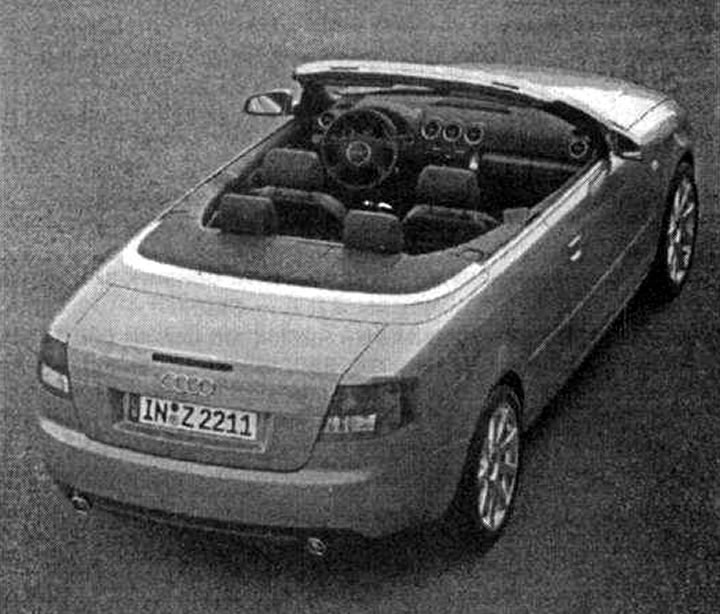
Offering passengers comfortable seats, the Audi Cabrio competes with open four-seaters
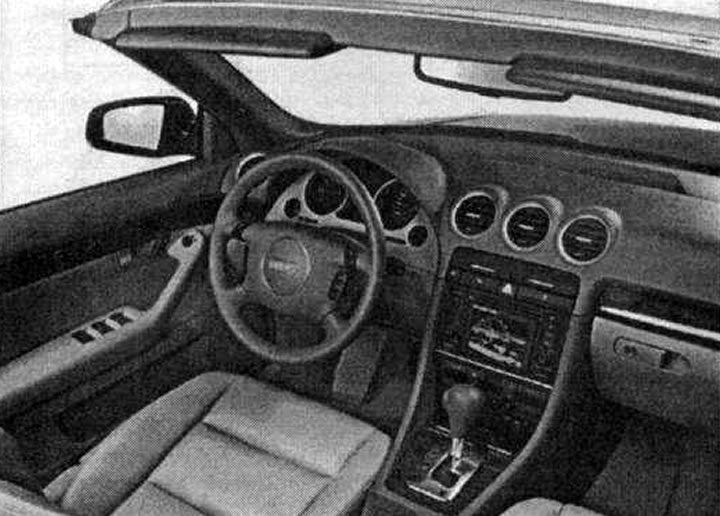
Interior of the new A4 convertible
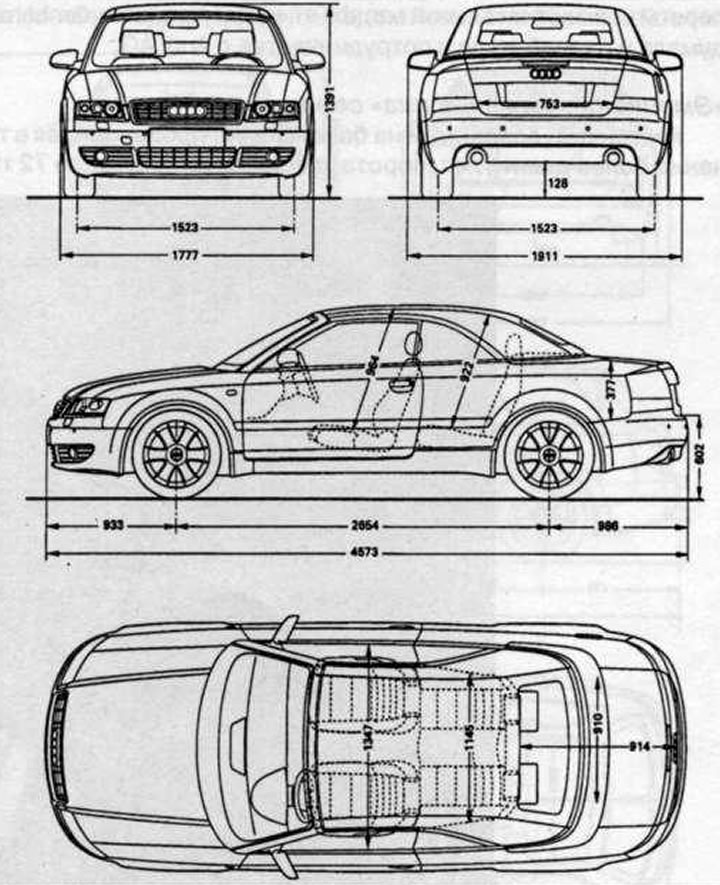
Dimensions of Audi-Cabrio
Wide range of engines: from 1.6 to 3.0 l
Right from the start, the new Audi A4 with its two completely newly designed engines in an aluminum crankcase caused a sensation. The limit values of the European exhaust emission standard EU4 were met with some reserve. With the start of series production in October 2000, the V6 engine with a displacement of 3.0 liters was presented to the general public, which became one of the best in its class. If we disregard the basic concept, i.e. the arrangement of the cylinder banks at an angle of 90° to each other and the identical bore diameter of the cylinders, it can be said that the new engine does not use many of the components that were already used in the previous 2.8 liter engine.
The second newcomer to the range of petrol engines was a 2.0-litre unit – a 4-cylinder in-line engine, which featured a number of technical innovations, in particular, continuous change of the position of the intake camshaft relative to the exhaust shaft, which ensures better filling of the engine cylinders. At the time of the release of the new A4, the 1.8-litre turbocharged engine was also considered a very successful unit, this engine provides high torque.
In the summer of 2001, the range was expanded to include a 1.6-litre saloon (102 hp). The estate version, which was still available with a 2.4 or 2.8-litre engine until the introduction of the new Avant in June 2001, now has a 2.0-litre in-line engine, a 1.8-litre engine and a 3.0-litre V6 engine.
Development of the Audi A4 model
1972.
With the Audi 80, the car company Audi introduced its first mid-size model. Lightweight construction and compact dimensions, comfort and large space provided to passengers, engines and chassis became the new standard in the market.
1994.
In November 8, the A4 was released as a successor to the Audi 80. The external dimensions did not increase.
However, clever use of space and a modest increase in track and wheelbase have resulted in noticeable improvements in interior space utilisation.
2000.
The new A4 premiered in October. Two completely new petrol engines are used as power units (2.0 and 3.0 l), as well as the proven 1.8L turbocharged engine.
The new star among mid-size cars is perceived as the quintessence of Audi's advertising slogan: "Technical advantage".
2001.
The A4 Saloon with a 1.6-litre engine fills a niche that has emerged among the various engine variants. This engine creates the prerequisites that, in combination with a body that is larger in all dimensions, allow for a significant increase in interior space.
The new A4 Avant ("Beautiful station wagons are called Avants") is also presented. This model offers more space and functionality.
(The text is based on materials from the website AudiManual)