



Table of contents: How to order spare parts correctly ↓ Branded parts or third party parts? ↓ Safety first ↓ Exchangeable parts ↓ Partial engine replacement or… ↓ Techniques for effective work ↓
The parts required for maintenance and repairs should be prepared the day before work. Make a list of the parts you will need during the work. In this case, you should think not only about the parts that are directly needed, but also about accessories such as seals, locking rings, hose clamps, various clamps, self-locking nuts. It is best to consult a specialist at the spare parts warehouse, he is familiar with these problems and will find the necessary parts.
Repairs whose scope cannot be accurately estimated in advance should be postponed until you can make an unplanned visit to an auto parts store. Remember that even repair shops do not always have all the parts on hand and they have to be ordered.
How to order spare parts correctly
During the production of a model, some parts change in almost every car. In this regard, in order to determine which part is suitable for a particular car, it is necessary, first of all, to know the year of its manufacture. You will make the work easier for yourself and the seller if you write down the information provided on the manufacturer's plate in a notebook. Important information is also contained in the plate with the characteristics of the vehicle(in terms of service maintenance). On the relevant sticker, which is located in your car, you can find the vehicle identification number, the model designation, the vehicle type, engine power, exhaust emission standard, engine and gearbox letter designation, paint coating number, interior and additional equipment letter designation, tare weight, consumption and CO₂ emissions.
Based on accurate information, an experienced seller will find a suitable part in a catalog or CD-ROM. To be on the safe side, it is best to take the removed part with you!
Branded parts or third party parts?
All the parts needed for repairs can be purchased from a dealer who sells goods under a contract with the manufacturer. However, you are not obliged to buy parts only from the dealer. Automotive accessory stores also offer a wide range, including parts from those manufacturers who are suppliers to the manufacturer of your car. If the service and delivery capabilities are the same, compare prices. Specialized magazines constantly point out that price differences of up to 50 percent are the rule, not the exception. In retail stores that are part of an association of trading enterprises not associated with certain markets, when buying the same part of the same quality (often even exactly the same detail) sometimes you can save up to 60 percent, in any case, not less than 20 percent. You should refuse to buy spare parts without a trade mark, such "savings" can cost you very dearly. Firstly, in this case you lose the opportunity to receive qualified advice if necessary, secondly, you risk losing the warranty, at least on the corresponding part, as well as on those parts that may fail as a result of its use. On the other hand, before the expiration of the warranty period, an experienced car enthusiast will always repair his car in a warranty workshop.
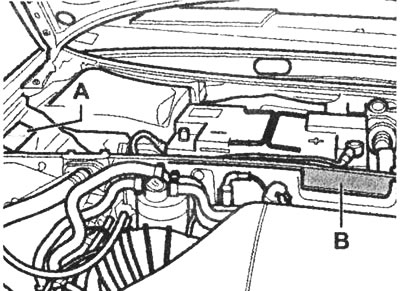
The vehicle identification number B is stamped on the rear wall of the engine compartment. The identification plate A is located under the cover on the right side of the battery compartment.
Safety first
When buying parts that are important for safety, saving is not an option. The quality of the brake discs, brake pads, wheel bearings, drive shafts and cardans you buy must match the quality of the original parts or the parts that were installed at the factory. Most cheap products do not meet the minimum requirements of the manufacturer at all. Do you need inexpensive brake discs from Eastern Europe or Asia if after installing them there will be an imbalance in the front axle that can only be fixed by paying a lot of money in a workshop?
Audi provides a special combination of brake lining material. The corresponding code is specified in the Operating Permit of the model. If the car is subject to an expert examination after a serious accident and it turns out that unauthorized linings were installed, the result of the examination may be unfavorable for you. Your own safety and the safety of other road users is worth a few extra euros.
Exchangeable parts
In many cases, it is justified to use parts that have already been used. The exchange parts offered by the manufacturer are of the same quality as new parts, they are sold with the same warranty obligations, but at a lower price. A large number of used parts in good condition are also sold in car accessory stores. The Bosch company sells refurbished units and parts through its own electrical workshops. In many cases, you can also turn to car dismantlers, especially if you want the repair to cost a small amount, and the appearance does not play a special role for you. This applies, for example, to such body parts as doors, bumpers and hood. However, the installation of used parts is justified only if they are much better than the parts that are in your car.
Sometimes you have to remove parts yourself when replacing them. Just in case, ask about the price: a used part should be at least half the price of a new part, and the price of the part that is being worn out should be no more than a quarter of the price of a new product.
Branded and third party parts:
- Starter
- Oil filter
- Generator
- Incandescent lamps
- Headlights
- V-belt
- Bumpers
- Wheel brake cylinders
- Brake hoses
- Varnish
- Engine Gaskets
- High voltage wires
- Spark plugs
- Cardan shafts
- Master brake cylinder
- Brake pipes
- Clutch
- Sheets for repair
Exchangeable parts:
- Starter
- Clutch pressure plate
- Flywheel
- Drive shafts
- Crankshaft with bearings
- Cylinder head
- Generator
- Disc brake calipers
- Clutch slave disc
- Transmission
- Cylinder block with pistons
Partial engine replacement or installation of an engine from the exchange stock?
If the crank mechanism, pistons and oil pan break, it makes sense to buy a part of the engine. This is a profitable option, since during installation the cylinder head and auxiliary units are taken from the old engine. On the contrary, a complete replacement of the engine is profitable only in the case of a not old, well-preserved car. Make the appropriate inquiries at the workshop. In addition, there are a number of companies that specialize in complete or partial overhaul of engines, these companies provide appropriate quality guarantees.
Techniques for effective work
First of all, clean up your work area. To avoid accidentally installing an unsuitable part, be sure to remove any bolts and parts that were left over from previous disassembly operations.
The removed parts are laid out in the order in which they were dismantled, this makes assembly easier.
Small parts are best placed in small boxes or cups. After dismantling, screws can be immediately screwed into the corresponding holes, this will allow you not to mix them up.
If there is a drain nearby, be sure to close it while working, otherwise small parts will definitely fall into it.
Before proceeding directly to work operations, carefully and thoroughly read the attached repair or installation documentation. During work, the documents should be kept nearby.
When doing large-scale work, you should make a sketch and write down the sequence of dismantling the parts; if you make a mistake, finding it will take much less time.
If you have to lie down under the car, for example, when working on wheel arches or bumpers, then it is recommended to use an old blanket as a bedding, which will protect you from the cold ground. On top of the blanket, put a synthetic film that is insensitive to oil and moisture.
If after work there are oil stains on the primer, then as an improvised means you can use a strong household cleaner or dishwashing detergent. In this case, it is best to use special means for removing oil stains, these means can be bought in a store of automotive accessories.