



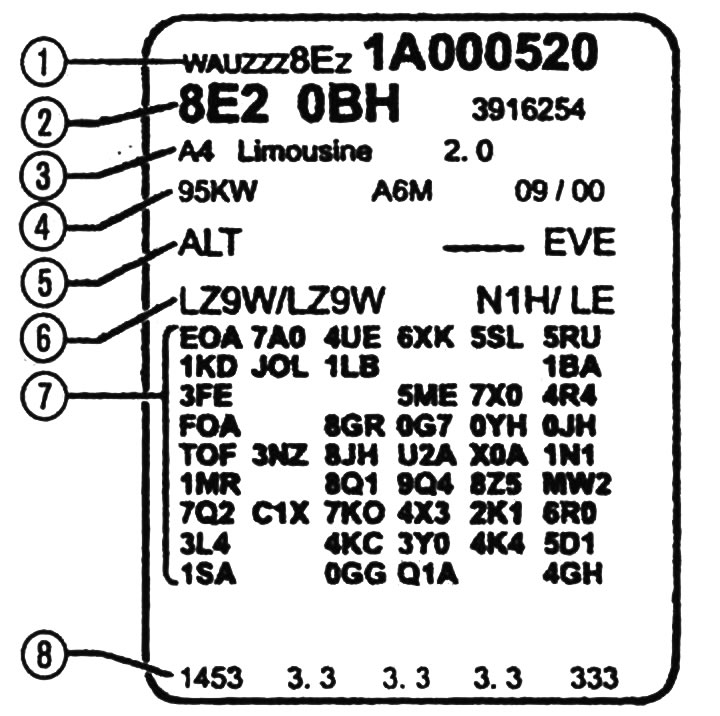
1. Vehicle Identification Number
2. Model designation / Product number
3. Decoding the vehicle type
4. Engine power / Emissions standard / Gearbox
5. Letter designation of the engine and gearbox (not used in some countries)
6. Varnish coating number / Interior equipment code
7. Additional equipment codes
8. Net weight / Fuel consumption / CO₂ emissions (not used in some countries)
The vehicle data plate contains all the information you need to purchase spare parts.
The nameplate is located under the casing on the right side of the battery compartment (cars supplied to some countries do not have a manufacturer's plate).
The vehicle identification number is stamped on the rear bulkhead in the engine compartment and is deciphered as follows:
- WAU — Manufacturer's designation
- ZZZ — Filler characters
- 8E - Short type designation
- Z — Filler character
- 1 — Year of model release (here: 2001.)
- A - Place of production
- 000 520 - Serial number, the number for each year of production starts with 000 001
The engine code is also on the vehicle data plate. The engine code and serial number are stamped into the cylinder block. The engine code, composed in the same way, is located at the junction of the engine and gearbox in the case of a 2V petrol engine, and in the case of a 5V petrol engine, (1.8L turbocharged and 2.0L) — on the left side of the cylinder block, and in the case of a V6 petrol engine — on the right inner side of the cylinder block between the cylinder head and the hydraulic pump. In addition, the engine number is indicated on a sticker located on the belt guard.
All of this information must be provided when ordering spare or exchange parts. Many parts are only suitable for certain engines, even though they may look similar to parts for other vehicles in the same series.
The original article is available on the website AudiManual.ru