



A bad tool that bends or breaks at the first rusty bolt can cause problems and ruin your enjoyment of the job.
When buying, pay attention to the quality - good tools are made from quality material and are exactly the right size.
For someone who works with bolts and nuts only occasionally, the following basic equipment is sufficient:
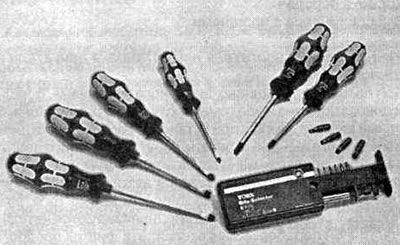
Screwdriver set with a strong, non-slip handle for screws with a regular, Phillips and Star slot.
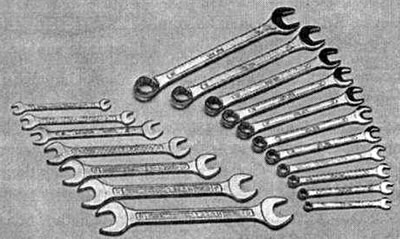
A set of fork and ring spanners. It makes sense to buy double spanners with a size from 6 to 19 mm. Buy two combination spanners of sizes 10, 13, 17 and 19 mm so that you can work with locked screw connections.
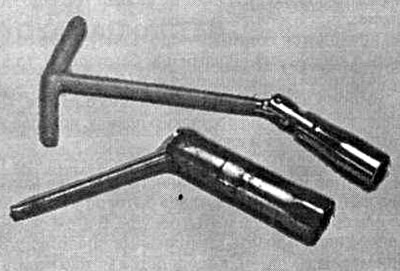
The 16mm spark plug wrench is a special socket wrench with a rubber insert.
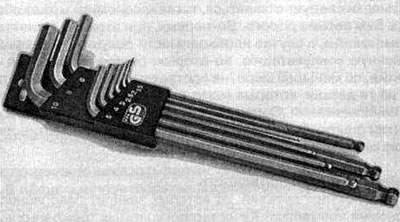
Keys for Allen screws from 2mm to 8mm
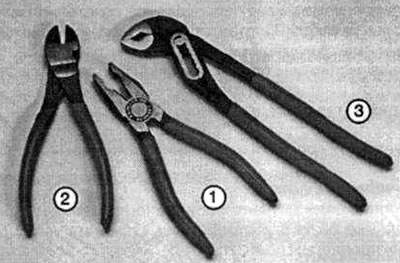
Pliers 1, pipe pliers 3 (length not less than 240 mm) and side cutters 2 will help you bend, rotate or cut almost any material that you may encounter in your car.
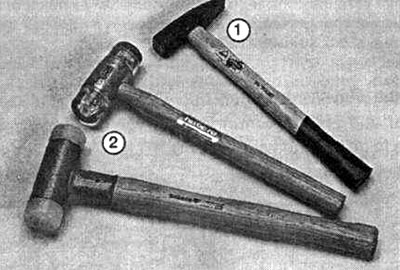
Locksmith's hammer 1 (weighing about 300 g) used as a striking tool, for example to loosen stuck bolts with a punch. Parts that are sensitive to impacts, such as bearings, cast and hardened parts, can only be processed with a plastic or rubber hammer 2. A straightening hammer will prove useful when straightening sheet material.
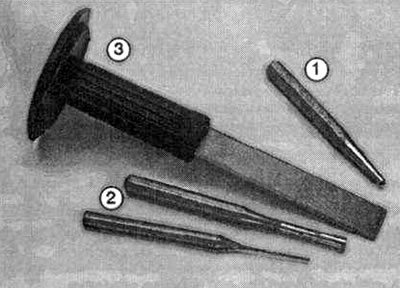
Center punch 1 is necessary when drilling metal. Punch 2 (diameter 3 and 6 mm) is a universal tool, it can be used when working with the chassis, engine and brakes. If necessary, a chisel 3 (with hardened cutting edge) will allow you to cope even with deformed or rusted bolted connections, for this you need to cut off the nut together with the bolt with a chisel.
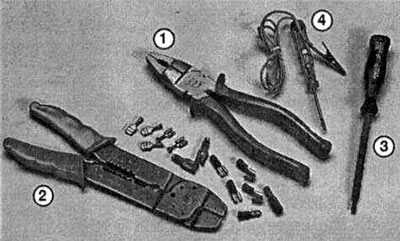
When working with electrical equipment, it is recommended to use pliers with insulated handles 1, crimping pliers 2 for plug and cable connections, a screwdriver with an insulated handle 3 and a tester for determining the presence of phase voltage with a probe and a separate wire for connection to ground 4.
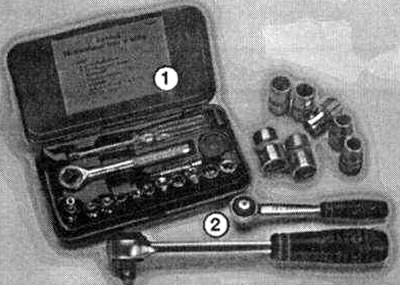
For work in the engine compartment and under the car, it is recommended to purchase a set of socket wrenches 1 with replaceable attachments from 10 to 32 mm and a ratchet 2 with a half-inch drive. It is more profitable to buy a whole set than individual attachments. A set of socket wrenches will also be useful when working in the cabin, but only with a smaller (quarter inch) drive. Here, along with screws with a regular, Phillips and star slot, as well as plastic clamps, manufacturers often use screws with a key size of 6 to 13 mm.
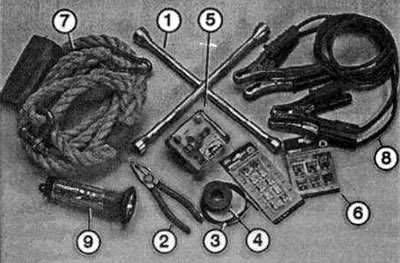
Checking the on-board instrument kit
Check the completeness of the tools you carry with you. The best garage equipment will be useless if you do not have the necessary tools at hand in the event of an accident on the road. Screwdrivers and a jack should always be in the car. In addition, the most essential tools include a Phillips key for dismantling wheels 1, pliers 2 are needed in case of poor contact or a loose cable connection. It is a good idea to have a spare cable 3 and electrical tape 4 with you. In addition, it is advisable to have a set of lamps 5 and spare fuses 6, a towing rope or rod 7, an emergency engine starter cable 8 and a flashlight 9 in the car. The manual that you keep in front of you is also better kept in the car and not on a bookshelf at home.
(The original material is located on the website: «AUDImanual»)