
Repair Chevrolet Repair Toyota Repair Honda Repair AvtoVAZ Repair Mercedes-Benz Repair BMW Repair Opel
Home  |  Contacts  |  Sitemap  |    
English Русский
Български
Беларускі
Український
Српски
Hrvatski
Română
Polski
Slovenský
Magyar
AudiManual.ru


  • AUDI 80
  • AUDI 100
  • AUDI A3
  • AUDI A4
  • AUDI A6
  • AUDI A8
  • AUDI Q
  • OTHER
  • ARTICLES
B8 (2007-2015) B7 (2004-2008) B6 (2000-2006) B6 (2000-2006, petrol) B5 (1994-2001) B5 (1994-2001, petrol)

Towing a car (Audi A4 B6)

  • Home
  • Audi A4
  • B6 (2000-2006, petrol)
  • General information
  • Introduction to the guide
  • Towing a car
            0
The basic rule of towing is as follows: both drivers must be familiar with the features of the towing process; inexperienced drivers should not participate in towing. Towing for the purpose of starting the engine should only be undertaken if it is not possible to start it from an external battery. Towing cars with an automatic transmission for this purpose is impossible for technical reasons. Due to the risk of damaging the catalytic converter, an engine with a warmed-up converter can only be started in this way if the towing distance does not exceed 50 m. Otherwise, unburned fuel may get into the converter and cause damage.

When towing vehicles with a manual transmission, the following four points must be observed:
  • Before towing, engage 2nd or 3rd gear, depress the clutch pedal and hold it in this position.
  • Turn on the ignition.
  • Once both vehicles have moved, release the clutch pedal.
  • Once the engine starts, depress the clutch pedal and shift out of gear to avoid hitting the towing vehicle.

What Else You Need to Know About Towing


For towing, use ropes made of artificial fibers or ropes made of other elastic materials, but it is better to use a towing rod. The towing rope or rod may only be attached to the shackles intended for this purpose. The towing shackles must be screwed in until they stop.

It is essential to ensure that no impermissible traction forces or jerky movements occur during towing. When towing off-road, there is a risk of overloading the fastening parts. If a towing rope is used, the driver of the towing vehicle must engage the clutch particularly gently when starting off and changing gears. The driver of the towed vehicle must ensure that the rope is kept taut at all times. In accordance with legal regulations, the hazard warning lights of both vehicles must be switched on. The ignition must also be switched on so that the steering wheel is not locked and that the direction indicators, horn and windscreen wipers function.


Since the brake booster only works when the engine is running, you have to press the brake pedal much harder if necessary. When the engine is not running, the power steering does not work, so you have to apply more force when steering.
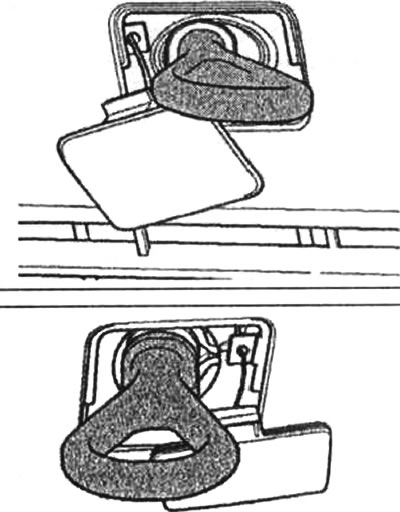
Front (top picture) and back (bottom drawing) the towing eye is located among the on-board tool.…

Front (top picture) and back (bottom drawing) the towing eye is located among the on-board tool. Remove the cover from the bumper. Then screw the towing eye until it stops and tighten it with a wrench


If there is no lubrication in a manual or automatic transmission, the vehicle can only be towed with the drive wheels raised.

When towing vehicles with front-wheel drive and automatic transmission, the following additional precautions must be observed:
  • The gear selector must be in the "W" position.
  • The speed when towing must not exceed 50 km/h.
  • The towing range must not exceed 50 km.

When towing over long distances, the front of the vehicle must be raised because the transmission oil pump does not work when the engine is not running. When towing at high speeds and over long distances, the transmission is not sufficiently lubricated. When using an emergency towing vehicle, the vehicle may only be towed with the front wheels raised. If the vehicle is raised from behind, the drive wheels rotate backwards, causing the planetary gears in the automatic transmission to rotate so fast that the transmission is severely damaged within a short time.

A link to the original source is available on the website: AudiManual.ru
The article was checked by auto expert Alexey Ivanov
This article is available at russian, bulgarian, belarusian, ukrainian, serbian, croatian, romanian, polish, slovak, hungarian

Share information:
Previous articles
Audi A4 B6: Introduction to the guide
Next articles

How to properly install a car on trestles
Safety First
Special tools for car repair
Basic tools for car repair
If the engine knocks at idle
Useful tips for repairmen
Tips for visiting the workshop


Similar articles on other Audi car models:
Towing Audi 80 B4 (1991-1996)
Lifting and towing a car Audi 100 C3 (1982-1990, petrol)
Jacking and towing Audi A3 Type 8L (1996-2003)
Removable towing hitch Audi A6 C5 (1997-2004)
Towing eyes Audi A8 D2 (1994-2002)
Removal the towing hitch Audi Q5 Type 8R (2008-2017)
Towing to start the engine Audi A2 (1999-2005)
Link to this page in different formats


Visitor comments

No comments yet


How much will 46 + 32 =


A4(B8, 2007-2015) 
  • General information
  • Operating instructions
  • Power unit
  • Petrol engines 1.8 l
  • Petrol engines 1.8/2.0 l
  • Petrol engines 3.0 l
  • Petrol engines 3.2 l
  • Fuel system (petrol)
  • Diesel engines 2.0 l (CA*)
  • Diesel engines 2.0 l (CJCB)
  • Diesel engines 2.7/3.0 l
  • Diesel engines 3.0 l
  • Fuel system (diesel)
  • Transmission
  • Manual gearbox 0B1
  • Manual gearbox 0B2
  • Manual gearbox 0B3
  • Manual gearbox 0B4
  • Automatic transmission 0B5
  • Automatic transmission 0B6
  • Automatic transmission 0AW
  • All-wheel drive system
  • Chassis
  • Front suspension
  • Rear suspension
  • Brake system
  • Steering system
  • Body
  • Exterior
  • Interior
  • Seats
  • Doors, locks and windows
  • Security system
  • Heating and air conditioning
  • Electrical equipment
  • Audio system
  • Power devices
  • Equipment and devices
  • Lighting and lamps
  • Electrical circuits
 
A4(B7, 2004-2008) 
  • General information
  • Introduction to manual
  • Troubleshooting
  • Operating instructions
  • Maintenance
  • Power unit
  • Petrol engines 2.0 (ALT)
  • Petrol engines 2.0 (TFSI)
  • Petrol engines 1.8 (MPI)
  • Diesel engines
  • Cooling system
  • Air conditioner
  • Fuel and exhaust system
  • Ignition system
  • Starting and charging
  • Transmission
  • Clutch
  • Manual gearbox
  • Automatic gearbox
  • Drive shafts
  • Chassis
  • Brake system
  • Front suspension
  • Rear suspension
  • Steering
  • Body
  • Exterior
  • Interior
  • Electrical equipment
  • Equipment and devices
  • Lighting and signaling
  • Windscreen wipers and washers
  • Electrical diagrams
  • Electrical diagrams (since 2007)
 
A4(B6, 2000-2006) 
  • General information
  • Vehicle Description
  • User manual
  • Maintenance
  • Power unit
  • Gasoline engine
  • Diesel engine
  • Lubrication system
  • Cooling system
  • Supply system
  • Injection system
  • Exhaust system
  • Ignition and control
  • Transmission
  • Gear box
  • Clutch and drive shafts
  • Chassis
  • Brake system
  • Car suspension
  • Steering
  • Body
  • Heating and ventilation
  • Exterior (external elements)
  • Interior (internal elements)
  • Electrical equipment
  • Power devices
  • Lighting and appliances
  • Electrical circuits
 
A4(B6, 2000-2006, petrol) 
  • General information
  • Introduction to the guide
  • Car care
  • Power unit
  • Engine repair
  • Lubrication system
  • Cooling system
  • Injection and control system
  • Ignition system
  • Power and exhaust system
  • Transmission
  • Clutch and drive shafts
  • Car gearbox
  • Chassis
  • Suspension and wheels
  • Steering
  • Brake system
  • Body
  • Interior
  • Exterior
  • Electrical equipment
  • Equipment and devices
  • Lighting and signaling
  • Power devices
  • Electrical circuits
 
A4(B5, 1994-2001) 
  • General information
  • Introduction to the guide
  • Car care
  • Maintenance (gasoline)
  • Maintenance (diesel)
  • Power unit
  • Gasoline engines
  • Diesel engines
  • Engine overhaul
  • Cooling system
  • Fuel injection (gasoline)
  • Fuel system (diesel)
  • Exhaust system
  • Ignition system
  • Transmission
  • Clutch
  • Mechanical gearbox
  • Automatic gearbox
  • Drive shafts
  • Chassis
  • Brake system
  • Car suspension
  • Steering
  • Body
  • Exterior
  • Interior
  • Doors, locks and windows
  • Heating and ventilation
  • Electrical equipment
  • Power devices
  • Equipment and devices
  • Electrical circuits
 
A4(B5, 1994-2001, petrol) 
  • General information
  • Vehicle description
  • Maintenance
  • Power unit
  • Engine repair
  • Turbocharging
  • Exhaust system
  • Cooling system
  • Ignition system
  • Fuel system
  • Motronic injection system
  • MPI and MPFI injection system
  • Transmission
  • Clutch
  • Gearbox and shafts
  • Chassis
  • Steering
  • Car suspension
  • Brake system
  • Wheels and tires
  • Body
  • Heating and ventilation
  • Body parts
  • Electrical equipment
  • Fuses and relays
  • Power devices
  • Lighting and lamps
  • Tools and devices
  • Electrical circuits
 
AudiManual.ru © 2017-2026 · Mobile version · Feedback · Sitemap: EN BG BY UA RS HR RO PL SK HU · Site search · News and articles
80 B2 · 80 B3 petrol · 80 B3 · 80 B4 · 100 C3 diesel · 100 C3 petrol · 100 C3 · 100 C4 petrol · 100 C4 · A3 Type 8L · A4 B5 petrol · A4 B5 · A4 B6 petrol · A4 B6 · A4 B7 · A4 B8 · A6 C4 · A6 C5 · A6 C5 Allroad · A8 D2 · Q5 Type 8R · Q7 Typ 4L · Audi A2 ·
This site uses cookies 🍪. Click the button to accept this fact.