



Table of contents: Front towing eye ↓ Rear towing eye ↓ Towing for the purpose of starting… ↓ Towing a four-wheel drive vehicle… ↓
When using a tow rope, remember the following:
Towing vehicle driver
- Start towing only when the rope is taut.
- When starting off, release the clutch pedal especially smoothly/use the accelerator pedal especially carefully in vehicles with automatic transmission.
Driver of the towed vehicle
- Turn on the ignition to prevent the steering wheel from locking while driving. You can turn on the turn signals, horn, windshield wipers and washers.
- Disengage the gear/set the automatic transmission control lever to the "NH" position.
- Remember that the brake and steering boosters only work when the engine is running. Therefore, you will have to apply significantly more force to the brake pedal and steering wheel when driving.
- Always ensure that the rope is tightly tensioned.
Tow rope or tow bar
The most reliable and safe is a towing rod. Only in the absence of a towing rod a towing rope is used.
To avoid damage to both vehicles, the towing rope must be elastic. Therefore, use ropes made of synthetic fibers or other elastic materials.
The towing rope or bar is attached only to special towing eyes.
Driving style
Towing requires certain skills - especially when using a tow rope. Both drivers must be familiar with the towing process. Towing or being towed by inexperienced drivers is not allowed.
When towing, make sure that there are no unacceptable jerks or shock loads. When towing with maneuvering off-road, there is always a risk of overloading and damage to fasteners.
If there is no lubrication in a manual or automatic transmission, the vehicle can only be towed with the drive axle raised/on a special car carrier or trailer.
- Do not twist the towing rope, as under certain conditions the front towing eye may be pulled out of your vehicle.
- Turn on the hazard warning lights on both vehicles. At the same time, observe other prescribed rules.
Front towing eye
The front towing eye is only installed when necessary.
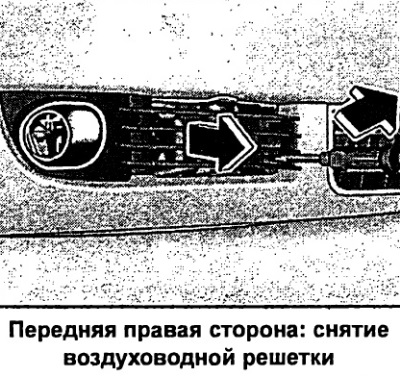
On the right side, under the front bumper, there is a thread for screwing in a towing eye. The thread is located under the air duct grille.
- Insert the screwdriver into the slot and push it towards the center of the car. At the same time, pull forward and remove the grille.
- Remove the towing eye from the trunk.
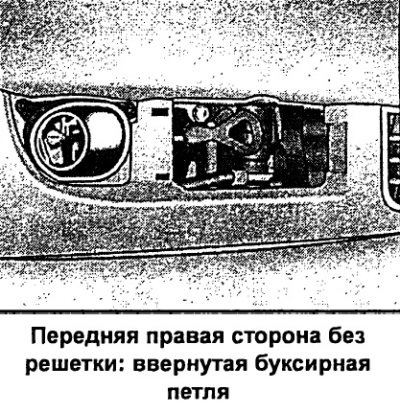
- Screw the towing eye into the threaded connection until it stops.
After use, unscrew the towing eye and store it in the tool kit. The towing eye must always be in the vehicle.
When installing the air duct grille, make sure that the grille's projections first fit into the specially provided grooves on the vehicle. Finally, press the grille firmly.
Rear towing eye
The towing eye is welded to the body.
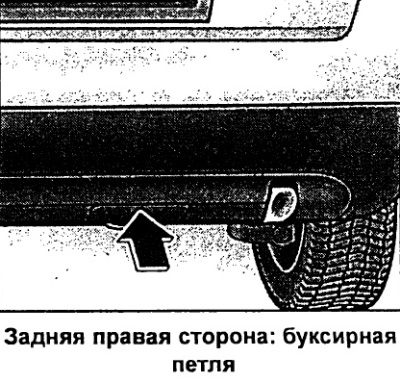
The rear towing eye is located on the right side under the rear bumper.
- To access the towing eye, press the cover up.
Towing for the purpose of starting the engine
Towing for the purpose of starting the engine is generally not recommended.
- Before starting to tow, engage 2nd or 3rd gear.
- Press and hold the clutch pedal.
- Turn on the ignition.
- Release the clutch pedal when both vehicles start moving.
- Once the engine starts, press the clutch pedal and disengage the gear.
If the engine does not start, first of all use the possibility of starting the engine from the battery of another car. And only if the engine fails to start, try towing. In this case, the engine is started by turning the wheels.
A vehicle with a gasoline engine may only be towed for short distances to start the engine, otherwise unburned fuel may enter the catalytic converter.
For technical reasons, it is not possible to tow a vehicle with an automatic transmission.
The maximum towing distance for starting the engine is 50 m - risk of damage to the catalytic converter.
Towing a front-wheel drive vehicle with a manual transmission
The vehicle can be towed in the usual way on a flexible or rigid hitch, as well as with the front or rear axle raised. The maximum speed is 50 km/h.
Towing a front-wheel drive vehicle with an automatic transmission
The vehicle can be towed in the usual way using a flexible or rigid hitch. Remember the following:
- Move the control lever to position "N".
- The maximum speed is 50 km/h.
- The maximum towing range is 50 km. This is because when the engine is not running, the gearbox oil pump does not operate and therefore at high speeds and over long distances, sufficient lubrication of the gearbox is not ensured.
A vehicle can only be towed with a tractor with the front axle raised. This is because the front wheels are on the drive shafts. When towing a vehicle with the rear axle raised, i.e. when towing a vehicle with the rear bumper, the drive shafts rotate backwards. As a result, the planetary gears of the automatic transmission reach such high speeds that it can be quickly and seriously damaged.
If normal towing is not possible or if it is necessary to deliver a faulty vehicle over a distance of more than 50 km, it will have to be transported on a special trailer.
Towing a four-wheel drive vehicle with a manual transmission
The vehicle can be towed in the usual way on a flexible or rigid hitch. The vehicle can also be towed by a tractor, with the front or rear axle raised. When towing in this way, remember the following:
- The maximum speed is 50 km/h.
- The maximum towing range is 50 km.
If normal towing is not possible or if it is necessary to deliver a faulty vehicle over a distance of more than 50 km, it will have to be transported on a special trailer.
Towing a four-wheel drive vehicle with an automatic transmission
The vehicle can be towed in the usual way using a flexible or rigid hitch. Remember the following:
- Move the control lever to position "N".
- The maximum speed is 50 km/h.
- The maximum towing range is 50 km. This is because when the engine is not running, the gearbox oil pump does not operate and therefore at high speeds and over long distances, sufficient lubrication of the gearbox is not ensured.
The vehicle must not be towed with the front or rear axle raised.
If normal towing is not possible or if it is necessary to deliver a faulty vehicle over a distance of more than 50 km, it will have to be transported on a special trailer.
[The original text of the material can be found on the website: AUDImanual]