



Table of contents: On-board electrical network in… ↓ Telematics opens up new possibilities ↓ Don't be afraid of electronics! ↓
A car needs electricity even when it is parked, let alone when it is moving. Energy is needed to control the engine and inject gasoline. Without electricity, all other, of course, necessary systems cannot operate, including automatic systems that ensure your safety and comfort, as well as the lighting system. Thus, the electrical equipment of the car is a matter of primary importance.
Audi experts assume that in the future, about 90 percent of innovations concerning the car will be implemented on the basis of the key technology – electronics. In the car of the future, intelligent systems will exchange information in real time. The car will be connected to the whole world via the Internet, it will receive data about its surroundings via numerous sensors, and at the same time, the car will remain easy to operate.
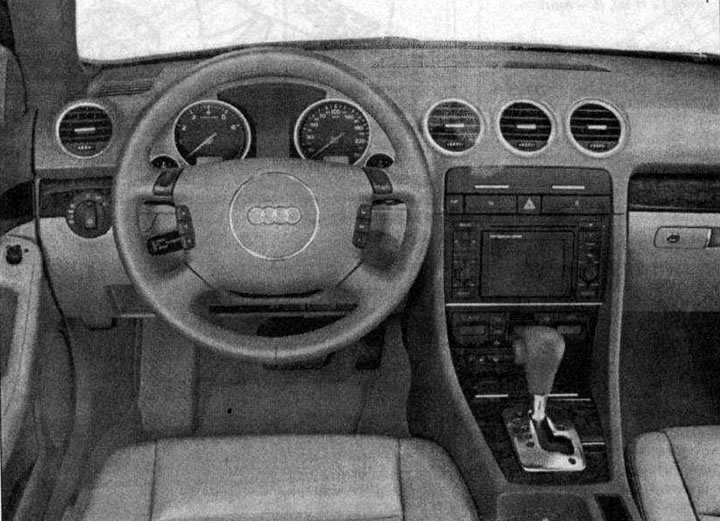
Electrical and electronic controls in the driver's workplace A4
On-board electrical network in development
The introduction of innovative ideas is gradual, many of them have already been implemented, others are being introduced with an interval of several months. For example, in the collection of basic electrical circuits of Audi already in mid-2001 some circuits were included, which will be valid only from 2002.
New principles of power supply are being intensively developed. In the 12-volt network of today's production cars, the battery is the result of a compromise. The battery is designed both to start the engine and to supply consumers. However, the requirements that must be met in this case are partially contradictory. During engine starting, the battery must deliver a current of 300 to 500 amperes, i.e. provide greater power, while various devices that include microprocessors may suffer from a decrease in voltage.
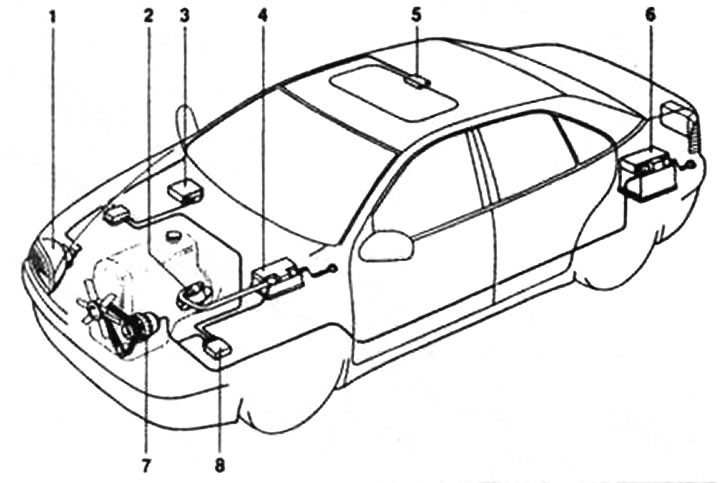
On-board network of the future: Separate batteries provide reliable stable starting and uninterruptible power supply. The charging and isolating module prevents voltage drop when starting the engine and battery discharge due to consumers. 1 - lighting installation (on-board network), 2 - starter, 3 - engine control unit (on-board network), 4 - starting battery, 5 - other consumers (for example, control of a retractable roof), 6 - power battery, 7 - generator, 8 - charging and interrupting module.
It is difficult to create a battery that meets these two requirements. In the future on-board network, these functions will be divided between the starting and supply batteries. Thanks to this, reliable cold starting will be ensured even with a charge level of the supply battery of only 30%.
However, the future on-board networks of Audi vehicles will be distinguished above all by the presence of the MMI multimedia interface. This interface ensures convenient operation, in which various controls of individual systems are combined with one logic. All this creates the prerequisites for the operation of future complex systems without lengthy preliminary driver training.
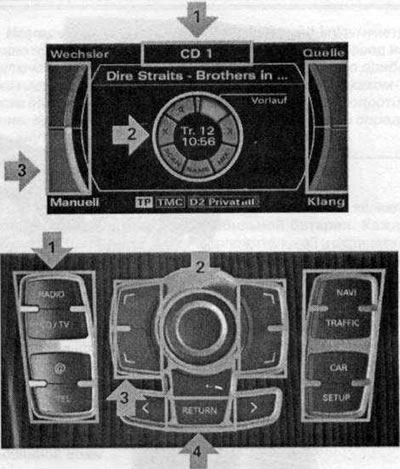
control unit with multimedia interface on the center console: The key 1 is used to directly select the main functions, the selection is made using the rotary push-button controller 2. The four corners of the display correspond to the four keys 3, which are located around the controller. Reset is performed using key 4.
The advances that have been made in networking, as well as a powerful processor for menu-driven control, make it possible to combine the interfaces of all components in one place.
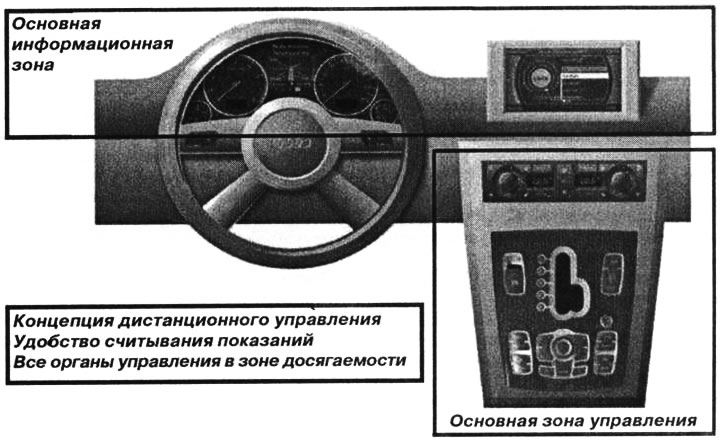
This remote control concept will work on the principle of spatially separated arrangement of indicator elements and controls. For the most important menus there are four pairs of specially assigned (physical) keys, four programmable keys allow access to individual sub-functions depending on the context. The key element for all functions is the main rotary-push control. The control panel between the gearshift lever and the armrest in the middle of the seat provides the driver with convenient (blind) control.
The indicator elements are two high-resolution color displays. One is located in the middle of the combined instrument panel, and the other (larger size) - at the top of the center console. Both displays are in the driver's primary field of vision.
Due to the great importance of temperature regulation, a separate control element was deliberately chosen to control the air conditioner, but this element was also created based on the same simple and understandable logic.
Telematics opens up new possibilities
The navigation system is being adapted more and more flexibly to the driver's needs. In addition to current services such as automatic emergency call in the event of an airbag deployment and dynamic route guidance via the navigation system, the next step in the development of telematics is the introduction of an information service. This service will enable the driver to contact the Audi service centre at the push of a button.
When planning a route, data on several (up to five) information points can be stored in the memory of a special device. With the introduction of a new generation of devices using telematics achievements, Internet technologies and the corresponding standards are beginning to be used in cars. New services based on the use of Internet technologies are being created on the basis of the services known today. Far-reaching integration of telematics and automotive electronics promises to bring great returns.
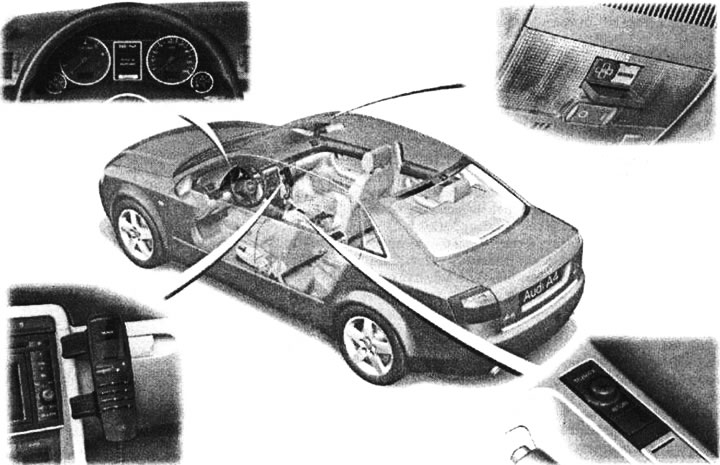
Using telematics in Audi vehicles: With the introduction of a new generation of devices using telematics achievements, Internet technologies and the corresponding standards are beginning to be used in the car. The far-reaching integration of telematics and car electronics promises to bring great returns.
Don't be afraid of electronics!
True, for now you have to deal with parts that have been installed in the car throughout its history: the battery, the starter, and the generator. Together, they are responsible for starting the engine. These parts depend on each other to perform their joint task. Without the battery, the starter does not turn, without the starter, the engine and generator do not work, without the generator, the battery does not recharge.
The current is produced in the engine room, and the working conditions are not ideal. Sometimes the engine room is cold, sometimes it is hot, and often it is not only humid, but also really damp. Therefore, the current sources (battery and generator) sometimes become a source of irritation. Since many consumers of electricity are located in unprotected places, their malfunctions inevitably occur. In view of the above, it is not so rare to have to work with electrical equipment. Despite the complexity of this equipment, you should not lose heart if nothing happens when you press a switch. Often the cause of the defect is a poorly secured wire or a corroded contact. Many malfunctions can be eliminated with simple means even if you are not a professional electrician. Naturally, you need to know some electrical engineering, so we will explain some concepts to you and give you the appropriate recommendations.