
Repair Chevrolet Repair Toyota Repair Honda Repair AvtoVAZ Repair Mercedes-Benz Repair BMW Repair Opel
Home  |  Contacts  |  Sitemap  |    
English Русский
Български
Беларускі
Український
Српски
Hrvatski
Română
Polski
Slovenský
Magyar
AudiManual.ru


  • AUDI 80
  • AUDI 100
  • AUDI A3
  • AUDI A4
  • AUDI A6
  • AUDI A8
  • AUDI Q
  • OTHER
  • ARTICLES
B4 (1991-1996) B3 (1986-1991) B3 (1986-1991, petrol) B2 (1979-1986)

Reducing the content of harmful substances in exhaust gases (Audi 80 B4)

  • Home
  • Audi 80
  • B4 (1991-1996)
  • Power unit
  • Exhaust systems
  • Reducing the content of harmful substances in exhaust gases
            0
AUDI vehicles meet the most stringent environmental requirements. Vehicles with petrol engines are equipped with adjustable catalytic converters, which reduce the level of harmful substances in the exhaust gases. As for vehicles with diesel engines, the latter, due to their specificity, have a more extensive system for combating harmful emissions. This includes an oxidation catalyst, a turbocharger and an exhaust gas recirculation system.

The unregulated catalytic converter converts carbon monoxide and hydrocarbon compounds contained in the exhaust gas into carbon dioxide (CO₂) and water (H₂ O). The air required by the catalytic converter to burn (oxidize) the carbon monoxide and hydrocarbons comes from the turbocharger. The catalytic converter itself consists of a honeycomb ceramic monolith coated with a thin layer of precious metals (see illustration 3.0).
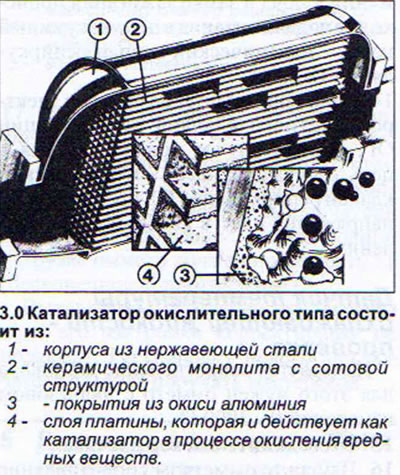
The unregulated catalytic converter converts carbon monoxide and hydrocarbon compounds contained in…


The high content of nitrogen oxides (NOx) in the exhaust gases is reduced by the exhaust gas recirculation system. The system is based on valves through which part of the exhaust gases is diverted back into the intake manifold and from there into the combustion chambers. The volume of these gases is regulated and depends on the operating load on the engine. Since these gases contain almost nothing that could burn, they do not burn. However, this reduces the volume of fresh air supplied and at the same time reduces the temperature in the combustion chambers, thereby reducing the level of nitrogen oxides.


Since the supply of exhaust gases back to the intake manifold is only necessary from the moment the engine starts to operate under load, the recirculation process is regulated by a whole link of control elements. The main one is the electromagnetic two-way exhaust gas recirculation valve, which operates from reduced pressure and is controlled by the electronic unit of the exhaust gas recirculation system. The reduced pressure for the mechanical recirculation valve is generated by a vacuum pump.

The partial load switch, located on the high-pressure fuel pump, ensures that part of the exhaust gases are returned to the intake manifold only when the accelerator pedal is pressed.

The coolant temperature sensor sends a corresponding signal about the current coolant temperature. When the engine is cold, when the coolant temperature does not exceed 50°C, the exhaust gas outlet is not required.

The generator terminal "W" receives a speed signal. At engine speeds above 1200 rpm, EGR is interrupted for two seconds. If the engine speed reaches 3200 rpm, EGR is switched off (see illustration 3.0a).
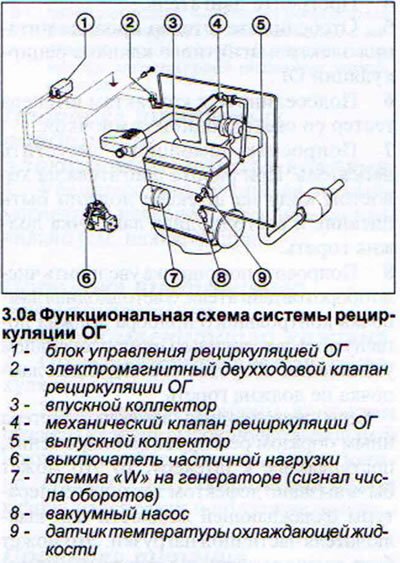
The generator terminal «W» receives a speed signal. At engine speeds above 1200 rpm, EGR is…


The altitude corrector of the electronic control unit of the recirculation system switches off the recirculation system when driving at an altitude of approximately 1000 m above sea level.


The electronic control unit of the recirculation system, depending on the received information, sends a corresponding command to the electromagnetic valve of the exhaust gas recirculation. The control unit is located under No.14 on the block of additional relays under the instrument panel on the left side. Recently, the functional "responsibilities" of the control unit have been expanded by installing an idle speed increase sensor (for cars with air conditioning). The block and the specified sensor are combined in one housing and are located under numbers 13 and 14 on the block of additional relays (see arrow in illustration 3.0b).
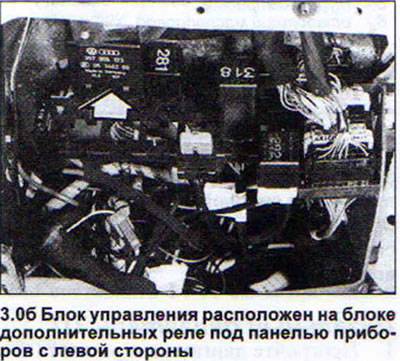
The electronic control unit of the recirculation system, depending on the received information,…
The article was checked by auto expert Timur Bazhenov
This article is available at russian, bulgarian, belarusian, ukrainian, serbian, croatian, romanian, polish, slovak, hungarian

Share information:
Previous articles
Audi 80 B4: Exhaust systems
Next articles

Exhaust system — removal and installation
General description
Exhaust Gas Recirculation System — Checking the Status
TDI diesel engines — EGR system


Similar articles on other Audi car models:
Adjustment of carbon monoxide (CO) content in exhaust gases… Audi 100 C3 (1982-1990, petrol)
Checking the condition of the exhaust system Audi A3 Type 8L (1996-2003)
Checking the composition of exhaust gases (once every 2 years) Audi A4 B5 (1994-2001)
Checking the exhaust system Audi A6 C5 (1997-2004)
Checking the exhaust system Audi A8 D2 (1994-2002)
Exhaust system Audi Q5 Type 8R (2008-2017)
Pressure reducing valve of the engine crankcase ventilation… Audi A2 (1999-2005)
Link to this page in different formats


Visitor comments

No comments yet


How much will 35 + 41 =


80(B4, 1991-1996) 
  • General information
  • User manual
  • Maintenance
  • Troubleshooting
  • Power unit
  • Engine
  • Cooling system
  • Heating and ventilation
  • Petrol injection
  • Diesel fuel system
  • Fuel system
  • Exhaust systems
  • Ignition system
  • Transmission
  • Clutch
  • Car gearbox
  • Chassis
  • Brake system
  • Suspension and steering wheel
  • Body
  • Body and trim
  • Electrical equipment
  • Electrical system
  • Electrical circuits
 
80(B3, 1986-1991) 
  • General information
  • Repair characteristics
  • Maintenance
  • Power unit
  • Gasoline engine
  • Diesel engine
  • Engine lubrication system
  • Fuel system (gasoline)
  • Injection system (gasoline)
  • Fuel system (diesel)
  • Ignition system
  • Cooling system
  • Heater
  • Exhaust system
  • Transmission
  • Clutch and gearbox
  • Chassis
  • Steering
  • Brake system
  • Car suspension
  • Body
  • Body elements
  • Electrical equipment
  • Power devices
  • Lighting and appliances
  • Electrical circuits
 
80(B3, 1986-1991, petrol) 
  • General information
  • User manual
  • Maintenance
  • Power unit
  • Engine 4-cylinder
  • Engine 5-cylinder
  • Cooling system
  • Fuel and exhaust systems
  • Ignition system
  • Transmission
  • Clutch
  • Mechanical transmission
  • Automatic transmission
  • Drive shafts
  • Chassis
  • Brake system
  • Suspension
  • Steering
  • Body
  • Exterior
  • Interior
  • Electrical equipment
  • Equipment and devices
  • Electrical circuits
 
80(B2, 1979-1986) 
  • General information
  • User manual
  • Power unit
  • Engine FZ
  • Engine EP, YP, YZ, DT, DS, DZ
  • Transmission
  • Clutch
  • 4 speed gearbox
  • 5 speed gearbox
  • Front wheel drive
  • Chassis
  • Front suspension
  • Rear suspension
  • Steering
  • Brake system
  • Electrical equipment
  • Equipment and devices
  • Electrical circuits
 
AudiManual.ru © 2017-2026 · Mobile version · Feedback · Sitemap: EN BG BY UA RS HR RO PL SK HU · Site search · News and articles
80 B2 · 80 B3 petrol · 80 B3 · 80 B4 · 100 C3 diesel · 100 C3 petrol · 100 C3 · 100 C4 petrol · 100 C4 · A3 Type 8L · A4 B5 petrol · A4 B5 · A4 B6 petrol · A4 B6 · A4 B7 · A4 B8 · A6 C4 · A6 C5 · A6 C5 Allroad · A8 D2 · Q5 Type 8R · Q7 Typ 4L · Audi A2 ·
This site uses cookies 🍪. Click the button to accept this fact.