



Table of contents: EGR solenoid valve - check. Vehicles… ↓ Checking the power supply of the… ↓ EGR solenoid valve - check. Cars… ↓
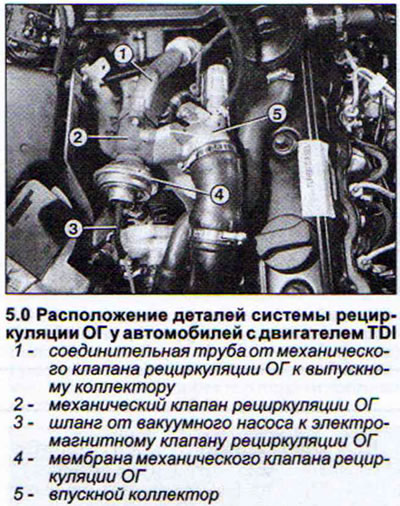
The turbocharger and oxidation catalyst in TDI diesel engines operate in the same way as in TD engines, but the exhaust gas recirculation system is completely different. In TDI engines, the exhaust gas recirculation system does not operate on the "On-Off" principle, but also performs an intermediate function. For this purpose, the mechanical exhaust gas recirculation valve has a cone-shaped piston, which allows you to adjust the diameter of the opening for exhaust gas removal when moving the piston. The piston stroke ensures any movement. The electronic control unit controls the electromagnetic exhaust gas recirculation valve based on the specified values that were obtained during bench tests and ensure the maximum reduction in the content of nitrogen oxides in the exhaust gases. Here, the principle is also used that ensures the maximum temperature drop in the combustion chambers when removing the maximum volume of exhaust gas, which helps to reduce the content of nitrogen oxides (see illustration 5.0).
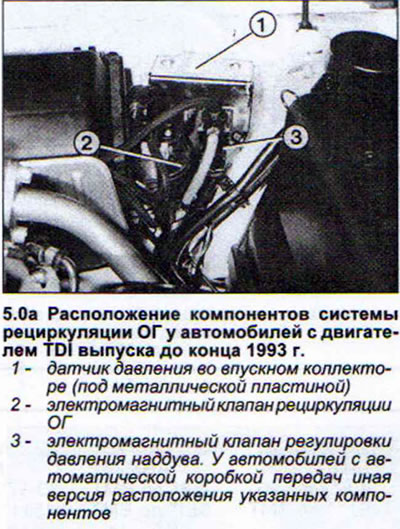
EGR solenoid valve - check. Vehicles with TDI engine and manual transmission manufactured before the end of 1993.
Checking the solenoid valve hose connections
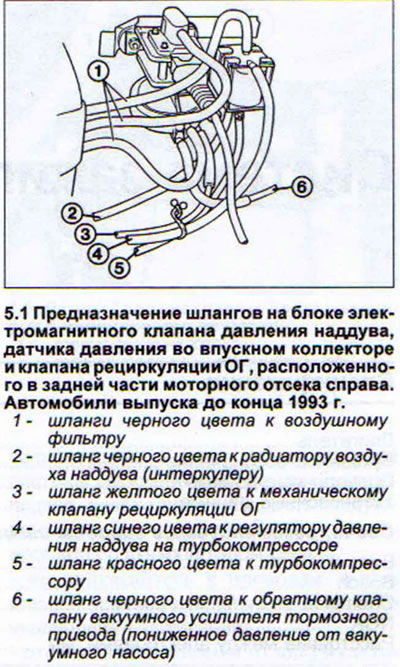
1. Make sure the hoses on the solenoid valve are connected correctly (see illustration).
Checking the internal resistance of the solenoid valve
2. Disconnect the EGR valve plug.
3. Connect a highly sensitive and accurate ohmmeter to both contacts of the valve plug. The resistance should be 4-8 ohms. Otherwise, the valve is faulty and must be replaced.
Checking the power supply of the solenoid valve
4. Connect a voltmeter to pin 2 on the connector plug and to ground (-) (see illustration).
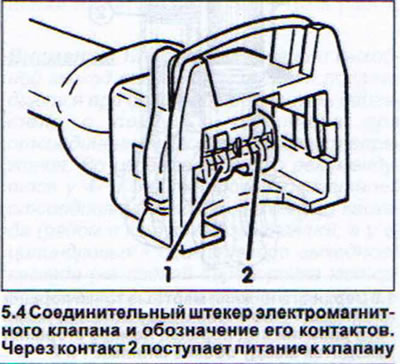
5. Turn on the ignition. The voltmeter should show the battery voltage. Otherwise, the power supply wire is broken.
EGR solenoid valve - check. Cars with TDI engine and manual transmission manufactured since the end of 1993 and cars with automatic transmission
The EGR solenoid valve for vehicles with a TDI engine and manual transmission manufactured from the end of 1993 and vehicles with an automatic transmission is located on the front side of the air filter housing (see illustration 5.0b).
Checking the internal resistance of the solenoid valve
6. Disconnect the EGR valve plug.
7. Connect a highly sensitive and accurate ohmmeter to both contacts of the valve plug. The resistance should be 14-10 P. Otherwise, the valve is faulty and must be replaced.
Checking the power supply of the solenoid valve
8. Connect a voltmeter to pin 2 on the connector plug and to ground (-).
9. Turn on the ignition. The voltmeter should show the battery voltage. Otherwise, there is a break in the power supply wire.
The procedure for checking the mechanical EGR valve is completely identical to the procedure for checking this valve in TD engines.
Considering that the functioning of the exhaust gas recirculation system of vehicles with TDI engines is largely determined by the control unit, the cause of the defect of the exhaust gas recirculation system may also be the sensors of the fuel system. For this reason, it is recommended to print out the fault codes and then check the corresponding sensor.