



Note: The following describes the adjustment on a 90 hp engine. (jN designation). Different adjustment points for other engines are referred to at the end of the chapter.
When working with 113 and 115 hp engines, a device is required to determine the averaging coefficient (the ratio of a long pulse to the duration of the interval between two adjacent pulses) (or the pulse duty cycle associated with it). The averaging coefficient characterizes the control signal for the idle stabilization valve. The higher the averaging coefficient, the more the valve opens.
Test conditions: The exhaust system must be sealed
Warm up the engine. Oil temperature is about 80°C
Turn off all electrical consumers, including the air conditioner.
If the injection pipes have been opened or replaced, before checking it is necessary to bring the speed up to 3000 rpm several times with intervals of at least 2 minutes at idle speed.
Check the lambda adjustment.
Check the ignition timing.
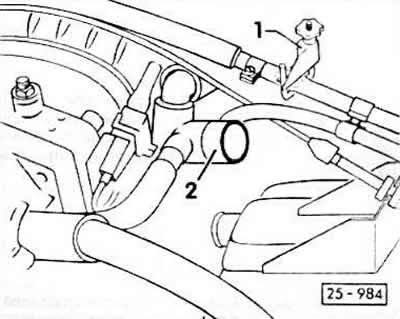
Clamp the idle speed control hose with clamp "1".
For 90 hp engine only: Disconnect the crankcase ventilation hose "2" on the cylinder head and place it so that fresh air can be sucked in. If the hose is secured with a wire clip, use the special pliers HA2ET 798-48.
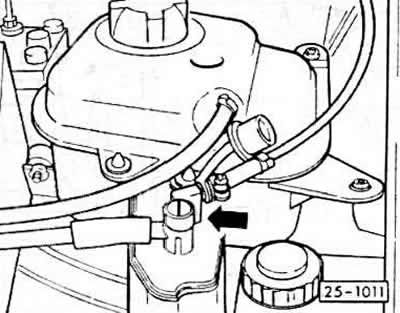
Remove the cap from the top of the activated carbon box.
Attention: Connect measuring instruments only when the ignition is off.
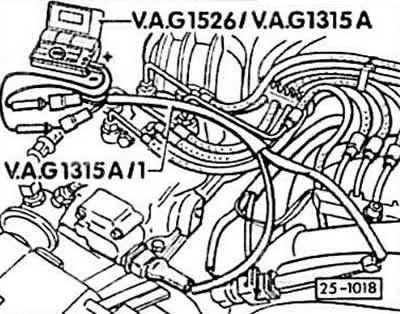
Connect the tachometer according to the operating instructions.
This article was copied from an online resource AudiManual.ru