
Repair Chevrolet Repair Toyota Repair Honda Repair AvtoVAZ Repair Mercedes-Benz Repair BMW Repair Opel
Home  |  Contacts  |  Sitemap  |    
English Русский
Български
Беларускі
Український
Српски
Hrvatski
Română
Polski
Slovenský
Magyar
AudiManual.ru


  • AUDI 80
  • AUDI 100
  • AUDI A3
  • AUDI A4
  • AUDI A6
  • AUDI A8
  • AUDI Q
  • OTHER
  • ARTICLES
B4 (1991-1996) B3 (1986-1991) B3 (1986-1991, petrol) B2 (1979-1986)

Removal and installation brake pads (Audi 80 B3)

  • Home
  • Audi 80
  • B3 (1986-1991)
  • Chassis
  • Brake system
  • Removal and installation brake pads
            0
Table of contents: Removal ↓ Installation ↓

Removal


Remove the brake drum.
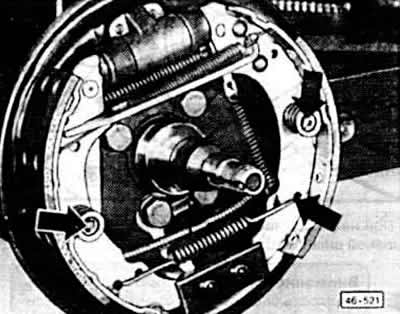
Remove the brake drum.


Press the spring plate with pliers and turn it 90° (¼ turn). While pressing, hold the pin on the brake shield from behind.

Disconnect the lower return spring.
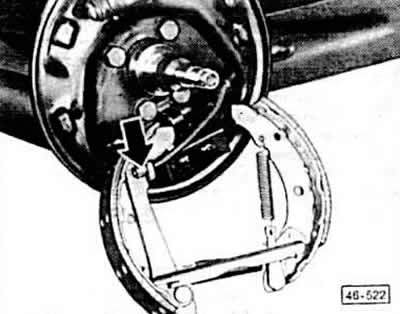
Disconnect the lower return spring.


Lift the brake pads from the lower support by hand and remove the return spring.

Disconnect the brake cable

Clamp the pads in a vice.

Release the wedge tension spring and the upper tension spring with a combination collet.

Clamp the brake shoe in a vice and release the pressure spring.
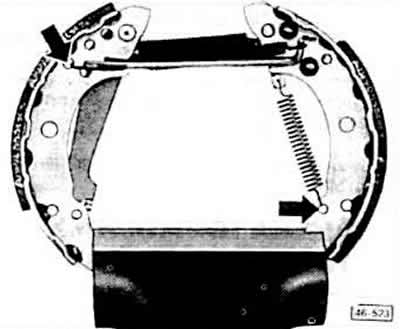
Clamp the brake shoe in a vice and release the pressure spring.


Clamp the brake shoe in a vice and release the pressure spring.


Installation


Be sure to install the same type of pads. Blow out the brake drum and brake shield with compressed air. When the pads are removed, do not press the brake pedal to avoid the pistons coming out of the cylinder. If the wheel cylinder is wet, it is subject to repair. If there are grooves, bore the brake drum. In this case, bore both drums.
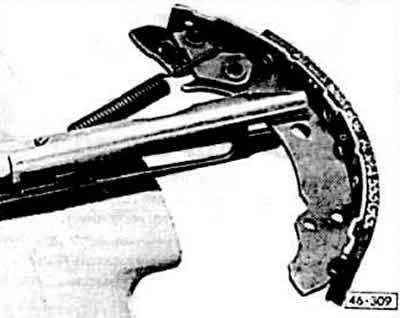
Be sure to install the same type of pads. Blow out the brake drum and brake shield with compressed…


Clamp the expansion bar in the clutch, install the pressure spring and put the shoe on the bar.

Place a wedge. The wedge is placed between the brake shoe and the brake shield.

Note: The nose is directed towards the shield.
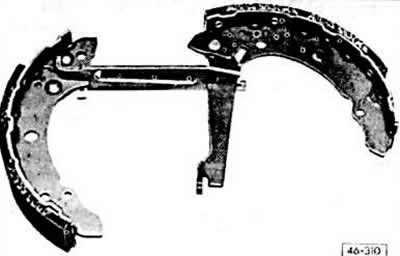

Note: The nose is directed towards the shield.


Insert the brake shoe into the brake lever.

Attach the return spring to the top.

Connect the brake cable to the brake lever.

Install the shoe on the wheel brake cylinder pistons.


Insert the return spring from below and install the brake shoes into the lower support.

Insert the pins of the pressure springs, put the cups on and compress the springs. Hold the pin from behind, turn the cup 90° to fix it.

Install the brake drum and adjust the bearing clearance.

Press the brake pedal several times to install the pads.

Install the wheel, lower the vehicle and tighten the wheel bolts to 110 Nm.
The article was checked by auto expert Elisey Ermolaev
This article is available at russian, bulgarian, belarusian, ukrainian, serbian, croatian, romanian, polish, slovak, hungarian

Share information:
Previous articles
Audi 80 B3: Brake system
Next articles

Removal and installation the brake drum
Removal and installation the brake disc/brake caliper
Rear drum brakes
Checking the thickness of the brake disc
Removal and installation of working brake cylinders
Bleeding the brake system
Replacing brake pipes/hoses
Checking the power steering


Similar articles on other Audi car models:
Brake pedal — removal and installation Audi 100 C3 (1982-1990, diesel)
Removal and installation the brake disc / caliper Audi A3 Type 8L (1996-2003)
Removal and installation front brake pads Audi A4 B6 (2000-2006)
Front Brake Pads with Caliper FNR-G60 — Removal and Installation Audi A6 C5 Allroad (1999-2005)
Removal and installation the engine Audi A8 D2 (1994-2002)
Front brake pads FBC-60. Removal Audi Q5 Type 8R (2008-2017)
Removal and installation the upper brake light Audi A2 (1999-2005)
Link to this page in different formats


Visitor comments

No comments yet


How much will 39 + 21 =


80(B4, 1991-1996) 
  • General information
  • User manual
  • Maintenance
  • Troubleshooting
  • Power unit
  • Engine
  • Cooling system
  • Heating and ventilation
  • Petrol injection
  • Diesel fuel system
  • Fuel system
  • Exhaust systems
  • Ignition system
  • Transmission
  • Clutch
  • Car gearbox
  • Chassis
  • Brake system
  • Suspension and steering wheel
  • Body
  • Body and trim
  • Electrical equipment
  • Electrical system
  • Electrical circuits
 
80(B3, 1986-1991) 
  • General information
  • Repair characteristics
  • Maintenance
  • Power unit
  • Gasoline engine
  • Diesel engine
  • Engine lubrication system
  • Fuel system (gasoline)
  • Injection system (gasoline)
  • Fuel system (diesel)
  • Ignition system
  • Cooling system
  • Heater
  • Exhaust system
  • Transmission
  • Clutch and gearbox
  • Chassis
  • Steering
  • Brake system
  • Car suspension
  • Body
  • Body elements
  • Electrical equipment
  • Power devices
  • Lighting and appliances
  • Electrical circuits
 
80(B3, 1986-1991, petrol) 
  • General information
  • User manual
  • Maintenance
  • Power unit
  • Engine 4-cylinder
  • Engine 5-cylinder
  • Cooling system
  • Fuel and exhaust systems
  • Ignition system
  • Transmission
  • Clutch
  • Mechanical transmission
  • Automatic transmission
  • Drive shafts
  • Chassis
  • Brake system
  • Suspension
  • Steering
  • Body
  • Exterior
  • Interior
  • Electrical equipment
  • Equipment and devices
  • Electrical circuits
 
80(B2, 1979-1986) 
  • General information
  • User manual
  • Power unit
  • Engine FZ
  • Engine EP, YP, YZ, DT, DS, DZ
  • Transmission
  • Clutch
  • 4 speed gearbox
  • 5 speed gearbox
  • Front wheel drive
  • Chassis
  • Front suspension
  • Rear suspension
  • Steering
  • Brake system
  • Electrical equipment
  • Equipment and devices
  • Electrical circuits
 
AudiManual.ru © 2017-2026 · Mobile version · Feedback · Sitemap: EN BG BY UA RS HR RO PL SK HU · Site search · News and articles
80 B2 · 80 B3 petrol · 80 B3 · 80 B4 · 100 C3 diesel · 100 C3 petrol · 100 C3 · 100 C4 petrol · 100 C4 · A3 Type 8L · A4 B5 petrol · A4 B5 · A4 B6 petrol · A4 B6 · A4 B7 · A4 B8 · A6 C4 · A6 C5 · A6 C5 Allroad · A8 D2 · Q5 Type 8R · Q7 Typ 4L · Audi A2 ·
This site uses cookies 🍪. Click the button to accept this fact.