



Note: Perform guided fault finding for the auxiliary heater. Guided fault finding for the auxiliary heater is performed, for example, using the diagnostic system "VAS 5051/" or the tester "VAS 5052". Guided fault finding for the auxiliary heater only works when the ignition is on (the diagnostic interface of the data bus "J533" is only active when the ignition is on). After switching the auxiliary heater to diagnostic mode, guided fault finding can be continued even when the ignition is off. The auxiliary heater is available in different versions (on the Audi Q5, independent heaters with the number 8K0.xxx.xxx cannot and are not installed), therefore, when replacing the independent heater, take into account the correct correspondence. Since 10.2010, the gradual use of independent heaters with the part number 4xx xxx xxx has begun. This version of the independent heater can be installed in a service center on a car originally equipped with an independent heater with the part number 8R0 xxx xxx or 8K0 xxx xxx. Since individual components differ in different versions of the independent heater (e.g. 2-pin plug connector of the power supply circuit of the additional heater control unit "J364"), take into account the correct correspondence when replacing individual components of the independent heater. When installing an independent heater with the part number 4xx xxx xxx, it is necessary to take into account the correct coding for the corresponding car for this version (various functions are provided depending on the vehicle type coded in the control unit). If the auxiliary heater needs to be replaced, the coding and adaptation of the auxiliary heater control unit "J364" must be interrogated before removal via the "Replace control unit" function in the guided fault finding (the auxiliary heater control unit "J364" is integrated into the heater). If, depending on the design of the auxiliary heater control unit "J364", the auxiliary heater cannot be switched on in a new vehicle or after installing a new auxiliary heater, component protection may be activated (if, before the first commissioning, for example, a large number of faults were detected simultaneously in production, then this fault message is not displayed, despite the fact that the fault is still present). In this case, the component protection function must be re-adapted, similar to installing a new independent heater, by disabling its activity with the tester in the U4S 5051/Guided Fault Finding mode. The following figure shows the arrangement of components and parts for an Audi A4 or Audi Q5; there are minor differences in the arrangement of components/parts from this figure.
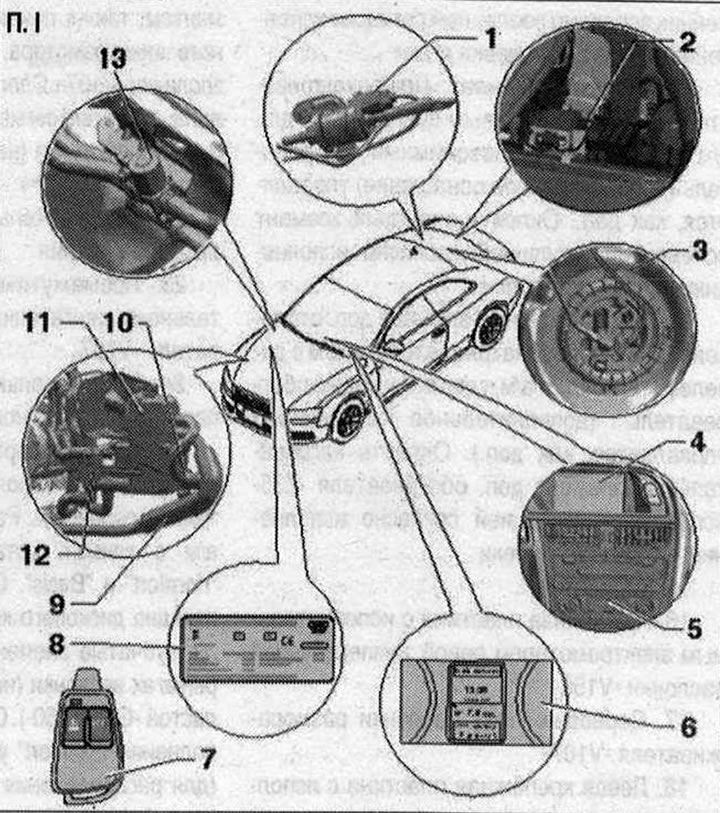
I 1. Dosing pump "V54". Fuel selection for the independent heater. Check the fuel supply volume. Depending on the vehicle version, a silencer may be built into the fuel line going to the independent heater in the area of the dosing pump "V54" to reduce noise. 2. Radio receiver of the independent heater "R64". Various versions of the radio signal receiver of the independent heater "R64" are provided; 3. Fuel supply module with a branch pipe for fuel selection for an independent heater. Various fuel supply modules, depending on the type of vehicle (petrol or diesel engine, front or all-wheel drive). After removing and installing the fuel system components, it is necessary to turn on the independent heater and let it run for at least 10 minutes at full load to ensure complete removal of air from the fuel line; 4. Multimedia Interface (MMI). Via the MMI, various control functions of the auxiliary heater and auxiliary ventilation are entered and displayed on the corresponding display. Operation of the auxiliary heater, MMI (in the "Car" menu), Multimedia Interface and the corresponding displays on the display are described in the corresponding operating manual. If there is too little fuel in the fuel tank (the fuel gauge needle is in the red zone), it is not possible to turn on the independent heater (the checkbox in the MMI for the "Immediate switching on of the independent heater" function and the independent heater icon on the clock do not turn on or go out immediately); 5. Control and display panel CU Climatronic "J255". Receives control signals via the data bus. When the independent heater is switched on via the "Timer" function or using the remote control, it decides in which mode to switch on the independent heater (autonomous ventilation or autonomous heater). In order for the independent heater to be switched on using the "Timer" function or the remote control (key fob), it is necessary to select a temperature higher than "Lo" on the control and display panel of the Climatronic control unit "J255". In order for the windows to be cleared of ice as quickly as possible, it is recommended to set the highest possible temperature on the control and display unit, the Climatronic control unit "J255" before switching off the ignition. Used and display units, the Climatronic control unit "J255" uses the last set temperature in the operation of the independent heater and regulates the temperature in the passenger compartment in accordance with the set temperature. Since the 2010 model year, the start/stop system has been offered for certain engines as an additional kit for this vehicle. On such vehicles, take into account the correct design of the climate control and display panel. installation of the Climatronic control unit "J255" and the independent heater. On vehicles with an engine start/stop system, the circulation pump "V55" of the auxiliary heater receives control signals from the auxiliary heater control unit "J364" during the stop function. The request to switch on "J364" comes from the climate control and display panel, Climatronic control unit "J255" via the "V55" data bus. Depending on the selected operating mode ("auxiliary heater" or "auxiliary ventilation"), certain fault messages that have a negative effect on the auxiliary heater/auxiliary ventilation mode are not stored in the memory of the auxiliary heater control unit "J364". Therefore, if there are complaints about the auxiliary heater, also read the fault memory of the control and display panel of the Climatronic control unit "J255" using the VAS 5051 Diagnostic system. After replacing the auxiliary heater, make sure that the new auxiliary heater is adapted correctly. When replacing an independent heater with the part number 8K0 xxx xxx, 8R0 xxx xxx or 4H0 xxx xxx up to index "A" with an independent heater with the part number 4H0 xxx xxx starting with index "B", it is necessary to activate the adaptation for the control signal of the circulation pump "V55" using the auxiliary heater control unit "J364" in the climate control mode (for an independent heater with the number 4H0 xxx xxx, starting with index "B", this function is disabled). If "V55" is not activated at the request of the climate control and display panel of the Climatronic control unit "J255" from "J364", for certain vehicle versions (depending on the engine and production period) you can report faults due to low or insufficient heating power. If in cars in which the manufacturer has installed an independent heater with the number 4H0 xxx xxx, starting with the index "B" (installed since 2012 MY), "V55" is activated by the request "J255" from "J364", this can also lead to a complaint; 6. Display in the instrument cluster. Installed in the instrument cluster. Depending on the version, the additional equipment "auxiliary heater" must be set via the "Adaptation" function in the control unit in the instrument cluster "J285". If there is too little fuel in the fuel tank (the fuel gauge needle is in the red zone), it is not possible to turn on the independent heater (the checkbox in the MMI for the "Immediate switching on of the independent heater" function and the independent heater icon on the clock do not turn on or go out immediately). Depending on the operating state of the independent heater (autonomous heating/ventilation mode) or when selecting the "Timer" function, 1 of the symbols for independent heating or independent ventilation will be continuously controlled or both symbols will flash. If the independent heater is equipped with a radio remote control (additional equipment), then the used additional heater "J364" can be controlled from it. The remote control then transmits the message "Auxiliary heater / auxiliary ventilation on or off" via the data bus to the operating and display unit Climatronic control unit "J255". The operating and display unit then decides whether the auxiliary heating mode must be switched on to achieve the set temperature or whether auxiliary ventilation mode is sufficient. If the auxiliary heater was activated via the "Timer" function or the remote control and the temperature on "J255" is set to "Lo", the auxiliary heater will only be switched on if the outside temperature is lower than the current temperature, e.g. 10°C. If the outside temperature with this setting is higher than approx. 10 C, only auxiliary ventilation mode is switched on; 7. Radio remote control for independent heater. For switching the independent heater function "Independent heater" or "Independent ventilation" on and off. When the buttons are pressed, the integrated indicator lamp lights up or flashes. In order for the remote control to recognise that the buttons have been pressed and to send a radio signal, the corresponding button must be pressed for at least 1 second. If the independent heater with a used additional heater "J364" is being replaced, the operation of at least one remote control must be checked and, if necessary, all remote controls must be reconfigured. After removing the power sources, the version of the remote (radio) control must be determined from the part number on the sticker. Depending on the selected operating mode ("independent heater" or "independent ventilation"), certain fault messages that have a negative effect on the independent heater/independent ventilation mode are not stored in the memory of the additional heater control unit "J364". Therefore, if there are complaints about the independent heater, also read the fault memory of the control panel and display of the Climatronic control unit "J255". Currently, a radio key fob without a display is provided for radio remote control of the independent heater. In the independent heater with a used additional heater "J364" with the part number 8xx xxx. xxx, adjustment is provided only by a radio key fob without a display. Since 10.2010, independent heaters with "J364" with the part number 4xx xxx xxx are used, in these independent heaters, the key fob design (with or without display) "J364" must be coded correctly. This is also true if in service department 1 "J364" with part number 8xx xxx xxx is replaced by another "J364" with part number 4xx xxx xxx. Ensure correct matching of the radio remote control of the independent heater to the radio receiver of the independent heater "R64" (various designs in radio key fob with and without display) and for the correct correspondence and coding of "J364"; 8. Duplicate nameplate of the independent heater. In addition to technical characteristics, it indicates the type of independent heater. Glued to the inside of the hood; 9. Exhaust silencer for independent heater; 10. Intake air noise muffler; 11. Independent heater. Since the 2009 model year, it is gradually being equipped with a modified independent heater bracket. When replacing the independent heater and bracket, take into account the correct match. Since the 2010 model year, the start/stop system is offered for certain engines as an additional kit for this vehicle. On such vehicles, take into account the correct design of the climate control and display panel, the installation of the Climatronic control unit "J255" and the independent heater. Vehicles with the engine start/stop system cannot be equipped with independent heaters with the part number 8K0 xxx xxx. On vehicles with the engine start/stop system, the circulation pump "V55" of the independent heater receives control signals from the additional heater control unit "J364" during the stop function. The request to switch on "J364" comes from the climate control and display panel, Climatronic control unit "J255" settings via the "V55" data bus. If the independent heater or auxiliary heater control unit "J364" is replaced, at least one remote control must be checked and, if necessary, all remote controls must be reconfigured. If, after replacing the independent heater or auxiliary heater control unit "J364", the fault message "incorrect control unit installed" appears, make sure that the correct fuel type "diesel" or "petrol" is specified in the coding of "J364" and, if necessary, make an adjustment. Depending on the selected operating mode ("auxiliary heater" or "auxiliary ventilation"), certain fault messages that have a negative effect on the independent heater/auxiliary ventilation mode are not stored in the memory of the auxiliary heater control unit "J364". Therefore, if there are complaints about the independent heater, also read the fault memory of the control panel and display unit Climatronic "J255" using the diagnostic complex VAS 5051. The independent heater has the following electrical units: Used additional heater "J364"; Temperature sensor "G18"; Flame sensor "G64"; Temperature sensor 2 additional and autonomous heater "G587"; Heater glow plug "Q9"; Combustion air supply fan "V6"; Heating element of the fuel preheating system "Z66"; 12. Circulation pump "V55". The circulation pump "V55" is controlled by the auxiliary heater "J364". Depending on the vehicle equipment, the auxiliary heater control unit "J364" can switch on the circulation pump "V55" even when the auxiliary heater is switched off, upon a request received via the data bus (a request, for example, from the engine control unit or from the control and display panel of the Climatronic control unit "J255"). Vehicles with an engine start/stop system cannot be equipped with auxiliary heaters with the part number 8K0 xxx xxx. On vehicles with an engine start/stop system, the circulation pump "V55" of the auxiliary heater receives control signals from the auxiliary heater control unit "J364" during the stop function. The request to turn on "J364" comes from the climate control and display panel, the Climatronic control unit "J255" installation via the "V55" data bus; 13. Heater coolant supply shut-off valve "N₂79". In the independent heating mode, the auxiliary heater "J364" is controlled. In vehicles with a 4 "or 6" cyl. petrol engine, the heater coolant supply shut-off valve "N₂79" can receive control signals even when the independent heater is switched off (e.g. with certain adjustments using the control panel and display unit Climatronic "J255" to block the coolant supply to the climate control unit heat exchanger). To ensure that the coolant flow from the cylinder head does not stop completely when the engine is running and receiving control signals from "N₂79", the coolant circulation circuit of some vehicles is equipped with a check valve. Control signals are only allowed to be sent to "N₂79" at a certain engine speed (at the moment no higher than 1200 rpm.), therefore, it is necessary to take into account the correct design, coding and adaptation of the autonomous heater.
(This article was copied from an online resource audimanual.ru)