Wheel imbalance leads to increased wear of steering components, tires and vehicle suspension, so if imbalance occurs, the wheels should be re-balanced. Steering wheel vibration from wheel imbalance occurs in a certain speed range and disappears when the speed decreases or increases. In addition, wheel balancing is necessary after mounting a new tire and after each tire repair.
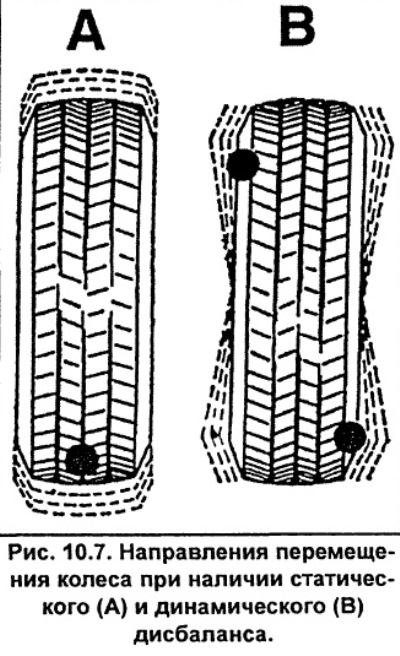
Static imbalance of wheel A (Fig. 10.7) is manifested in the fact that the weight of individual parts of the wheel relative to the axle has different masses. In this case, if the wheel is mounted on a freely rotating axle, the wheel will turn in such a way that the heavier part of the wheel will always be at the bottom. A wheel with static imbalance can bounce when the car is moving, which will lead to rapid wear of the shock absorber.
Dynamic wheel imbalance B (Fig. 10.7) appears only when the wheel rotates quickly. If present, the heavier section of the wheel is located to the side relative to the middle section of the wheel and when the wheel rotates, it causes it to swing, which leads to accelerated failure of the hub bearing and suspension elements.