Table of contents: Lifting with a jack ↓ Lifting with a lift ↓
Lifting with a jack
Only lift an unloaded vehicle on a level, hard-surfaced surface.
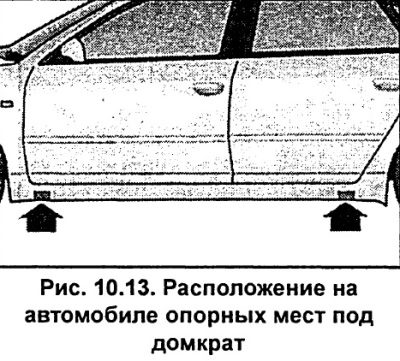
To lift the car, it is necessary to use a jack installed under the supporting points of the car body, which are located approximately 15 cm behind the front wheel arch and 25 cm in front of the rear wheel arch (see fig. 10.13).
Place the jack under the vehicle, with the jack's foot tightly gripping the vertical edge of the side member so that the jack cannot slip off when lifting the vehicle (see fig. 10.14). At the same time, you should align the jack and lift the jack paw until it fits tightly against the vertical edge. To prevent the car from rolling, place shoes under the wheels.
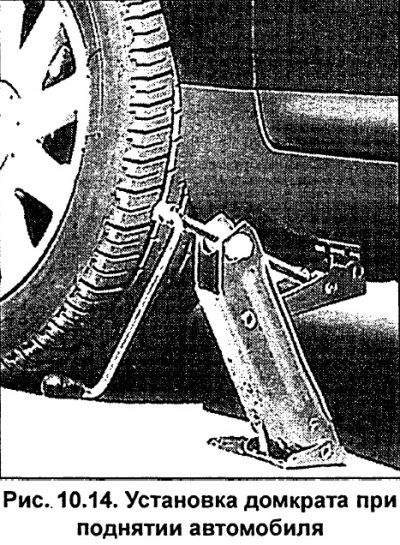
Attention. When installing the jack on soft ground, the car may fall off the jack. Therefore, it is necessary to place the jack on hard ground. If necessary, use a stable and relatively large support.
Turn the jack handle to raise the car so that the wheel does not rise above the ground. Place an additional support under the car.
Lifting with a lift
A lift is used to lift the car.
To avoid damage to the bottom of the car, rubberized pads should be installed on the lift legs.
Caution: Do not lift the vehicle by placing the lift arms under the oil pan, under the gearbox, under the rear or front axles, otherwise serious damage to the components and assemblies may occur.
Before driving onto the lift, check that there is sufficient distance between the lowest points of the vehicle and the lift elements.
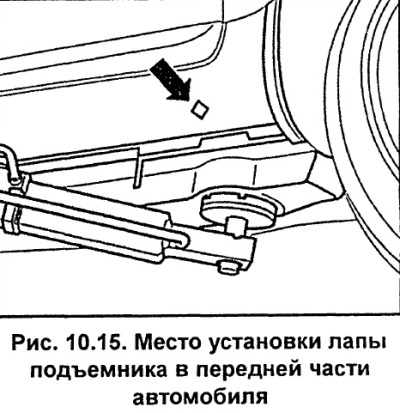
At the front of the vehicle, install the lift paw under the longitudinal reinforcement of the body bottom, in the area of the mark for installing the jack (see fig. 10.15).
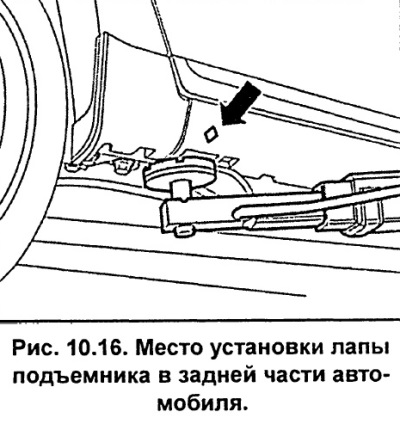
At the rear of the vehicle, place the lift paw under the vertical crossbar reinforcement, in the area marked for installing the jack (see fig. 10.16).