In radial tires, the cord threads are arranged along the shortest path between the tire beads. The belt surrounds a thin and elastic carcass and provides stability to the tire.
In tubeless tires, the tube is replaced by a vulcanized inner layer with high air permeability. The sidewall of such a tire must be installed on the rim of the disk securely and hermetically. The absence of a tube in the tire reduces the weight of the wheel and simplifies its installation on the rim of the disk.
Tire markings are located on the sidewall of the tire. The width of the tire, its design, and the rim diameter of the wheel are the minimum information required to mark the tire.
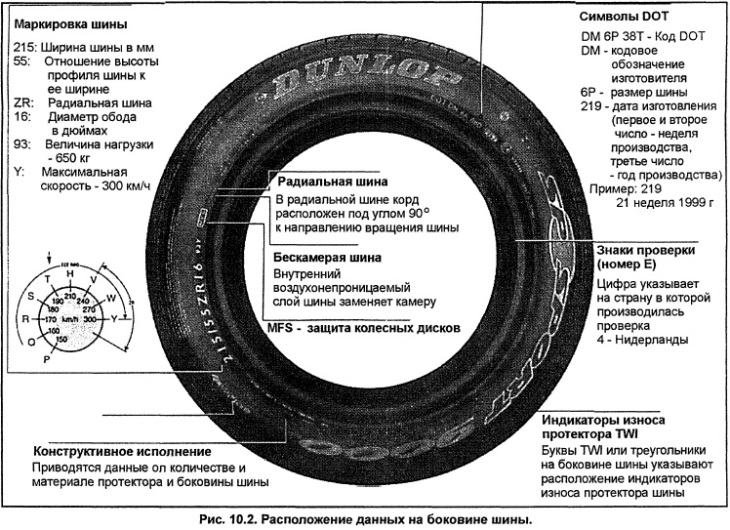
Knowing the tire markings helps when choosing them (see fig. 10.2). Radial tires have the following markings, for example: 215/55 ZR1693Y
215 — tire profile width, mm.
55 is the ratio of the tire profile height to its width x100.
This ratio for passenger car tires is between 60 and 80. A ratio of 35 indicates that the tires are intended for sports cars.
Regardless of the value of this ratio, one tire seat diameter is used. Low-profile tires (with a small value of the ratio of the height of the tire profile to its width) provide high stability of the vehicle when cornering.
2R - arrangement of cord threads - letter designation for a radial tire.
16 — rim diameter, inch,
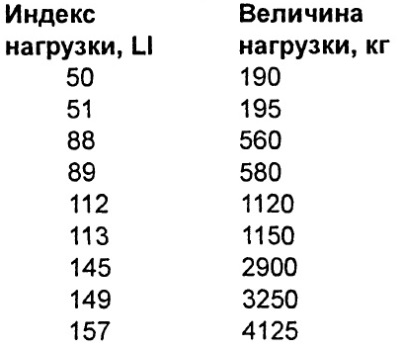
93 — index of permissible load.
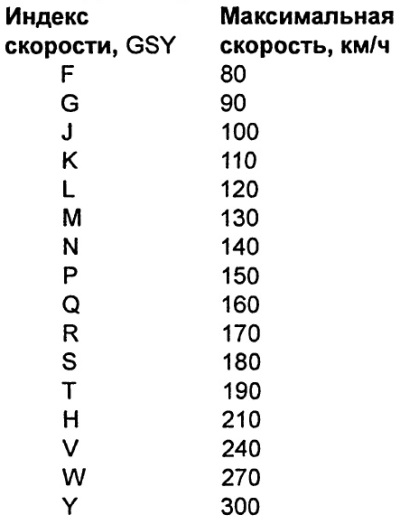
Y — speed index.
Data containing information about the tire identification code and date of manufacture, as well as information about the maximum load capacity and inflation pressure, are located near the DOT symbols on the sidewall of the tire.
The grooves of the tire tread pattern contain "tire wear indicators" 1.6 mm high located at right angles to the direction of the tire's forward movement. These indicators are from six to eight in number (depending on the manufacturer) are placed at equal distances around the circumference of the tire. Markers on the sidewall of the tire (for example, the letters "TWI" or a pictogram in the form of a triangle) show the location of the tire wear indicators.
The tires can be used until the profile depth reaches 1.6 mm, i.e. the profile grooves must have a depth of at least 1.6 mm over the entire surface of the tire. However, for safety reasons, it is recommended to change the tires at a profile depth of 2 mm.
M+S tyres have sufficient grip on snow with a tread depth of at least 4 mm.
Instructions for using tires
Optimum tire performance is only achieved when tires of the same design are installed on all wheels of the vehicle.
When mounting, do not install tires on a damaged, deformed rim with traces of corrosion.
When installing a tire with a directional road pattern (are determined by the arrow on the sidewall of the tire) it is necessary to ensure that it rotates in the correct direction. This will ensure optimal tire behavior in terms of aquaplaning, road grip, noise, and traction. If, when replacing a punctured wheel, a tire is temporarily installed with counter-rotation, its use in this mode should be short-term.
The service life of tires depends on the following factors:
- Air pressure in tires.
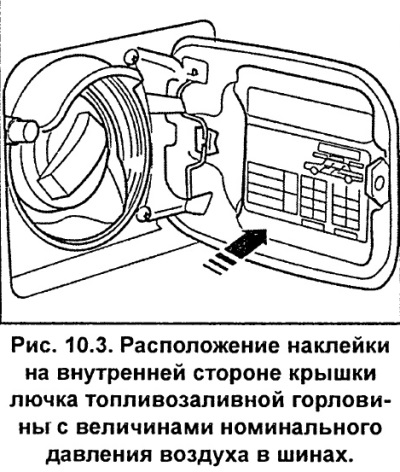
- The nominal air pressure values for summer tires are indicated on the sticker on the inside of the fuel filler cap (see fig. 10.3).
- Maintaining the recommended air pressure in your tires is especially important when driving at high speeds. Therefore, you should check the air pressure in your tires at least once a month and before each long trip.
- At the same time, do not forget to measure the air pressure in the spare tire.
- The air pressure in the tires should always be checked when the tires are cold. If the air pressure in the hot tires is too high, do not deflate the tire. If the load changes significantly, the air pressure in the tires should be changed accordingly.
- On vehicles with full-size wheel caps, instead of dust caps, there are extensions to improve ventilation. When checking and adjusting the air pressure in the tires, there is no need to unscrew these extensions.
- Low or high air pressure in tires reduces their service life and worsens the vehicle's driving performance.
Regularly checking the condition of your tires will allow you to promptly detect intense wear and eliminate its cause, which will help avoid more serious consequences.
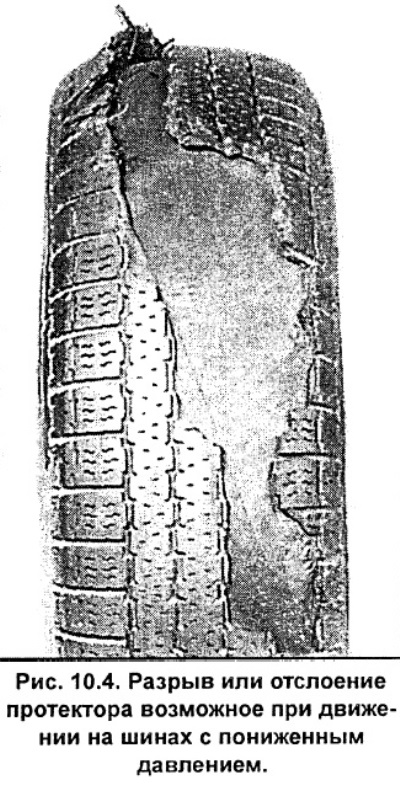
Rupture or separation of the tire tread. When driving for a long time at high speed, tires with low pressure perform a very large amount of lateral deformation work on the tires, causing the tires to heat up significantly. This can lead to partial separation of the tire tread and even to its rupture. At the same time, such defects often remain hidden for a long time, and with an increase in load or driving at high speeds, the tire can instantly fail.
Wear on the outside of the tire (front tire) occurs when cornering at high speeds. If such wear occurs, it is recommended to move the tires from the front axle to the rear axle of the vehicle.
Wear on the outer sides of the tread occurs when the vehicle is driven with low tire pressure.
Uniform, intense wear is probably caused by a faulty shock absorber.
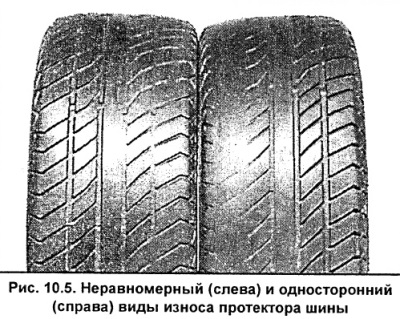
Uneven wear (in several places) occurs when there is an imbalance in the wheel. The wheel needs to be balanced.
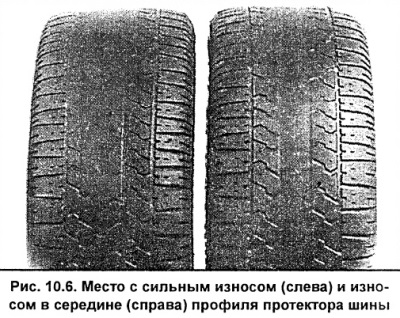
Areas with severe wear appear when braking with a locked wheel. It should be noted that even ABS cannot prevent short-term wheel locking.
One-sided wear of the tire tread. Incorrect wheel alignment angles not only cause increased tire wear, especially one-sided wear, but also contribute to reduced driving safety.
Severe wear in the middle of the tire tread profile. Occurs due to frequent movement of the car at the maximum tire speed, as a result of which, due to the action of centrifugal forces, the tire tread becomes convex in the center and wears out intensively. This type of wear is most pronounced on the rear wheels, with increased pressure in them.
Too low air pressure in the tires leads to increased fuel consumption.
Taking sharp turns at high speeds, accelerating quickly and braking hard all increase tire wear.
It is recommended to swap tires with different tread wear according to the scheme when a tire from one axle of the car is moved to its other axle. A decrease in the tire tread depth is accompanied by a decrease in the thickness of the protective layer of the cord and tire carcass. In addition, a decrease in the tire tread depth leads to a disproportionate increase in the braking distance of the car. For example, the braking distance of a front-wheel drive passenger car from a speed of 100 km / h with a tread depth of 8 mm is 75 m, and with a depth of 2 mm it reaches 129 m. It should be taken into account that the braking distance of a car largely depends on the condition and type of road surface, tire profile and quality of the tire material.
Mounting and repairing tires requires special tools and professional skills. These jobs should only be performed by professionals.
For reasons of road safety, tires should be replaced by axles rather than individually, if possible. The least worn tires should always be installed on the front wheels.
In addition, on a four-wheel drive vehicle, all tires must be the same model from the same manufacturer. Otherwise, the viscous coupling, due to the resulting difference in the rotation speed of the wheels of both axles, will undesirably increase the share of traction falling on the rear axle.
Different tread depths of the front and rear tires, for example due to wear, are not so important. However, it is recommended to fit tires with a greater tread depth to the front wheels - if the front tires are worn more than the rear tires, they have a smaller circumference and therefore rotate faster. Therefore, additional stress is created in the transmission, and the tires wear out faster.
If the spare tire is different in design from the other tires on the vehicle (for example, winter or wide-profile), then such a spare wheel should only be used for a short time in the event of failure of one of the vehicle's tires and with corresponding increased caution when driving the vehicle. Instead of such a wheel, the previous wheel should be installed again as soon as possible.
Never install a used tire on your vehicle unless you know where and how it has previously worked.
The tires on the front wheels provide a vehicle mileage of 15,000-35,000 km, on the rear wheels - 30,000-50,000 km. If the vehicle is used rarely, then regardless of the mileage, the tires must be replaced after 7-8 years, since over time the tire material (rubber compound) is being destroyed.
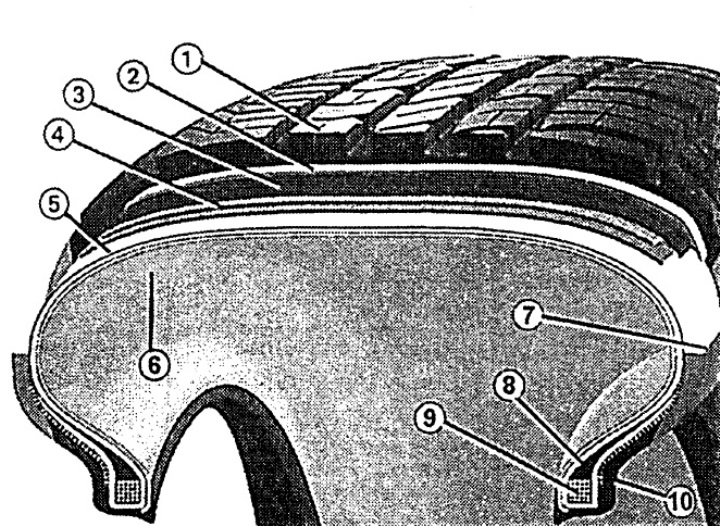
Fig. 10.1. PKW-Reifens radial tubeless tyre
1 - protector
2 - base
3 - nylon cord
4 - steel breaker
5 - tire frame
6 - airtight inner layer
7 - sidewall
8 - side
9 - bead core
10 - increasing thickening