
Repair Chevrolet Repair Toyota Repair Honda Repair AvtoVAZ Repair Mercedes-Benz Repair BMW Repair Opel
Home  |  Contacts  |  Sitemap  |    
English Русский
Български
Беларускі
Український
Српски
Hrvatski
Română
Polski
Slovenský
Magyar
AudiManual.ru


  • AUDI 80
  • AUDI 100
  • AUDI A3
  • AUDI A4
  • AUDI A6
  • AUDI A8
  • AUDI Q
  • OTHER
  • ARTICLES
C5 Allroad (1999-2005) C5 (1997-2004) C4 (1994-1997)

General information about V8 petrol engines (Audi A6 C5)

  • Home
  • Audi A6
  • C5 Allroad (1999-2005)
  • Power unit
  • V8 petrol engines
  • General information about V8 petrol engines
            0

Specifications


Engine designation BAS
Working volume, cm³4163
Power, kW at rpm221/6200
Power, hp at rpm300/6200
Maximum torque, Nm at rpm380/2600-4700
Cylinder diameter, mm84,5
Piston stroke, mm92,8
Compression ratio11,0
Cylinder firing order1-5-4-8-6-3-7-2

The Audi Allroad cars also use 8-cylinder petrol engines with two blocks of four cylinders each as a power plant. The cylinder blocks are located at an angle of 90° relative to each other, which is why such engines are designated V8. The cylinder block is made of gray cast iron, and the cylinder head is made of a light metal alloy. The cylinder head is made according to the so-called transverse principle, when the inlet and outlet channels are located diametrically opposite, across the longitudinal axis of the engine. The air-fuel mixture enters from one side of the cylinder head, and the exhaust gases exit on the opposite side, ensuring rapid gas exchange.

Each cylinder of the engine in question has three intake and two exhaust valves. Each cylinder block has two camshafts, which are connected by a drive chain to the corresponding exhaust valve shaft. The camshafts are driven by a chain. In addition, the drive of auxiliary units is also performed by a chain.

The intake and exhaust valves are actuated by the camshaft cams via hydraulic tappets, which automatically adjust the valve clearances and keep them constant. For this reason, valve clearance adjustment is not required during vehicle maintenance.

The crankshaft rotates in five main bearings. The axial clearance of the crankshaft is adjusted by thrust half rings located on the journal of the fourth main bearing (see illustration 1.0). The connecting rods are attached to the crankshaft by means of connecting rod bearings, and to the pistons by means of piston pins. The pistons are made of aluminum alloy and are equipped with three piston rings - two compression rings and one oil scraper ring (see illustration 1.0b).


Crankshaft dimensions


Main bearing journal diameter, mmConnecting rod bearing journal diameter, mm
Nominal size65,00054,000
Repair size64,75053,750

The engine has a liquid cooling system. It should be remembered that the engine cooling circuit must be filled with a cooling liquid all year round, which is a mixture of the appropriate concentrate (antifreeze) with anti-corrosion additives and distilled water.
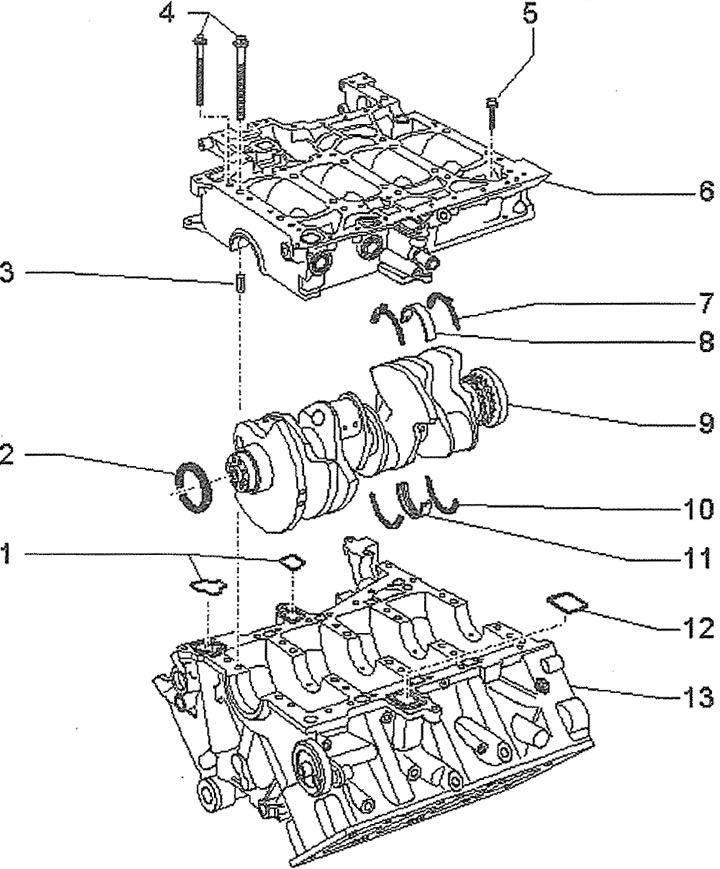
1.0. Crankshaft:

1.0. Crankshaft:
1 - sealing gaskets
2 - crankshaft oil seal
3 - centering sleeve (3 pcs.)
4 - crankshaft bearing housing mounting bolts
5 - crankshaft bearing housing mounting bolt
6 - crankshaft bearing housing
7 - lower thrust half ring
8 - lower main bearing shell
9 - crankshaft
10 - upper thrust half ring
11 - upper main bearing shell
12 - sealing gasket
13 - cylinder block
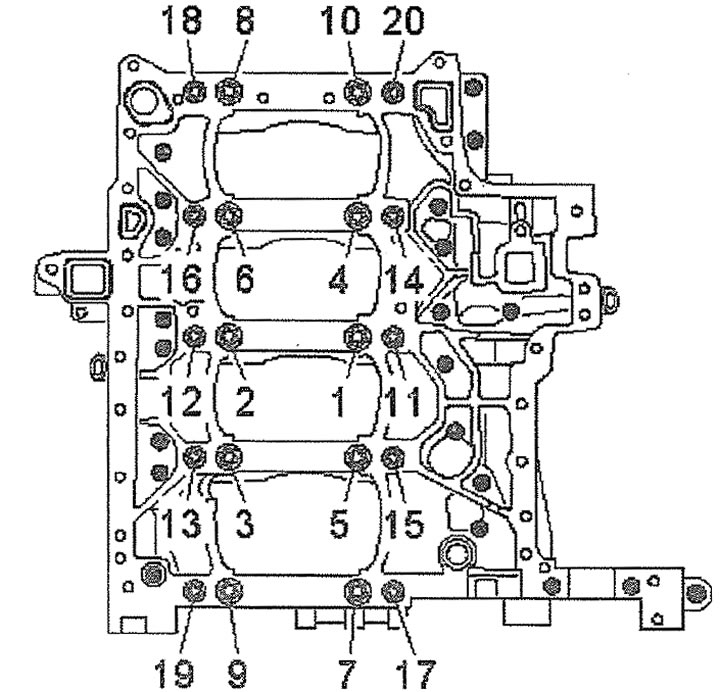

1.0a. Tightening the crankshaft bearing housing mounting bolts:

1.0a. Tightening the crankshaft bearing housing mounting bolts:
1st pass - tighten bolts 1-10 to 30 Nm;
2nd pass - tighten bolts 11-20 to 20 Nm;
3rd pass - tighten bolts 1-10 to 50 Nm;
4th pass - tighten bolts 11-20 to 30 Nm;
5th pass - tighten bolts 1-10 by 90°;
6th pass - tighten bolts 11-20 by 90°.
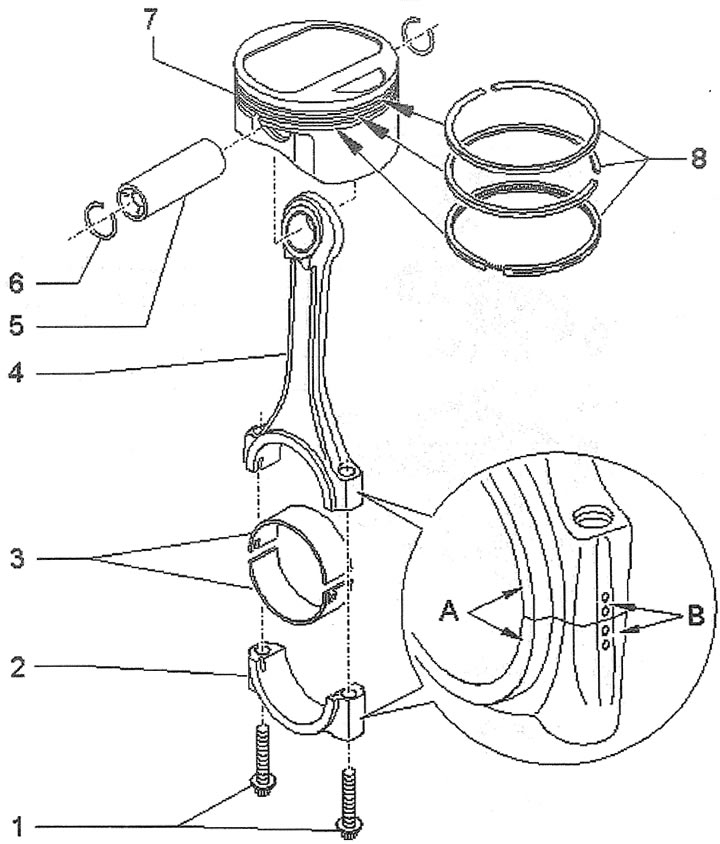


1.0b. Engine piston and connecting rod:

1.0b. Engine piston and connecting rod:
1 - connecting rod cap mounting bolts. Tightening torque: 1st pass - 30 Nm; 2nd pass - turn 90°
2 - connecting rod cap. The caps must not be interchanged. When removing, mark B to indicate that the cap belongs to the cylinder. When installing, observe mounting position A
3 - upper and lower connecting rod bearing shells
4 - connecting rod
5 - piston pin. When assembling the piston and connecting rod, it is recommended to heat the piston to 60'C
6 - piston pin retaining ring
7 - piston
8 - piston rings. The ring locks are located at an angle of 120° relative to each other. When installing, the inscription "TOP" should be facing the piston bottom


[The original text of the material can be found on the website audimanual.ru]
The article was checked by auto expert Alexey Ivanov
This article is available at russian, bulgarian, belarusian, ukrainian, serbian, croatian, romanian, polish, slovak, hungarian

Share information:
Previous articles
Audi A6 C5 Allroad: V8 petrol engines
Next articles

Gas distribution mechanism drive chain-design description
Timing chain — removal and installation
Camshaft Drive Chains — Removal and Installation
Auxiliary Unit Drive — Design Description


Similar articles on other Audi car models:
Petrol engines Audi 80 B4 (1991-1996)
Introduction to the Audi 100 C4 (petrol engines) manual Audi 100 C4 (1990-1994, petrol)
Setting the piston of the first cylinder to TDC (petrol) Audi A3 Type 8L (1996-2003)
Control of the cooling fan of petrol engines (BGB, BPG, BWE,… Audi A4 B7 (2004-2008)
Water pump for petrol engines 3.7 and 4.2 l Audi A8 D2 (1994-2002)
Removal the starter, cars with 2.0 l T01 engines and manual… Audi Q5 Type 8R (2008-2017)
Poly V-belt — checking condition (petrol engines) Audi A2 (1999-2005)
Link to this page in different formats


Visitor comments

No comments yet


How much will 11 + 22 =


A6(C5 AR, 1999-2005) 
  • General information
  • User manual
  • Maintenance
  • Troubleshooting
  • Power unit
  • V6 petrol engines
  • V8 petrol engines
  • Diesel engines
  • Cooling and heating system
  • Injection system (gasoline)
  • Fuel system (diesel)
  • Supply system
  • Exhaust system
  • Ignition system
  • Transmission
  • Clutch
  • Mechanical gearbox
  • Automatic gearbox
  • Chassis
  • Brake system
  • Car suspension
  • Steering
  • Body
  • Body elements
  • Doors, locks and windows
  • Electrical equipment
  • Equipment and devices
  • Power devices
  • Electrical circuits
  • Schemes (petrol engine 2.7 l)
  • Schemes (petrol engine 4.2 l)
  • Schemes (diesel engine 2.5 l)
 
A6(C5, 1997-2004) 
  • General information
  • User manual
  • Maintenance
  • Power unit
  • Engine repair
  • Cooling system
  • Fuel system
  • Engine management
  • Fuel system (diesel)
  • Exhaust system
  • Transmission
  • Clutch
  • Car gearbox
  • Chassis
  • Front suspension
  • Rear suspension
  • Steering
  • Wheels and tires
  • Brake system
  • Body
  • Exterior
  • Interior
  • Electrical equipment
  • Air conditioner
  • Equipment and devices
  • Electrical circuits
 
A6(C4, 1994-1997) 
  • General information
  • User manual
  • Maintenance (gasoline)
  • Maintenance (Diesel)
  • Gasoline engines
  • 4 cylinder engines
  • 5 cylinder engines
  • 6 cylinder engines
  • Diesel engines
  • 4 cylinder engines
  • 5 cylinder engines
  • Engine repair
  • Removal and reassembly
  • Cooling system
  • Single point injection system
  • Multipoint injection system
  • MPI/MPFI injection system
  • Fuel system (diesel)
  • Exhaust system
  • Ignition system
  • Transmission
  • Clutch
  • Manual transmission
  • Automatic transmission
  • Drive shafts
  • Chassis
  • Brake system
  • Front suspension
  • Rear suspension
  • Steering
  • Body
  • Exterior (external elements)
  • Interior (internal elements)
  • Electrical equipment
  • Power devices
  • Lighting and appliances
  • Electrical circuits
 
AudiManual.ru © 2017-2026 · Mobile version · Feedback · Sitemap: EN BG BY UA RS HR RO PL SK HU · Site search · News and articles
80 B2 · 80 B3 petrol · 80 B3 · 80 B4 · 100 C3 diesel · 100 C3 petrol · 100 C3 · 100 C4 petrol · 100 C4 · A3 Type 8L · A4 B5 petrol · A4 B5 · A4 B6 petrol · A4 B6 · A4 B7 · A4 B8 · A6 C4 · A6 C5 · A6 C5 Allroad · A8 D2 · Q5 Type 8R · Q7 Typ 4L · Audi A2 ·
This site uses cookies 🍪. Click the button to accept this fact.