
Repair Chevrolet Repair Toyota Repair Honda Repair AvtoVAZ Repair Mercedes-Benz Repair BMW Repair Opel
Home  |  Contacts  |  Sitemap  |    
English Русский
Български
Беларускі
Український
Српски
Hrvatski
Română
Polski
Slovenský
Magyar
AudiManual.ru


  • AUDI 80
  • AUDI 100
  • AUDI A3
  • AUDI A4
  • AUDI A6
  • AUDI A8
  • AUDI Q
  • OTHER
  • ARTICLES
B8 (2007-2015) B7 (2004-2008) B6 (2000-2006) B6 (2000-2006, petrol) B5 (1994-2001) B5 (1994-2001, petrol)

Starting the engine from an auxiliary power source (Audi A4 B7)

  • Home
  • Audi A4
  • B7 (2004-2008)
  • General information
  • Introduction to manual
  • Starting the engine from an auxiliary power source
            0
Using an auxiliary power source will help start the engine in an emergency, but then you should find out and fix the cause of the battery discharge. The most common causes include:
  • making repeated unsuccessful attempts to start the engine, or leaving the lights on for a long time with the engine not running;
  • malfunction of the charging system (the alternator drive belt is loose or broken, the electrical wiring is damaged, or the alternator itself is faulty);
  • malfunction of the battery itself (the electrolyte level has dropped or the battery's service life has expired).

When performing engine jump starting, some special precautions should be taken:
  • you should not try to start the engine from a frozen battery - warm it up first;
  • starting the engine from an auxiliary power source should only be done when the power unit and catalytic converter are cold;
  • do not start the engine using a battery booster charger;
  • before connecting the auxiliary battery, make sure the ignition is off;
  • use only cables with sufficient cross-section and insulated terminals;
  • make sure that all electricity consumers (lighting and heating devices, windshield wipers, etc.) were turned off;
  • wear protective gloves and glasses;
  • make sure that the auxiliary battery matches the battery installed in the faulty vehicle in terms of its output voltage;
  • if a battery installed in another vehicle is used as an auxiliary power source, ensure that the vehicles do not touch each other;
  • the donor car's engine must be running at idle speed;
  • make sure the transmission is in neutral;
  • remove the ventilation caps from the discharged battery and cover the holes with a rag.

Connect the end of one wire (usually red in color) to the positive terminal of the discharged battery. Connect the other end of this wire to the positive terminal of the auxiliary battery (see illustration 12). One end of the second wire (usually black in color) connect to the negative terminal of the auxiliary battery or to a ground point (for example, to the cylinder block) donor car.
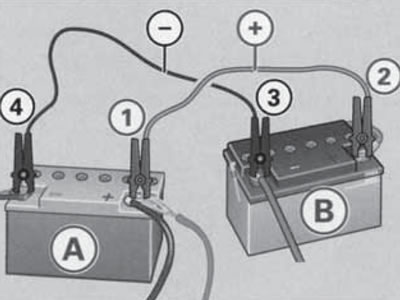


12. Wiring diagram of the auxiliary battery. A - Discharged battery;B - Auxiliary battery.

12. Wiring diagram of the auxiliary battery. A - Discharged battery;B - Auxiliary battery.


Connect the other end of the black wire to a reliable ground point on the vehicle with the dead battery (not to the battery itself!). A special nut in the engine compartment should be used as a mass point.

Make sure that the connecting wires do not come into contact with moving components in the engine compartments of both vehicles (fan impeller, drive belts, etc.). Start the donor car's engine and run it at high speed for a few minutes. Follow the normal procedure for starting a car with a dead battery, then run it at high speed for a few minutes.

Disconnect the wires in the reverse order. Do not forget to install the removed ventilation caps on the battery.
The article was checked by auto expert Timur Bazhenov
This article is available at russian, bulgarian, belarusian, ukrainian, serbian, croatian, romanian, polish, slovak, hungarian

Share information:
Previous articles
Audi A4 B7: Introduction to manual
Next articles

Jacking/hanging and emergency transportation of a vehicle
Vehicle Identification Numbers
Audi A4 Cars — Abstract
Troubleshooting — General Information
Specifications and technical characteristics
Abbreviations and acronyms used in this manual
Abbreviations and acronyms used in the manual


Similar articles on other Audi car models:
Starting the engine Audi 80 B3 (1986-1991, petrol)
Starting the engine (carburetor models) Audi 100 C3 (1982-1990, diesel)
Starting the engine from an auxiliary power source Audi A3 Type 8L (1996-2003)
Starting the engine using an auxiliary battery Audi A6 C5 Allroad (1999-2005)
Starting the engine Audi A8 D2 (1994-2002)
Starting the engine from an auxiliary power source Audi Q7 Typ 4L (2005-2015, diesel)
Towing to start the engine Audi A2 (1999-2005)
Link to this page in different formats


Visitor comments

No comments yet


How much will 48 + 24 =


A4(B8, 2007-2015) 
  • General information
  • Operating instructions
  • Power unit
  • Petrol engines 1.8 l
  • Petrol engines 1.8/2.0 l
  • Petrol engines 3.0 l
  • Petrol engines 3.2 l
  • Fuel system (petrol)
  • Diesel engines 2.0 l (CA*)
  • Diesel engines 2.0 l (CJCB)
  • Diesel engines 2.7/3.0 l
  • Diesel engines 3.0 l
  • Fuel system (diesel)
  • Transmission
  • Manual gearbox 0B1
  • Manual gearbox 0B2
  • Manual gearbox 0B3
  • Manual gearbox 0B4
  • Automatic transmission 0B5
  • Automatic transmission 0B6
  • Automatic transmission 0AW
  • All-wheel drive system
  • Chassis
  • Front suspension
  • Rear suspension
  • Brake system
  • Steering system
  • Body
  • Exterior
  • Interior
  • Seats
  • Doors, locks and windows
  • Security system
  • Heating and air conditioning
  • Electrical equipment
  • Audio system
  • Power devices
  • Equipment and devices
  • Lighting and lamps
  • Electrical circuits
 
A4(B7, 2004-2008) 
  • General information
  • Introduction to manual
  • Troubleshooting
  • Operating instructions
  • Maintenance
  • Power unit
  • Petrol engines 2.0 (ALT)
  • Petrol engines 2.0 (TFSI)
  • Petrol engines 1.8 (MPI)
  • Diesel engines
  • Cooling system
  • Air conditioner
  • Fuel and exhaust system
  • Ignition system
  • Starting and charging
  • Transmission
  • Clutch
  • Manual gearbox
  • Automatic gearbox
  • Drive shafts
  • Chassis
  • Brake system
  • Front suspension
  • Rear suspension
  • Steering
  • Body
  • Exterior
  • Interior
  • Electrical equipment
  • Equipment and devices
  • Lighting and signaling
  • Windscreen wipers and washers
  • Electrical diagrams
  • Electrical diagrams (since 2007)
 
A4(B6, 2000-2006) 
  • General information
  • Vehicle Description
  • User manual
  • Maintenance
  • Power unit
  • Gasoline engine
  • Diesel engine
  • Lubrication system
  • Cooling system
  • Supply system
  • Injection system
  • Exhaust system
  • Ignition and control
  • Transmission
  • Gear box
  • Clutch and drive shafts
  • Chassis
  • Brake system
  • Car suspension
  • Steering
  • Body
  • Heating and ventilation
  • Exterior (external elements)
  • Interior (internal elements)
  • Electrical equipment
  • Power devices
  • Lighting and appliances
  • Electrical circuits
 
A4(B6, 2000-2006, petrol) 
  • General information
  • Introduction to the guide
  • Car care
  • Power unit
  • Engine repair
  • Lubrication system
  • Cooling system
  • Injection and control system
  • Ignition system
  • Power and exhaust system
  • Transmission
  • Clutch and drive shafts
  • Car gearbox
  • Chassis
  • Suspension and wheels
  • Steering
  • Brake system
  • Body
  • Interior
  • Exterior
  • Electrical equipment
  • Equipment and devices
  • Lighting and signaling
  • Power devices
  • Electrical circuits
 
A4(B5, 1994-2001) 
  • General information
  • Introduction to the guide
  • Car care
  • Maintenance (gasoline)
  • Maintenance (diesel)
  • Power unit
  • Gasoline engines
  • Diesel engines
  • Engine overhaul
  • Cooling system
  • Fuel injection (gasoline)
  • Fuel system (diesel)
  • Exhaust system
  • Ignition system
  • Transmission
  • Clutch
  • Mechanical gearbox
  • Automatic gearbox
  • Drive shafts
  • Chassis
  • Brake system
  • Car suspension
  • Steering
  • Body
  • Exterior
  • Interior
  • Doors, locks and windows
  • Heating and ventilation
  • Electrical equipment
  • Power devices
  • Equipment and devices
  • Electrical circuits
 
A4(B5, 1994-2001, petrol) 
  • General information
  • Vehicle description
  • Maintenance
  • Power unit
  • Engine repair
  • Turbocharging
  • Exhaust system
  • Cooling system
  • Ignition system
  • Fuel system
  • Motronic injection system
  • MPI and MPFI injection system
  • Transmission
  • Clutch
  • Gearbox and shafts
  • Chassis
  • Steering
  • Car suspension
  • Brake system
  • Wheels and tires
  • Body
  • Heating and ventilation
  • Body parts
  • Electrical equipment
  • Fuses and relays
  • Power devices
  • Lighting and lamps
  • Tools and devices
  • Electrical circuits
 
AudiManual.ru © 2017-2026 · Mobile version · Feedback · Sitemap: EN BG BY UA RS HR RO PL SK HU · Site search · News and articles
80 B2 · 80 B3 petrol · 80 B3 · 80 B4 · 100 C3 diesel · 100 C3 petrol · 100 C3 · 100 C4 petrol · 100 C4 · A3 Type 8L · A4 B5 petrol · A4 B5 · A4 B6 petrol · A4 B6 · A4 B7 · A4 B8 · A6 C4 · A6 C5 · A6 C5 Allroad · A8 D2 · Q5 Type 8R · Q7 Typ 4L · Audi A2 ·
This site uses cookies 🍪. Click the button to accept this fact.