



Table of contents: The Future: Light by Measure ↓ Headlights ↓ Reflection from segmented surfaces… ↓ Fog lights with ellipsoid reflector ↓
Vehicle lighting is the main element of active safety when driving at night. In addition, due to the ever-increasing density of traffic, driving with the lights on during the day is becoming increasingly important. In many Scandinavian and Eastern European countries, this has become a mandatory rule, and this topic is constantly being discussed in Russia. According to studies, driving with the lights on would reduce the number of fatal accidents by 25 percent.
Hella has recently developed a compact and economical headlight for use as additional equipment. Compared to the usual consumption of 100 watts with normal low beam, these headlights consume only 12 watts. The headlights are mounted as additional headlights at the front of the vehicle. When the ignition is switched on, only these headlights are automatically switched on.
The Future: Light by Measure
As important as lighting systems are, their character has remained the same. Restricted to pure lighting functions, they essentially only use the information from the on-board network to adjust the headlight range. In the future, lighting technology will be integrated into the vehicle's information and communication system. New network solutions are needed to make new systems a reality. Adjustable headlights and taillights are being developed that operate according to special computer programs. On-board networks are also being created to meet future lighting system requirements such as headlights that can be adjusted in advance, intelligent rear lights and adaptive interior lighting.
Advanced Frontlighting System Project (advanced front lighting system) provides that the light will be distributed depending on changes in external conditions such as the type and configuration of the road, weather conditions and driving style. Thanks to the time-varying light distribution, the best visibility conditions are ensured, without blinding oncoming drivers. Wherever the driver turns, the light is already concentrated in the desired direction. This system also allows for different transition processes from bright to shaded lighting and back; a parking light with a wide beam angle, a cornering light for illuminating country roads and a highway light with a longer range of visibility become a reality.
When approaching an intersection, a wide angle of illumination is provided so that cyclists and pedestrians can be seen in advance. When driving on a turn, conventional systems illuminate mainly the edges of the road. In the future, it is planned to use a turning low beam, which will allow illuminating the side area depending on the situation. When controlling the turning low beam, the system processes signals from sensors about the speed of movement and the angle of rotation of the steered wheels. The lighting can be changed even before the turn begins, when the turn signals are activated.
Rear lighting as a means of communication between the driver and the drivers of vehicles moving behind must be unambiguous and understandable, at the same time it must not disturb anyone. The light of the rear fog lights, which is often used incorrectly, can be controlled automatically by electronics. It turns out to be an adaptive rear light, the light intensity of the rear light is adjusted depending on the conditions; in fog or rain the lantern shines brightly, but in clear visibility at night it shines weaker.
In future, signals from the anti-lock braking system and vehicle stability control will also be processed to automatically trigger warning lights in dangerous situations. Light levels can be measured by a sensor, and the rear lights, brake lights and turn signals can be adjusted accordingly. At night, a level reduced by one third compared to the normal level will be used, as the eyes get used to the darkness. During the day, due to bright sunlight, a luminous intensity three times greater than that used today is intended to be used.
Another development direction is the use of pollution and visibility sensors integrated into the lights. These sensors will detect fog, splashes, rain, snow and pollution on the diffuser. In addition, the distance and speed of the vehicles behind will be analyzed, in combination with other data, this will allow the rear lighting to be adjusted. Matrix LED rear lights can be of different shapes and provide different light intensity. It is even possible to design lights of different designs for different equipment options.
Interior lighting ensures optimal orientation in the vehicle and thus increases vehicle safety. It should also be part of the overall interior design and create a feeling of well-being in the dark. In addition to LEDs of all possible colours, non-glaring electroluminescent films, which are already used in aircraft cabins, can be used as new light sources. These films are particularly suitable for marking contours, as they form evenly illuminated stripes. Interior lighting can be adjusted to suit the specific situation.
Headlights
Even without taking into account future innovations, today's lighting installations are perfect devices, first of all, the main headlights. The headlights contain incandescent lamps of different designs. In addition, sufficient illumination is provided by fog lights, tail lights, rear fog lights, license plate lights, and lampshades.
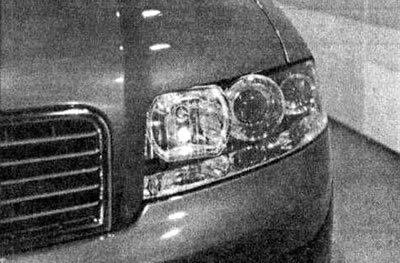
Audi A4 headlight: several reflectors are located behind the transparent glass
A modern headlight should, if possible, not blind oncoming drivers, illuminate the road well even at high speeds and give the car an individual look. The most important parts of a headlight include a light source, a reflector and a diffuser, and modern headlights do without a diffuser. The turn signal is an integral part of the Audi A4 headlight, it does not change separately.
Audi headlights use halogen and gas-discharge lamps as light sources. Previously, only a parabolic reflector was used, now stepped reflectors with computer-calculated surfaces are used, as well as systems with ellipsoid headlights. Reflectors made of tin or plastic are coated with a thin layer of aluminum, as well as a special layer.
Reflection from segmented surfaces or diffuser?
The legislator prescribes a special light distribution for low beams with an asymmetrical border between the light and dark areas, whereby the maximum light is concentrated on the right side of the road. To meet this requirement, a diffuser is usually used, which is equipped with cylindrical lenses, prisms and parallel surfaces on the inside. The parallel surfaces distribute the light reflected from the reflector in the appropriate direction.
However, in Audi the glass in front of the headlight is completely transparent, i.e. it serves only for protection and is not a diffuser in the true sense of the word. The glass is made of plastic, since plastic is ten times more resistant to stone impacts than glass. A hard layer of varnish serves to protect against scratches. A headlight of this design is approximately half a kilogram lighter than a conventional headlight.
The elimination of the diffuser became possible thanks to headlights with several reflective surfaces. These headlights produce a precisely defined light cone without lenses or prisms. The optimal shape of the reflector is calculated by a computer using special mathematical formulas. Certain segments of the reflector correspond to precisely defined sections of the road. Due to the fact that this made it possible to achieve shorter focal lengths, three separate reflectors for low beam, high beam and fog light are now placed in the space where a conventional parabolic reflector was previously mounted. At the same time, the efficiency of the headlight increases.
Fog lights with ellipsoid reflector
A reflector in the form of a three-axis ellipse allows high power to be achieved with small headlight dimensions. Such headlights function like slide projectors: the diaphragm, which acts as a slide, limits the distribution of light and creates a border between the light and dark areas. This border is particularly sharp, so this technique is very suitable for fog lights. The lens functions as an objective, it projects the distribution of light onto the road. Polyellipsoid systems have recently been developed.