
Repair Chevrolet Repair Toyota Repair Honda Repair AvtoVAZ Repair Mercedes-Benz Repair BMW Repair Opel
Home  |  Contacts  |  Sitemap  |    
English Русский
Български
Беларускі
Український
Српски
Hrvatski
Română
Polski
Slovenský
Magyar
AudiManual.ru


  • AUDI 80
  • AUDI 100
  • AUDI A3
  • AUDI A4
  • AUDI A6
  • AUDI A8
  • AUDI Q
  • OTHER
  • ARTICLES
B8 (2007-2015) B7 (2004-2008) B6 (2000-2006) B6 (2000-2006, petrol) B5 (1994-2001) B5 (1994-2001, petrol)

General information about the car body (Audi A4 B6)

  • Home
  • Audi A4
  • B6 (2000-2006, petrol)
  • Body
  • Exterior
  • General information about the car body
            0
Table of contents: Dimensions of gaps at joints ↓ Passive safety ↓ Glass and windows ↓ Bodywork ↓
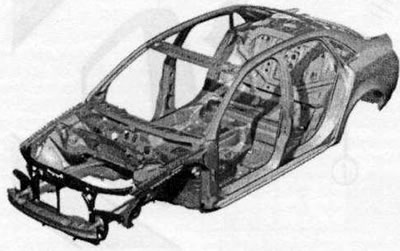
The A4 body has clear contours, it combines discreet sportiness and consistently applied modern architecture. Audi speaks of "lines that embody aerodynamic perfection and typical Audi dynamics". The modernity of the design is emphasized by the radiator grille and the high-positioned, sculpted belt line. The drag coefficient is only 0.28. The A4 body is characterized by significant torsional rigidity, which would do credit to a car of a higher class. Advanced lightweight construction technology has even been applied to individual parts.

Load-bearing body: The lower and side body parts, roof and rear fenders are welded together

Load-bearing body: The lower and side body parts, roof and rear fenders are welded together


A fully galvanized body has become something self-evident. The absence of through corrosion is guaranteed for 12 years. Unfortunately, rust is not the only problem that can cause damage to the body. Over time, due to constant loads, unpleasant phenomena such as knocking and sharp sounds occur.

True, you will definitely not hear these sounds for many years. Very high torsional rigidity significantly prevents the occurrence of noise due to aging of the body. Body parts that previously consisted of several parts are now manufactured as a single element. Individual structural elements are assembled using modern laser welding. The body frame is manufactured so precisely that the gaps are reduced to a minimum. This reduces both the unpleasant noise that occurs due to air flowing around the car and fuel consumption.


The body is load-bearing. The lower and side parts of the body, the roof and the rear wings are welded together. Repair of serious damage to the body, as well as replacement of the glued windshield and rear window, is best left to a specialized workshop.

The hood, doors and front wings are screwed on, they can be replaced with more or less expense. Of course, given that the parts must be installed very precisely, and the gaps must be even and of a certain size, this work requires experience and a fine sense. When installing body parts, it is necessary to observe the specified dimensions, otherwise, for example, the door will knock, or too much noise will occur while driving.

Dimensions of gaps at joints


Despite its clever design, the A4 is, in principle, made in such a way that it is easy to repair. You will understand this as soon as you start to replace a damaged bumper, wing or tailgate.

However, during any bodywork, the specified gap sizes at the joints between individual body parts must be maintained. Otherwise, the newly installed part may start knocking, or excessive flow noise may occur while driving. The gap must be uniform along the entire length of the joint. The permissible deviation is 1 millimeter. The size of the gaps can be checked using a special tool 3371. The figures show the most important joints for the sedan.
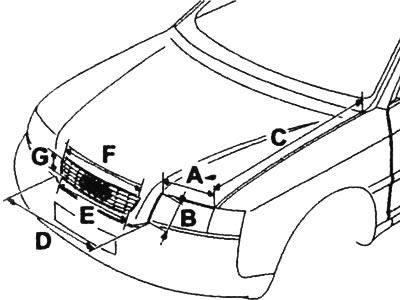
Dimensions of gaps at joints in the front part of the body: A - 5.5±0.5 mm; B = 5.5±0.5 mm; C =…

Dimensions of gaps at joints in the front part of the body: A - 5.5±0.5 mm; B = 5.5±0.5 mm; C = 3.5±0.5 mm; D = 4.0±0.5 mm; E = 1.5±0.5 mm; F= 1.5±0.5 mm; G = 1.5±0.5 mm.
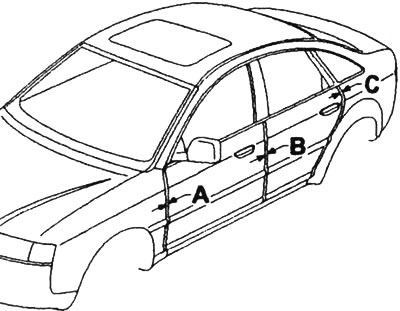


Dimensions of gaps at the joints between doors and the body: A = 4.5 ±0.5 mm; B = 4.5±0.5 mm; C =…

Dimensions of gaps at the joints between doors and the body: A = 4.5 ±0.5 mm; B = 4.5±0.5 mm; C = 3.5±0.5 mm
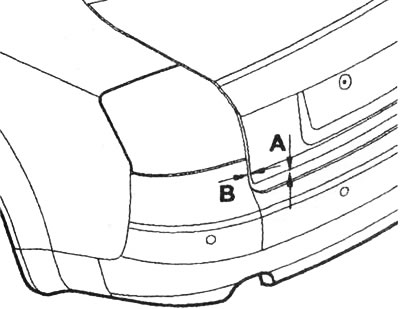

Dimensions of gaps at joints in the rear of the body: A = 4.0±0.5 mm; B = 2.0±0.5 mm.

Dimensions of gaps at joints in the rear of the body: A = 4.0±0.5 mm; B = 2.0±0.5 mm.


Passive safety


When creating the new A4 models, great attention was paid to ensuring safety. The level of safety for which Audi cars have always been famous was raised to a new level in the A4. The impact strength of the body was increased, and in a collision the passenger compartment is deformed less than before. A new rollover protection system was presented for the convertible at the 2001 International Automobile Exhibition.

Passive safety of passengers, both in the limousine and the station wagon, is provided by a load-bearing safe passenger compartment. This is supplemented by a rigid body structure and impact-softening pads installed on both sides.
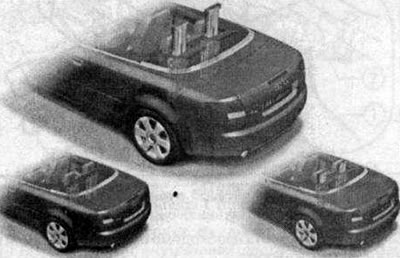


Occupant protection system in the event of a rollover in the new A4 Cabriolet

Occupant protection system in the event of a rollover in the new A4 Cabriolet


Glass and windows


The windshield and rear window do not provide much opportunity for independent repair. As a structural element, they are glued to the body. Without special tools, there is nothing to do here, that is, this is a typical case when you should contact a workshop. The same is recommended for dismantling door and window glass.

The doors themselves are not so easy to dismantle, and special difficulties arise when adjusting them. Therefore, we do not recommend that you dismantle these parts, and limit ourselves to describing the work with door handles and locks.

Bodywork


You can do most of the repairs described in this chapter yourself using a basic set of tools. Many parts are attached with star-head screws, so you will need to purchase an additional set of appropriate wrenches for them. Parts such as the hood and tailgate are quite bulky and difficult to fix when dismantling, so you should have an assistant. Another tip: it will be easier to install the hood and tailgate if you mark the position of the hinges during dismantling, for example, with a felt-tip pen.
The article was checked by auto expert Alexey Ivanov
This article is available at russian, bulgarian, belarusian, ukrainian, serbian, croatian, romanian, polish, slovak, hungarian

Share information:
Previous articles
Audi A4 B6: Exterior
Next articles

Safety rules for bodywork
Cleaning drain hoses
Centralized door locking system (installation diagram)
Removal and installation the radiator grille


Similar articles on other Audi car models:
Body. General information Audi 80 B3 (1986-1991)
General information Audi 100 C3 (1982-1990, diesel)
General information about the setup Audi A3 Type 8L (1996-2003)
Car body — general information Audi A6 C5 Allroad (1999-2005)
General information about the 2.8L petrol engine Audi A8 D2 (1994-2002)
Body specifications and general information Audi Q7 Typ 4L (2005-2015, diesel)
General information about the fuel injection system Audi A2 (1999-2005)
Link to this page in different formats


Visitor comments

No comments yet


How much will 30 + 38 =


A4(B8, 2007-2015) 
  • General information
  • Operating instructions
  • Power unit
  • Petrol engines 1.8 l
  • Petrol engines 1.8/2.0 l
  • Petrol engines 3.0 l
  • Petrol engines 3.2 l
  • Fuel system (petrol)
  • Diesel engines 2.0 l (CA*)
  • Diesel engines 2.0 l (CJCB)
  • Diesel engines 2.7/3.0 l
  • Diesel engines 3.0 l
  • Fuel system (diesel)
  • Transmission
  • Manual gearbox 0B1
  • Manual gearbox 0B2
  • Manual gearbox 0B3
  • Manual gearbox 0B4
  • Automatic transmission 0B5
  • Automatic transmission 0B6
  • Automatic transmission 0AW
  • All-wheel drive system
  • Chassis
  • Front suspension
  • Rear suspension
  • Brake system
  • Steering system
  • Body
  • Exterior
  • Interior
  • Seats
  • Doors, locks and windows
  • Security system
  • Heating and air conditioning
  • Electrical equipment
  • Audio system
  • Power devices
  • Equipment and devices
  • Lighting and lamps
  • Electrical circuits
 
A4(B7, 2004-2008) 
  • General information
  • Introduction to manual
  • Troubleshooting
  • Operating instructions
  • Maintenance
  • Power unit
  • Petrol engines 2.0 (ALT)
  • Petrol engines 2.0 (TFSI)
  • Petrol engines 1.8 (MPI)
  • Diesel engines
  • Cooling system
  • Air conditioner
  • Fuel and exhaust system
  • Ignition system
  • Starting and charging
  • Transmission
  • Clutch
  • Manual gearbox
  • Automatic gearbox
  • Drive shafts
  • Chassis
  • Brake system
  • Front suspension
  • Rear suspension
  • Steering
  • Body
  • Exterior
  • Interior
  • Electrical equipment
  • Equipment and devices
  • Lighting and signaling
  • Windscreen wipers and washers
  • Electrical diagrams
  • Electrical diagrams (since 2007)
 
A4(B6, 2000-2006) 
  • General information
  • Vehicle Description
  • User manual
  • Maintenance
  • Power unit
  • Gasoline engine
  • Diesel engine
  • Lubrication system
  • Cooling system
  • Supply system
  • Injection system
  • Exhaust system
  • Ignition and control
  • Transmission
  • Gear box
  • Clutch and drive shafts
  • Chassis
  • Brake system
  • Car suspension
  • Steering
  • Body
  • Heating and ventilation
  • Exterior (external elements)
  • Interior (internal elements)
  • Electrical equipment
  • Power devices
  • Lighting and appliances
  • Electrical circuits
 
A4(B6, 2000-2006, petrol) 
  • General information
  • Introduction to the guide
  • Car care
  • Power unit
  • Engine repair
  • Lubrication system
  • Cooling system
  • Injection and control system
  • Ignition system
  • Power and exhaust system
  • Transmission
  • Clutch and drive shafts
  • Car gearbox
  • Chassis
  • Suspension and wheels
  • Steering
  • Brake system
  • Body
  • Interior
  • Exterior
  • Electrical equipment
  • Equipment and devices
  • Lighting and signaling
  • Power devices
  • Electrical circuits
 
A4(B5, 1994-2001) 
  • General information
  • Introduction to the guide
  • Car care
  • Maintenance (gasoline)
  • Maintenance (diesel)
  • Power unit
  • Gasoline engines
  • Diesel engines
  • Engine overhaul
  • Cooling system
  • Fuel injection (gasoline)
  • Fuel system (diesel)
  • Exhaust system
  • Ignition system
  • Transmission
  • Clutch
  • Mechanical gearbox
  • Automatic gearbox
  • Drive shafts
  • Chassis
  • Brake system
  • Car suspension
  • Steering
  • Body
  • Exterior
  • Interior
  • Doors, locks and windows
  • Heating and ventilation
  • Electrical equipment
  • Power devices
  • Equipment and devices
  • Electrical circuits
 
A4(B5, 1994-2001, petrol) 
  • General information
  • Vehicle description
  • Maintenance
  • Power unit
  • Engine repair
  • Turbocharging
  • Exhaust system
  • Cooling system
  • Ignition system
  • Fuel system
  • Motronic injection system
  • MPI and MPFI injection system
  • Transmission
  • Clutch
  • Gearbox and shafts
  • Chassis
  • Steering
  • Car suspension
  • Brake system
  • Wheels and tires
  • Body
  • Heating and ventilation
  • Body parts
  • Electrical equipment
  • Fuses and relays
  • Power devices
  • Lighting and lamps
  • Tools and devices
  • Electrical circuits
 
AudiManual.ru © 2017-2026 · Mobile version · Feedback · Sitemap: EN BG BY UA RS HR RO PL SK HU · Site search · News and articles
80 B2 · 80 B3 petrol · 80 B3 · 80 B4 · 100 C3 diesel · 100 C3 petrol · 100 C3 · 100 C4 petrol · 100 C4 · A3 Type 8L · A4 B5 petrol · A4 B5 · A4 B6 petrol · A4 B6 · A4 B7 · A4 B8 · A6 C4 · A6 C5 · A6 C5 Allroad · A8 D2 · Q5 Type 8R · Q7 Typ 4L · Audi A2 ·
This site uses cookies 🍪. Click the button to accept this fact.