
Repair Chevrolet Repair Toyota Repair Honda Repair AvtoVAZ Repair Mercedes-Benz Repair BMW Repair Opel
Home  |  Contacts  |  Sitemap  |    
English Русский
Български
Беларускі
Український
Српски
Hrvatski
Română
Polski
Slovenský
Magyar
AudiManual.ru


  • AUDI 80
  • AUDI 100
  • AUDI A3
  • AUDI A4
  • AUDI A6
  • AUDI A8
  • AUDI Q
  • OTHER
  • ARTICLES
B8 (2007-2015) B7 (2004-2008) B6 (2000-2006) B6 (2000-2006, petrol) B5 (1994-2001) B5 (1994-2001, petrol)

Timing marks — general information and use (Audi A4 B5)

  • Home
  • Audi A4
  • B5 (1994-2001)
  • Power unit
  • Gasoline engines
  • Timing marks — general information and use
            0
Table of contents: General information ↓ Setting piston N4 to TDC ↓

General information


1. Camshaft, crankshaft and sprockets (except AHL engine) auxiliary shaft are driven by a toothed belt and rotate in phase. If the timing belt is removed during repairs, the shafts will be able to rotate independently and their rotation in phase will be disrupted.

2. The design of the engines discussed in this chapter is such that when the timing belt is removed, the pistons rest against the valves when the crankshaft rotates. Therefore, it is important to maintain the relative positions of the crankshaft, camshaft and (if provided) auxiliary shaft with the timing belt removed. This is achieved by setting the engine in a certain position (called TDC - top dead center) before removing the timing belt and preventing the shafts from turning. For the same purpose, when repairing the engine, the engine must be set to TDC, restoring the correct phasing of the shafts.

Note: On AHL engines, the coolant pump is also driven by the timing belt, but the pump phasing is not important. On ADP, APT, APW. AFY, AEB and AJL engines, the auxiliary shaft only drives the oil pump, so its phasing is also not important.


3. TDC - the highest point reached by the piston of the corresponding cylinder (in a four-stroke engine, twice per stroke; once on the compression stroke and once on the exhaust stroke). Usually (unless otherwise stated) this means the TDC of the first cylinder in the compression stroke. The cylinders are numbered from 1 to 4, starting from the timing belt.


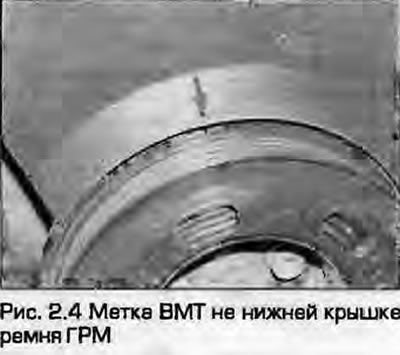
4. The crankshaft pulley has a mark which, when combined with the mark on the timing belt cover, indicates that piston No.1 (and, accordingly, piston No.4) is at TDC (Fig. 2.4).
4. The crankshaft pulley has a mark which, when combined with the mark on the timing belt cover,…


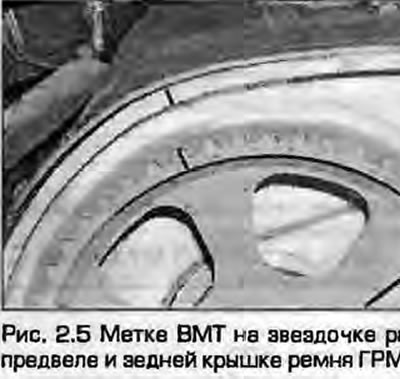
5. Camshaft sprocket (exhaust camshaft on DOHC engines) also has a TDC mark (Fig. 2.5). When it is aligned with the mark on the small upper timing belt cover or valve cover, the piston of cylinder No.1 is also set at TDC of the compression stroke.
5. Camshaft sprocket (exhaust camshaft on DOHC engines) also has a TDC mark (Fig. 2.5). When it is…


6. In addition, the flywheel/faceplate also has marks that can be seen if the protective cover is removed from the clutch/gearbox bell. However, these marks are useless if the gearbox is removed - the corresponding mark is on the bell.

Setting piston N4 to TDC


7. Before starting work, turn off the ignition.


8. If necessary, remove the top engine cover.

9. On the ADP engine, remember the connection of the high-voltage wire of the first cylinder to the distributor cap, remove the cap and mark the position of the electrode of the first cylinder on the distributor body. This will help to determine the installation of the piston of the first cylinder at TDC by the runner.

10. Remove the spark plugs as described in Chapter 1A.

11. Using a wrench, turn the crankshaft clockwise on the crankshaft pulley bolt. To determine the compression, plug the spark plug hole of the first cylinder with a rubber plug (the pressure will push it out). On engines with a distributor, the runner will approach the mark applied in accordance with point 9.

12. Continue to rotate the crankshaft until the TDC mark on the crankshaft pulley or flywheel/faceplate aligns with the corresponding mark on the valve cover or bellhousing. For added assurance, remove the upper timing belt cover to view the marks on the camshaft sprocket.

Read the original source on the website: audimanual
The article was checked by auto expert Timur Bazhenov
This article is available at russian, bulgarian, belarusian, ukrainian, serbian, croatian, romanian, polish, slovak, hungarian

Share information:
Previous articles
Audi A4 B5: Gasoline engines
Next articles

Repair work on the engine without removing it from the car
General information about gasoline engines
Petrol Engine Specifications
Compression measurement and analysis of results
Timing Belt — Removal, Checking and Installation
Timing Belt Tensioner and Sprockets — Removal, Checking and…
Accessory Drive Belts — Removal and Installation


Similar articles on other Audi car models:
Design and technical characteristics. General information Audi 80 B2 (1979-1986)
Valve timing marks — general description and use Audi 100 C3 (1982-1990, diesel)
General information about the setup Audi A3 Type 8L (1996-2003)
General information Audi A6 C5 (1997-2004)
General information about the 2.8L petrol engine Audi A8 D2 (1994-2002)
General information — climate system Audi Q7 Typ 4L (2005-2015, diesel)
General information about the fuel injection system Audi A2 (1999-2005)
Link to this page in different formats


Visitor comments

No comments yet


How much will 10 + 35 =


A4(B8, 2007-2015) 
  • General information
  • Operating instructions
  • Power unit
  • Petrol engines 1.8 l
  • Petrol engines 1.8/2.0 l
  • Petrol engines 3.0 l
  • Petrol engines 3.2 l
  • Fuel system (petrol)
  • Diesel engines 2.0 l (CA*)
  • Diesel engines 2.0 l (CJCB)
  • Diesel engines 2.7/3.0 l
  • Diesel engines 3.0 l
  • Fuel system (diesel)
  • Transmission
  • Manual gearbox 0B1
  • Manual gearbox 0B2
  • Manual gearbox 0B3
  • Manual gearbox 0B4
  • Automatic transmission 0B5
  • Automatic transmission 0B6
  • Automatic transmission 0AW
  • All-wheel drive system
  • Chassis
  • Front suspension
  • Rear suspension
  • Brake system
  • Steering system
  • Body
  • Exterior
  • Interior
  • Seats
  • Doors, locks and windows
  • Security system
  • Heating and air conditioning
  • Electrical equipment
  • Audio system
  • Power devices
  • Equipment and devices
  • Lighting and lamps
  • Electrical circuits
 
A4(B7, 2004-2008) 
  • General information
  • Introduction to manual
  • Troubleshooting
  • Operating instructions
  • Maintenance
  • Power unit
  • Petrol engines 2.0 (ALT)
  • Petrol engines 2.0 (TFSI)
  • Petrol engines 1.8 (MPI)
  • Diesel engines
  • Cooling system
  • Air conditioner
  • Fuel and exhaust system
  • Ignition system
  • Starting and charging
  • Transmission
  • Clutch
  • Manual gearbox
  • Automatic gearbox
  • Drive shafts
  • Chassis
  • Brake system
  • Front suspension
  • Rear suspension
  • Steering
  • Body
  • Exterior
  • Interior
  • Electrical equipment
  • Equipment and devices
  • Lighting and signaling
  • Windscreen wipers and washers
  • Electrical diagrams
  • Electrical diagrams (since 2007)
 
A4(B6, 2000-2006) 
  • General information
  • Vehicle Description
  • User manual
  • Maintenance
  • Power unit
  • Gasoline engine
  • Diesel engine
  • Lubrication system
  • Cooling system
  • Supply system
  • Injection system
  • Exhaust system
  • Ignition and control
  • Transmission
  • Gear box
  • Clutch and drive shafts
  • Chassis
  • Brake system
  • Car suspension
  • Steering
  • Body
  • Heating and ventilation
  • Exterior (external elements)
  • Interior (internal elements)
  • Electrical equipment
  • Power devices
  • Lighting and appliances
  • Electrical circuits
 
A4(B6, 2000-2006, petrol) 
  • General information
  • Introduction to the guide
  • Car care
  • Power unit
  • Engine repair
  • Lubrication system
  • Cooling system
  • Injection and control system
  • Ignition system
  • Power and exhaust system
  • Transmission
  • Clutch and drive shafts
  • Car gearbox
  • Chassis
  • Suspension and wheels
  • Steering
  • Brake system
  • Body
  • Interior
  • Exterior
  • Electrical equipment
  • Equipment and devices
  • Lighting and signaling
  • Power devices
  • Electrical circuits
 
A4(B5, 1994-2001) 
  • General information
  • Introduction to the guide
  • Car care
  • Maintenance (gasoline)
  • Maintenance (diesel)
  • Power unit
  • Gasoline engines
  • Diesel engines
  • Engine overhaul
  • Cooling system
  • Fuel injection (gasoline)
  • Fuel system (diesel)
  • Exhaust system
  • Ignition system
  • Transmission
  • Clutch
  • Mechanical gearbox
  • Automatic gearbox
  • Drive shafts
  • Chassis
  • Brake system
  • Car suspension
  • Steering
  • Body
  • Exterior
  • Interior
  • Doors, locks and windows
  • Heating and ventilation
  • Electrical equipment
  • Power devices
  • Equipment and devices
  • Electrical circuits
 
A4(B5, 1994-2001, petrol) 
  • General information
  • Vehicle description
  • Maintenance
  • Power unit
  • Engine repair
  • Turbocharging
  • Exhaust system
  • Cooling system
  • Ignition system
  • Fuel system
  • Motronic injection system
  • MPI and MPFI injection system
  • Transmission
  • Clutch
  • Gearbox and shafts
  • Chassis
  • Steering
  • Car suspension
  • Brake system
  • Wheels and tires
  • Body
  • Heating and ventilation
  • Body parts
  • Electrical equipment
  • Fuses and relays
  • Power devices
  • Lighting and lamps
  • Tools and devices
  • Electrical circuits
 
AudiManual.ru © 2017-2026 · Mobile version · Feedback · Sitemap: EN BG BY UA RS HR RO PL SK HU · Site search · News and articles
80 B2 · 80 B3 petrol · 80 B3 · 80 B4 · 100 C3 diesel · 100 C3 petrol · 100 C3 · 100 C4 petrol · 100 C4 · A3 Type 8L · A4 B5 petrol · A4 B5 · A4 B6 petrol · A4 B6 · A4 B7 · A4 B8 · A6 C4 · A6 C5 · A6 C5 Allroad · A8 D2 · Q5 Type 8R · Q7 Typ 4L · Audi A2 ·
This site uses cookies 🍪. Click the button to accept this fact.