



Turbocharger
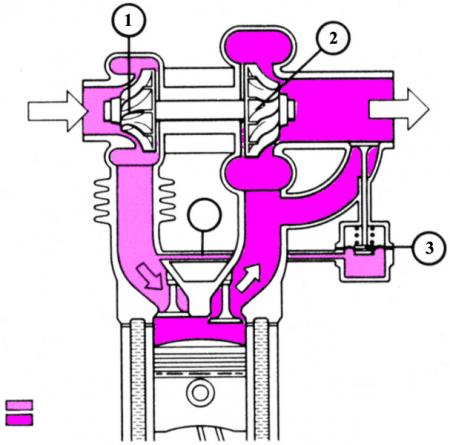
The turbocharger turbine (2) is driven by the pressure of the exhaust gases flowing out. The impeller (1) on the suction side is driven by a passing shaft at a high speed, due to which the suction air can be compressed. Significantly more air enters the combustion chambers, providing increased power or higher torque. As soon as the pressure in the suction chamber becomes higher than required, the vacuum box (3) for regulating the boost pressure opens a bypass channel and passes some of the exhaust gases past the turbocharger into the exhaust system. A solenoid valve for regulating the boost pressure is built into the control pipe (4) to take into account the influence of altitudes on the boost pressure.
- a) Air;
- b) Exhaust gas.
If your Audi Turbo is noticeably underpowered or not reaching top speed, the cause could be a faulty turbocharger.
Before troubleshooting, you need to make sure that the engine and injection system are in good working order.
|
Cause
|
Your help
|
|
A.
Exhaust and turbocharger system components are leaking
|
1. Air hose between the compressor and the intake manifold above the radiator
the charge air hose is leaking or disconnected
2. The section between the intake manifold and the cylinder head is not sealed 3. The flanges on the intake manifold are not tight 4. Leaky section between the exhaust manifold and the cylinder head or turbocharger |
| IN. Turbocharger faulty | 1. Check the boost pressure. If it is too high:
check the boost pressure limiting solenoid valve, check the vacuum box of the boost pressure control valve. If both in working condition, conduct a fault memory interrogation in the car 2. Boost pressure too low: check the boost pressure limiting vacuum box. If it is working properly, replace turbocharger |