



1. Place the vehicle on a horizontal surface.
2. Turn off the engine and wait at least five minutes for the oil to drain into the pan.
3. Be careful not to burn yourself on the hot engine.
4. Remove the dipstick and wipe it with a lint-free cloth or paper towel.
5. Insert the dipstick back into place and after a while pull it out again.
6. Check the oil level. If it is near the minimum mark on the dipstick, add oil.
Checking the coolant level
Do not rely on the coolant level indicator light on the instrument panel. We recommend regular visual checks of the coolant level in the expansion tank. The exact coolant level in the expansion tank can only be determined with the engine off. The expansion tank is made of transparent material, so you can determine the volume of liquid in it without removing the cap. The coolant level with a cold engine should be between both marks on the expansion tank. With a warm engine, the coolant level is higher.
A noticeable drop in the coolant level in the expansion tank is a sign of a malfunction or defect in the cooling system. The coolant circulates in a closed space and does not evaporate. A leak in the form of steam is possible only when the engine overheats.
The coolant in the system is replenished through the expansion tank.
Caution! When the engine is hot, before removing the cap from the filler neck of the tank, place a rag on it or use work gloves to avoid burns.
7. Unscrew the cap one turn and thus release the pressure in the system. Only then completely unscrew and remove the cap.
8. Fill with coolant until its level in the expansion tank reaches the "MAX" mark. Do not fill the liquid above this mark. When heated, the liquid will expand and excess liquid will be squeezed out of the tank.
A small amount of coolant can be poured into the expansion tank both when the engine is cold and when it is hot. However, if there is a significant loss of coolant, do not pour coolant into the expansion tank when the engine is still hot. This may cause deformation of the cylinder head or rupture of the cylinder block.
The density of the coolant is checked using a calibrated hydrometer. If the density of the coolant has decreased, it is enough to add antifreeze. First, 1-2 liters of coolant are drained from the system. ¼ liter of antifreeze is enough to increase the density of the liquid by 10°C.
Checking the brake fluid level
Low brake fluid level is indicated by a control lamp on the instrument panel. However, it is recommended to regularly check the brake fluid level in the expansion tank.
9. Open the hood and, if necessary, wipe the expansion tank with a rag.
The brake fluid level in the reservoir should be between the "Min" and "MAX" marks
Checking the fluid level in the power steering reservoir
A drop in the fluid level indicates a fluid leak from the system. Therefore, before adding fluid to the reservoir, inspect the power steering, identify and eliminate the leak.
10. Start the engine and let it idle.
11. Align the wheels.
The fluid level in the transparent expansion tank should be between both marks on the tank. These marks on the tank are not available on all AUDI models. In such cases, use the liquid level indicator rod (dipstick).
12. Remove the reservoir cap to which the dipstick is attached. Be careful, the cap is equipped with a spring.
13. Wipe the dipstick shaft with a clean cloth and insert the dipstick into place until the cap fits. Do not screw the cap on.
14. Remove the dipstick again and check the fluid level in the reservoir. It should be between both marks on the dipstick.
Checking the fluid level in the automatic transmission
The oil level in automatic transmissions depends on the oil temperature. If it is cold, the level is low. After a long trip, the oil level is usually high.
15. Drive about 10 km to warm up the oil.
16. Apply the parking brake and move the gearshift lever to position "P".
17. Start the engine and let it idle.
18. Remove the oil level indicator (dipstick), located, when viewed in the direction of travel, at the rear of the left side of the engine.
19. Wipe the dipstick with a clean, lint-free cloth.
20. Insert the dipstick back and remove it again. The oil level should be between both marks.
Topping up windshield washer fluid
The windshield washer reservoir is located on the left side of the engine compartment next to the coolant expansion tank. The rear door windshield washer reservoir on Avant cars is located on the right side of the trunk under the lid. The volume of the windshield washer reservoir of a car without headlight washers is about 4 liters, and with headlight washers - about 6.5 liters. First, the appropriate additive is poured into the liquid, and then water so that they mix well.
Checking the air pressure in the tires
The tire pressure is indicated on a sticker attached to the inside of the fuel filler cap.
Winter tyres typically have an air pressure 0.2 bar higher than the air pressure specified for summer tyres.
The best thing to do is to have your own pressure gauge so you can measure your tire pressure before each ride and then compare it to the sticker.
Checking the operation of lighting and brake lights
21. Turn on the ignition, and then turn on all the lights one by one: parking light, low beam headlights, fog lights (if installed), high beam headlights, turn signal (left, right and hazard warning lights) reversing lights and number plate lights, rear right and left direction indicators, (and also in emergency signaling mode), stop signal.
Checking the direction indicators and hazard warning lights
The hazard warning light system must operate continuously, so its switch is connected via a fuse directly to the positive terminal of the battery.
The direction indicators only function when the ignition is on; current is supplied to them from terminal 15.
22. Without turning on the ignition, press the hazard warning switch on the instrument panel.
All four direction indicator lamps, the indicator lamp in the hazard warning switch and both direction indicator lamps should flash at the same rate.
Checking the operation of the sound signal
23. Turn on the ignition.
24. Press the horn button. If there are no faults, an acoustic signal should sound (see illustration).
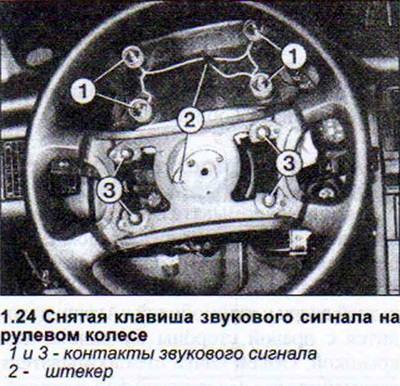
When the relay control circuit is closed (pressed sound signal key) the relay contacts close and power is supplied to the sound signals via a wire with black and yellow insulation.
The connection of sound signals to ground is carried out using a wire with brown insulation.
25. Remove the engine splash guard.
26. Disconnect the plug.
27. Remove the corresponding sound signal (see illustration).
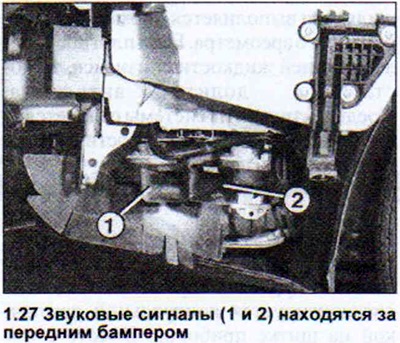
28. Connect the auxiliary wires to the horn contacts and connect the wires to the battery. If the horn does not work, it is faulty. The hoarse or muffled sound of the horn can be adjusted using the adjustment screw on the side of the horn.
29. Clean the adjusting screw from sealant.
30. Adjust the horn sound, then fix the position of the adjusting screw with the sealant used to protect the body from moisture.
The two-tone sound signal is tested in the same way.
Checking windshield wipers and washers
31. Turn on the ignition.
32. Make sure that the wiper blades move according to the selected glass cleaning speed.
33. Make sure that the interval mode of the brushes is functioning.
34. Make sure that the rear window wiper also works and that the washer supplies fluid to wash the windows.
Checking the operation of the brakes
35. Check the operation of the brakes at low speed (pedestrian speed). The brake marks left on the asphalt can be used to check the simultaneous operation and performance of the brakes.
36. Check the parking brake in the same way.
37. Repeat the brake test on a level surface and at 50 km/h. Before braking, release the steering wheel to ensure that the brakes work simultaneously and do not pull to one side.
38. Place the car on a slight slope and let it roll to check the ease of movement of the wheels.
39. Take a test drive. Afterwards, make sure the wheel rims are not overheating.
(The original publication in its entirety is posted on the website «AudiManual.ru»)