
Repair Chevrolet Repair Toyota Repair Honda Repair AvtoVAZ Repair Mercedes-Benz Repair BMW Repair Opel
Home  |  Contacts  |  Sitemap  |    
English Русский
Български
Беларускі
Український
Српски
Hrvatski
Română
Polski
Slovenský
Magyar
AudiManual.ru


  • AUDI 80
  • AUDI 100
  • AUDI A3
  • AUDI A4
  • AUDI A6
  • AUDI A8
  • AUDI Q
  • OTHER
  • ARTICLES
B4 (1991-1996) B3 (1986-1991) B3 (1986-1991, petrol) B2 (1979-1986)

Vehicle power supply system (Audi 80 B2)

  • Home
  • Audi 80
  • B2 (1979-1986)
  • General information
  • User manual
  • Vehicle power supply system
            0
Table of contents: Fuel filter ↓ Air filter ↓ Replacing the air filter element ↓ Fuel level indicator ↓ Carburetor ↓ Econometer ↓ Automatic engine stop-start device… ↓

Fuel filter


Replace the fuel filter every 30,000 km.

Air filter


Every 15,000 km, remove the air filter element and blow it out with compressed air at a pressure of no more than 0.5 kg/cm². When driving on very dusty roads, blow it out more often. Never use gasoline or oil to clean the filter element.

Replace the air filter element every 30,000 km.

Replacing the air filter element


To replace the filter element in carburetor engines:
  • remove the filter element from the air filter housing and thoroughly clean the surfaces of the filter housing;
  • install a new filter element and secure the air filter cover.

To replace the filter element in engines with a fuel injection system:
  • unfasten the spring clamps and separate the dispenser-distributor together with the air filter from the bracket, applying some force;
  • unfasten the four fasteners and slightly lift the dispenser-distributor together with the upper part of the air filter housing;
  • push the bottom of the air filter down so that the filter element can be removed;
  • when installing, place the filter element in the lower part of the air filter housing and secure the filter in the bracket using fasteners; two fastening pins should enter the rubber bushings in the side of the power unit compartment;
  • lower the dispenser-distributor together with the upper part of the air filter housing into its lower part and fasten the remaining spring clamps;
  • check the reliability of the air filter and the distributor-distributor.


Fuel level indicator


The fuel gauge is located in the center of the instrument cluster and turns on when the ignition is turned on. The divisions of the gauge scale correspond to 1/4, 1/2, etc. of the fuel in the tank. When the gauge pointer has reached the extreme lower position, there are about 2 liters of gasoline left in the tank.

Carburetor


The factory carburetor adjustment should not be violated. The correct adjustment of the carburetor and ignition directly affects the efficiency of operation and the power developed by the engine. Incorrect adjustment can lead to engine failure.

Econometer


Econometer (fuel consumption indicator) is a pointer indicator, the arrow of which moves along a vertical scale. The deflection of the arrow determines the fuel consumption depending on the position of the accelerator pedal. The readings of the device are valid only when the car is moving and are not correct when the engine is idling. If the arrow is in the lower sector of the scale, then the fuel consumption is low. If the arrow is in the upper sector of the scale, then the fuel consumption is high (the instrument readings in this case are not valid when driving in 5th gear).
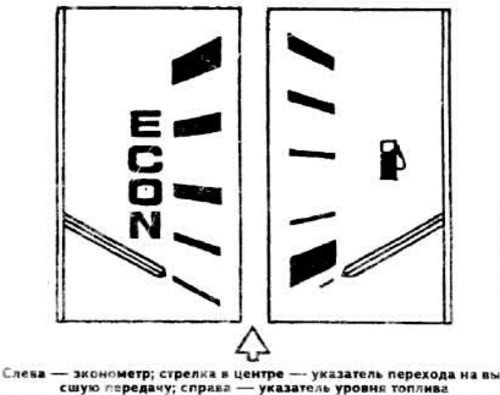
Econometer (fuel consumption indicator) is a pointer indicator, the arrow of which moves along a…


Automatic engine stop-start device "Stop-Start"


This device ensures automatic engine stop whenever the vehicle stops and automatic engine start when the vehicle starts moving again. Depending on the configuration, the device's on/off button may be located to the left of the lower row of indicator lights and to the right of the indicators or in the lower left part of the instrument panel.

The device works as follows:

— Stop function. If the device is turned on by pressing the button, the engine automatically stops each time the car stops under the following conditions:
  • at this moment, I and II gears and reverse gear are not engaged;
  • speed below 5 km/h;
  • the engine has been idling for more than 2 seconds;
  • up until this point, the vehicle's speed was higher than 5 km/h.

Every time the engine is stopped, the rear window heating is switched off if it was on;

— "Start" function. The engine starts automatically when the gearshift lever is moved from neutral to the left. If the engine stalls, the start attempt is repeated after 6 seconds. If no gear is engaged within 6 seconds after the engine starts, the device automatically stops the engine.
The article was checked by auto expert Georgy Rodionov
This article is available at russian, bulgarian, belarusian, ukrainian, serbian, croatian, romanian, polish, slovak, hungarian

Share information:
Previous articles
Audi 80 B2: User manual
Next articles

Checking the coolant level
Coolant temperature
Engine bay of Audi cars
Engine lubrication system
Car ignition system
Clutch and gearbox
Car chassis system
Car braking system


Similar articles on other Audi car models:
Pumping the power supply system Audi 100 C3 (1982-1990)
Vehicle Identification Numbers Audi A3 Type 8L (1996-2003)
Power supply system specifications Audi A4 B6 (2000-2006)
Power steering system Audi A6 C4 (1994-1997)
Airbag system Audi A8 D2 (1994-2002)
General information and safety precautions: power supply system Audi Q7 Typ 4L (2005-2015, diesel)
Safety precautions when working with the fuel supply system Audi A2 (1999-2005)
Link to this page in different formats


Visitor comments

No comments yet


How much will 47 + 44 =


80(B4, 1991-1996) 
  • General information
  • User manual
  • Maintenance
  • Troubleshooting
  • Power unit
  • Engine
  • Cooling system
  • Heating and ventilation
  • Petrol injection
  • Diesel fuel system
  • Fuel system
  • Exhaust systems
  • Ignition system
  • Transmission
  • Clutch
  • Car gearbox
  • Chassis
  • Brake system
  • Suspension and steering wheel
  • Body
  • Body and trim
  • Electrical equipment
  • Electrical system
  • Electrical circuits
 
80(B3, 1986-1991) 
  • General information
  • Repair characteristics
  • Maintenance
  • Power unit
  • Gasoline engine
  • Diesel engine
  • Engine lubrication system
  • Fuel system (gasoline)
  • Injection system (gasoline)
  • Fuel system (diesel)
  • Ignition system
  • Cooling system
  • Heater
  • Exhaust system
  • Transmission
  • Clutch and gearbox
  • Chassis
  • Steering
  • Brake system
  • Car suspension
  • Body
  • Body elements
  • Electrical equipment
  • Power devices
  • Lighting and appliances
  • Electrical circuits
 
80(B3, 1986-1991, petrol) 
  • General information
  • User manual
  • Maintenance
  • Power unit
  • Engine 4-cylinder
  • Engine 5-cylinder
  • Cooling system
  • Fuel and exhaust systems
  • Ignition system
  • Transmission
  • Clutch
  • Mechanical transmission
  • Automatic transmission
  • Drive shafts
  • Chassis
  • Brake system
  • Suspension
  • Steering
  • Body
  • Exterior
  • Interior
  • Electrical equipment
  • Equipment and devices
  • Electrical circuits
 
80(B2, 1979-1986) 
  • General information
  • User manual
  • Power unit
  • Engine FZ
  • Engine EP, YP, YZ, DT, DS, DZ
  • Transmission
  • Clutch
  • 4 speed gearbox
  • 5 speed gearbox
  • Front wheel drive
  • Chassis
  • Front suspension
  • Rear suspension
  • Steering
  • Brake system
  • Electrical equipment
  • Equipment and devices
  • Electrical circuits
 
AudiManual.ru © 2017-2026 · Mobile version · Feedback · Sitemap: EN BG BY UA RS HR RO PL SK HU · Site search · News and articles
80 B2 · 80 B3 petrol · 80 B3 · 80 B4 · 100 C3 diesel · 100 C3 petrol · 100 C3 · 100 C4 petrol · 100 C4 · A3 Type 8L · A4 B5 petrol · A4 B5 · A4 B6 petrol · A4 B6 · A4 B7 · A4 B8 · A6 C4 · A6 C5 · A6 C5 Allroad · A8 D2 · Q5 Type 8R · Q7 Typ 4L · Audi A2 ·
This site uses cookies 🍪. Click the button to accept this fact.