



Table of contents: Removal ↓ Installation ↓
Note. Before removing the brake pads, if they are not to be replaced, carefully mark their positions so that they can be installed in their original position. Never press the brake pedal if the brake pads are removed. Replace the brake pads only in pairs on both brake mechanisms at the same time. Brake pad wear can be checked without removing the wheels using a feeler gauge inserted between the caliper and the wheel disc. The gap is checked between the pressure spring and the brake pad lining substrate.
Removal
Raise the front of the vehicle, place it on stands and remove the wheels.
Remove the brake shoe retaining pin retaining spring.
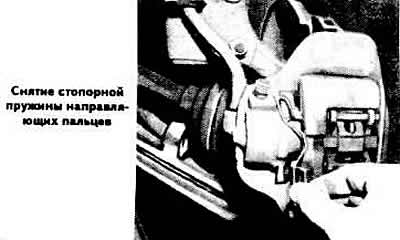
Use a punch to knock out the lower locking pin.
Remove the cross-shaped pressure spring.
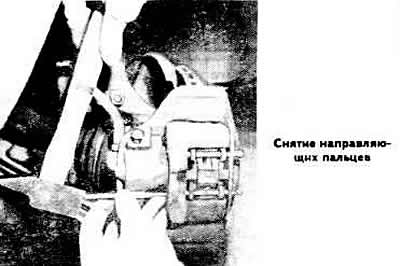
Remove the upper guide pin, using, if difficult, a puller with hooks that fit into the holes for the pins.
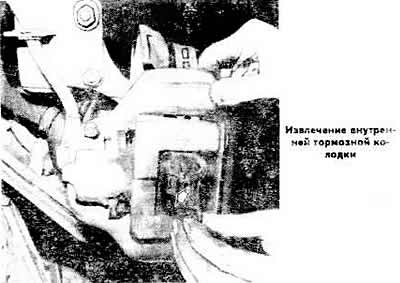
Use pliers to remove the inner shoe.
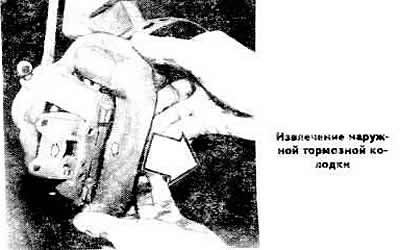
Move the bracket towards the outer shoe and remove the outer shoe, recess (shown by a small arrow in the photo) fits onto the caliper protrusion.
Use pliers to remove the outer shoe.
Clean the pad pockets in the caliper. Fully press the piston into the cylinder, trying to prevent the brake fluid from splashing out of the master cylinder reservoir. If necessary, remove some of the brake fluid from the reservoir with a syringe. The removed fluid cannot be reused.
Installation
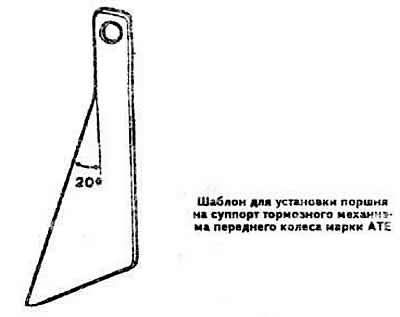
Use a template to check the position of the piston relative to the caliper: the piston should be positioned at an angle of 20° to the support plane of the pads. If necessary, set the piston to the correct position.
Checking the correct installation of the piston with a template (see drawing) is performed as follows:
- apply the template to the upper guide plane in the support;
- if the piston is not positioned in the caliper at an angle of 20°, turn the piston with special pliers until it occupies the desired position.
Install new brake pads into the caliper. When installing the inner brake pad, take care not to jam the piston or damage the protective cap.
Install new locking pins, lock them with a new locking spring. Install a new pressure spring.
Replace the brake pads of the other wheel in the same way.
Press the brake pedal several times to set the pistons to the working position.
Check and, if necessary, restore the brake fluid level in the reservoir.
Bleed the brake hydraulic system if necessary.
Install the wheels and lower the car to the floor.