



Table of contents: Clamp installation location ↓ Removal the vane pump, vehicles with… ↓ Removal ↓ Installation ↓
Repair work for the vane pump is not provided. In case of complaints, the cause should be determined by pressure testing and leak testing. If a fault is found, the vane pump should be replaced. If there is no working fluid in the reservoir, the steering control should be checked for leaks. If there is no leakage near the line connections, first check the lines/line connections for leaks, tighten them if necessary and wipe dry. The vane pump is supplied unfilled. Therefore, before installation, it is necessary to fill the pump with hydraulic fluid and turn it by hand. Otherwise, noise may occur during operation or the vane pump may be damaged.
Vehicles with 4-cyl. diesel engine, vehicles with dynamic steering system
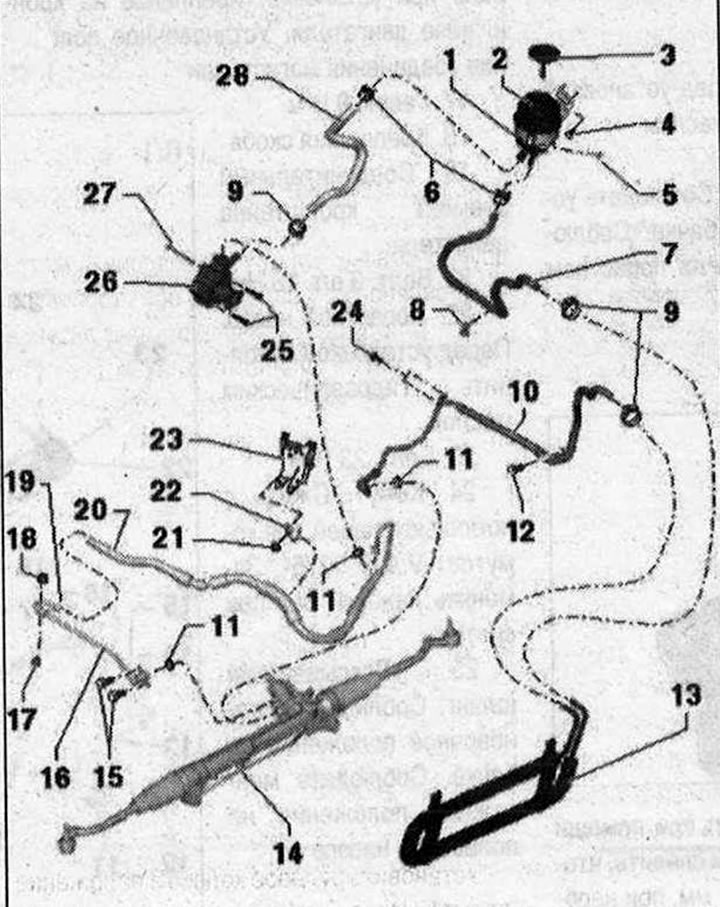
I 1. Bandage. Fastening on the body; 2. Expansion tank. Consider the installation position. Installation position of the hose lines on the tank; 3. Locking cap with measuring probe; 4/5/12/24. Bolt. 9 Nm; 6. Spring clamp. Remove and install with hose clamp pliers "V.A.G 1921"; 7. Return hose from hydraulic oil cooler to expansion tank. Fastening on side member. Observe installation position on tank. Observe installation position on hydraulic oil cooler; 8. Clamp; 9. Clamp. Tighten with clamp pliers "V.A.G 1275". After installation, make sure it is properly secured. Replace each time you remove it; 10. Return line from the power steering mechanism to the hydraulic oil cooler. Insert the return line fully during installation. Mounting on the subframe. Observe the installation position on the hydraulic oil cooler. Mounting position on the line connection; 11. Sealing ring. Replace each time when removed; 13. Hydraulic oil cooler. Fixed to the condenser with a clip; 14. Power steering; 15. Bolt. 20 Nm; 16. Pressure line from vane pump to power steering gear. Insert the pressure line fully during installation.; 17. Rubber cushion. 6 Nm; 18. Nut..6 Nm; 19. Union nut. 40 Nm; 20. Pressure line from vane pump to power steering. Insert pressure line fully during installation. Observe installation position: angle between line connection and vane pump axis is approx. 90°. Tightening torque of union nut: 38 Nm. Fastening on engine bracket; 21. Nut. 9 Nm; 22. Mounting bracket; 23. Engine bracket connecting element; 25. Bolt. 3 pcs. 23 Nm; 26. Vane pump. Fill with hydraulic oil before installation; 27. Bolt. 23 Nm; 28. Suction hose. Observe installation position on tank. Observe installation position on vane pump
Clamp installation location
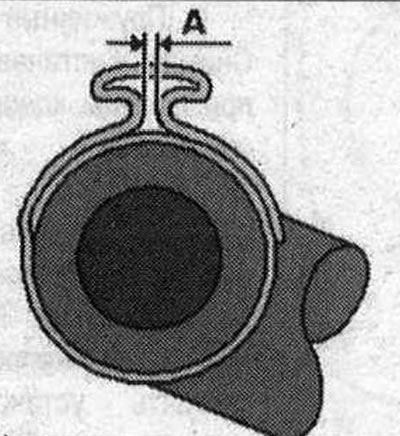
Tighten the clamp completely using pliers "V.A.G 1275". In this case, make sure that the size "A" does not exceed 1 mm; if necessary, tighten the clamp with pliers "V.A.G 1275".
Vehicles with 4-cyl. diesel engine, vehicles without dynamic steering system
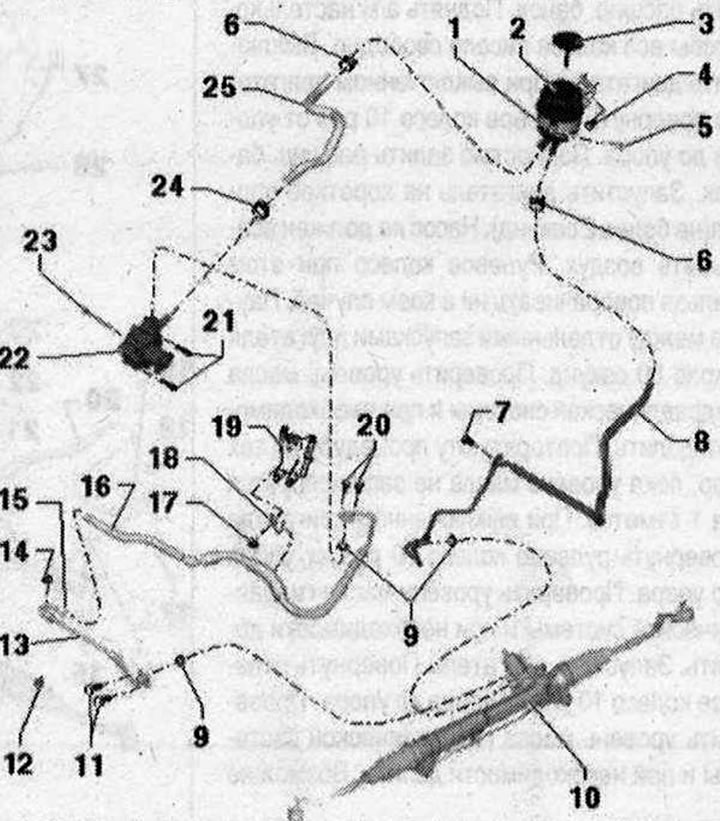
I 1. Bandage; 2. Expansion tank. Consider the installation position. Installation position of the hose lines on the tank; 3. Locking cap with measuring probe; 4/5/7/20. Bolt. 9 Nm; 6. Spring clamp. Remove and install with hose clamp pliers "V.A.G 1921"; 8. Return line from the power steering gear to the reservoir. Insert the return line fully during installation. Subframe mount. Observe the installation position on the reservoir; 9. Sealing ring. Replace each time when removed; 10. Power steering; 11. Bolt. 20 Nm; 12. Rubber cushion. 6 Nm; 13. Pressure line from vane pump to power steering gear. Insert pressure line fully during installation. Fastening on crosspiece of braces. Installation position of line connection; 14. Nut. 6 Nm; 15. Union nut. 40 Nm; 16. Pressure line from vane pump to power steering gear. Insert the pressure line fully during installation. Fastening on engine bracket. Installation position of line connection; 17. Nut. 9 Nm; 18. Mounting bracket; 19. Engine bracket connecting element; 21. Bolt. 3 pcs. 23 Nm; 22. Vane pump. Fill with hydraulic oil before installation; 23. Bolt. 23 Nm; 24. Clamp. Press with clamp pliers "V.A.G 1275". Replace each time when removed; 25. Suction hose. Observe installation position on tank. Observe installation position on vane pump
Vehicles with 4-cyl. diesel engine, vehicles with and without dynamic steering system, pipes and hoses
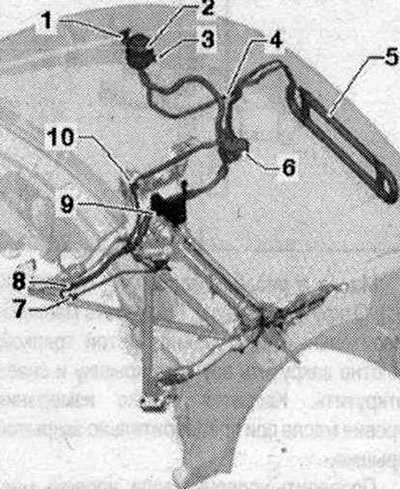
Parts and assemblies, fasteners for pipelines and hoses 1. Tank bracket on the body; 2. Tank in bracket; 3. Bracket bolt; 4. Clamp the return hose on the side member and clamp the suction hose on the pressure pipe; 5. Hydraulic fluid radiator to condenser; 6. Vane pump in bracket; 7. Pressure main on the crosspiece of the stretchers; 8. Installation position of the pressure line connection; 9. Pressure line on the engine bracket; 10. Return line on subframe, return line bracket on side member
Tank bracket on the body
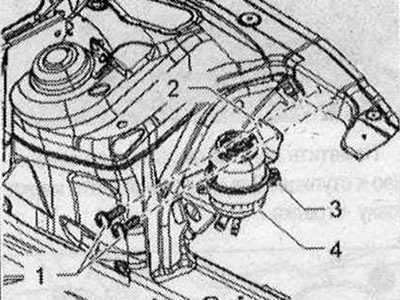
Bracket "1" is fastened to the body with bolts "2". Fasten tank "4" with bolt "3" in bracket "2".
Tank in bracket
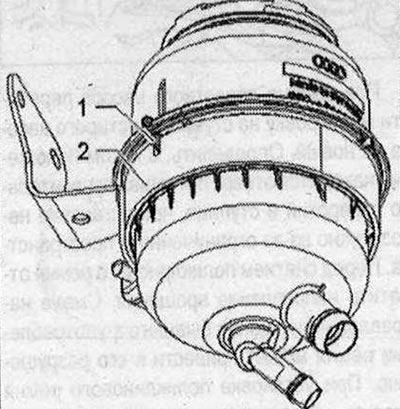
Install the tank with the protrusion "1" into the recess on the bracket "2".
Return hose clamp on the side member
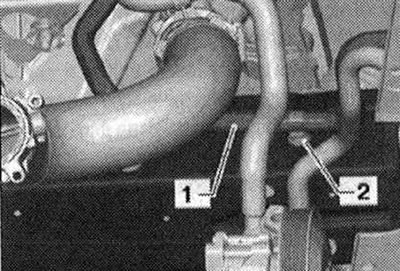
Secure the return hose "1" with the clamp "2" to the left side member.
Suction hose in pressure tube clamp
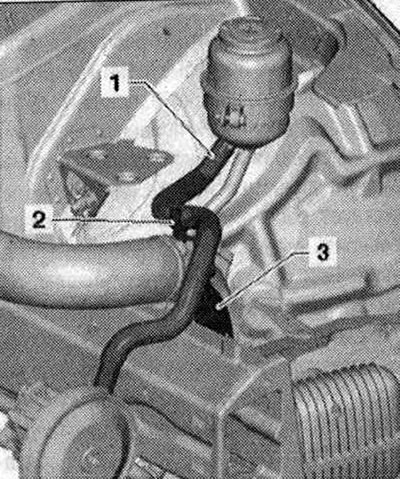
Insert the suction hose "1" into the clamp "2" of the pressure pipe "3".
Hydraulic fluid radiator to condenser
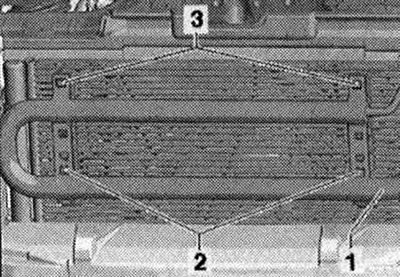
Install the hydraulic fluid radiator "1" on the brackets "2", then secure it in the fasteners "3". Main lines to the hydraulic fluid radiator.
Pressure main on the crosspiece of the stretchers
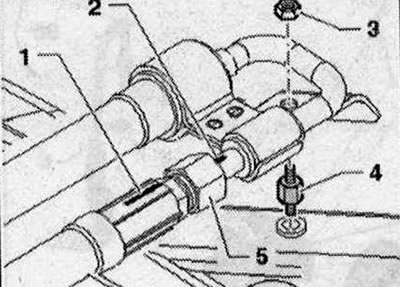
Screw the pressure main line using nut "3" and rubber support "4" on the cross connection of the braces. When screwing the main line connection, take into account the installation position of the main line. Marks "1" and "2" must be located opposite each other.
Pressure line on the engine bracket
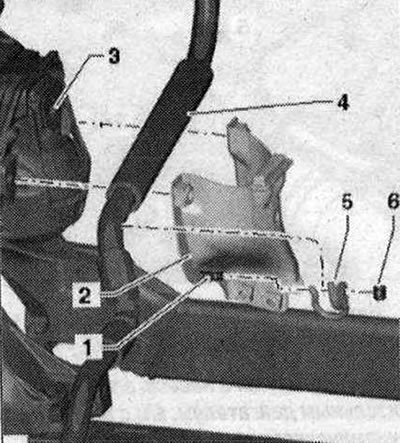
Lay the pressure line "4" between the connecting element "2" and the engine bracket "3". Screw the fastening bracket "5" with the nut "6" onto the threaded pin "1".
Return line holder on subframe
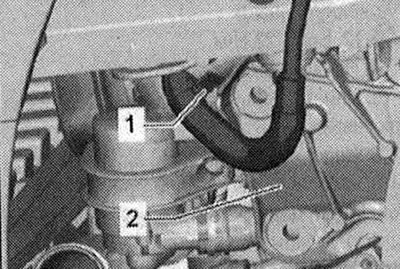
Secure the return line with the holder "1" at the front left on the subframe "2".
Return line on the subframe
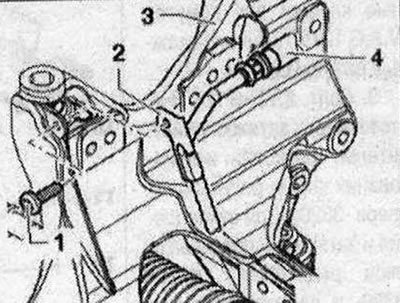
Secure the return line "4" with the holder "2" and bolt "1" to the subframe "3".
Radiator hydraulic fluid lines to radiator frame
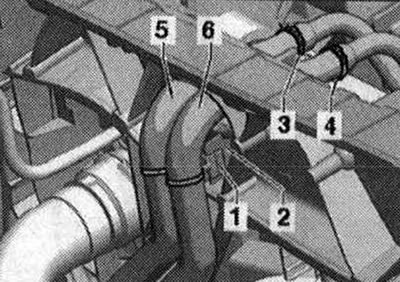
Place lines "5" and "6" with clamps "1" (2 pcs.) on protrusions "2" (2 pcs.).
Removal the vane pump, vehicles with a 4-cyl. diesel engine, vehicles with a dynamic steering system
Replace the sealing rings. Do not reuse drained hydraulic oil. Use only hydraulic oil.
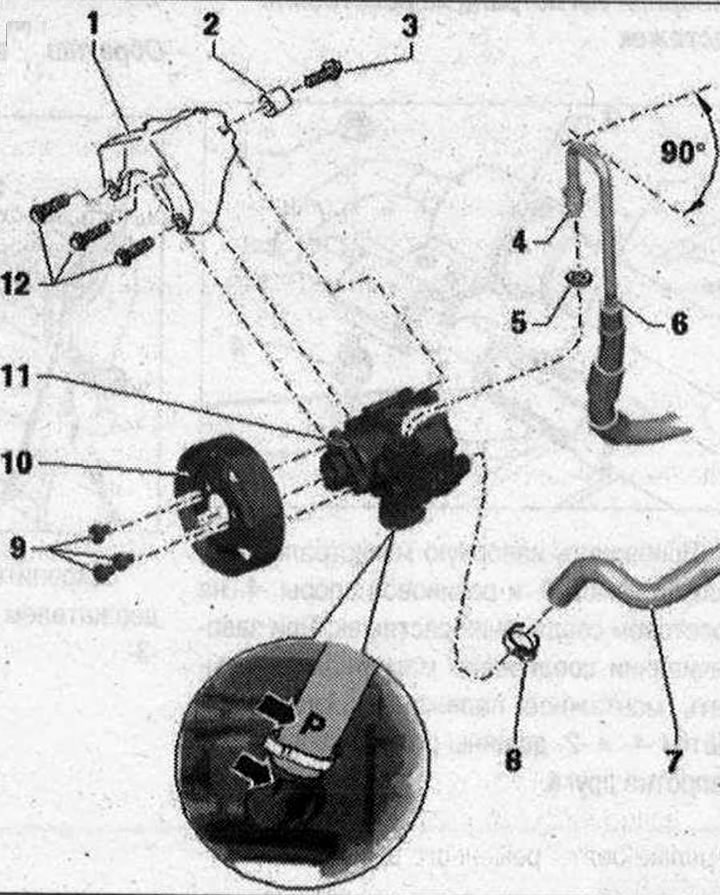
I 1. Holder; 2. Bushing. To install the vane pump, the bushing needs to be moved back a little; 3/12. Bolt. 23 Nm; 4. Union nut. 38 Nm; 5. Sealing ring. Replace each time when removed; 6. Pressure line. Insert the pressure line completely during installation. Observe the installation position: the angle between the line connection and the axis of the vane pump is approx. 90°; 7. Suction hose. The "P" "arrow" marking on the suction hose must be aligned with the profiled seam "arrow" on the vane pump; 8. Clamp. Tighten with clamp pliers "V.A.G 1275". Replace each time when removed; 9. Bolt. 23 Nm. 20 Nm, this tightening torque is only valid when using the door adjustment key "3320". For loosening and tightening, use the door adjustment key "3320" and the corresponding bit "3320/2"; 10. Pulley; 11. Vane pump. Fill with hydraulic oil before installation
Bleed the air from the steering system. Check the level of working fluid in the hydraulic system.
Check the steering for leaks
Removal
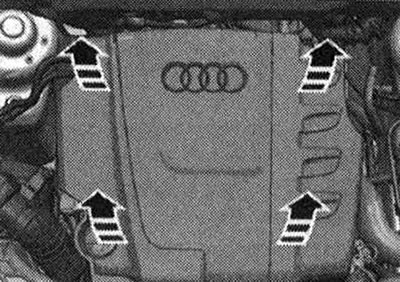
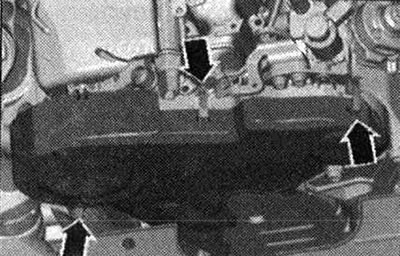
Repair work for the vane pump is not provided. In case of complaints, the cause should be determined by pressure testing and leak testing. If a fault is found, the vane pump should be replaced. If there is no working fluid in the reservoir, the steering system should be checked for leaks. If there is no leakage near the line connections, first check the lines/line connections for leaks, tighten them if necessary and wipe dry. The vane pump is supplied unfilled. Therefore, before installation, it is necessary to fill the pump with hydraulic fluid and turn it by hand. Otherwise, noise may occur during operation or the vane pump may be damaged. Place the car on a lift. Remove the engine casing in the upward direction of the "arrows".
Release the "arrow" clamps and remove the timing belt cover.
Mark the position of the pulley in relation to the hub. To do this, make a marking "arrow".
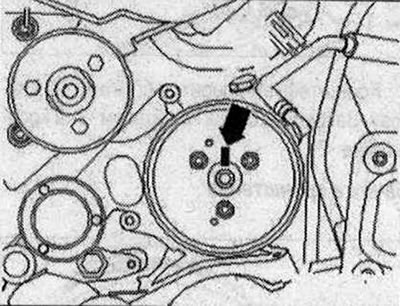
When replacing the vane pump, transfer the marking on the hub from the old pump to the new one. It is impossible to determine the position of the pulley holes relative to the holes in the hub during installation due to limited space. Before removing the poly V-belt, mark the direction of rotation. Changing the direction of rotation of a used belt can lead to its destruction. When installing the poly V-belt, ensure that it is correctly positioned on the pulleys. Remove the poly V-belt only from the vane pump pulley. First, simply loosen the pulley bolts "arrow" using the door adjustment key "3320" and the corresponding bit "3320/2". If necessary, use the counterholder "T10172" with the adapter "T10172/5" "1" for this.
Loosen the loose bolts and remove the pulley. Pump out the hydraulic fluid from the reservoir using a device for collecting and pumping out waste oil.
Clamp the suction hose "1" and the return hose "2" with hose clamps up to 025 mm "3094".
It is prohibited to fix the clamps for hoses up to 025 mm "3094" on the return hose "2" near the check valve. Otherwise, the check valve may be damaged.
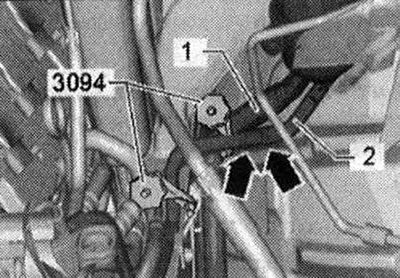
The check valve is located in the return hose "2" between the clamps, "arrows".
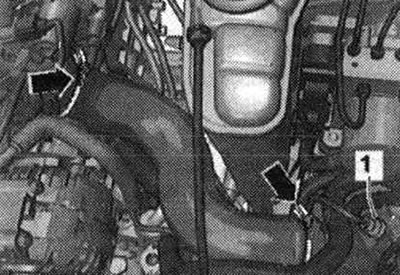
Loosen the hose clamps "arrows" and disconnect the air duct hose. Remove the sound insulation. Install a tray under the vane pump.
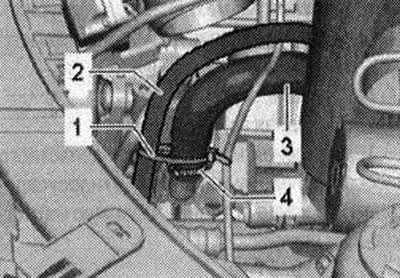
Cut carefully (if available) cable ties "1" of the wire harness "2". Remove the clamp "4" from the suction hose "3". Remove the suction hose "3". Place a rag under the vane pump and the pressure line.
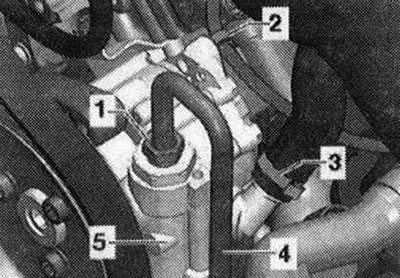
Unscrew the union nut "1" and remove the pressure line "4" from the vane pump. Close the connections of the vane pump and the line with clean plugs.
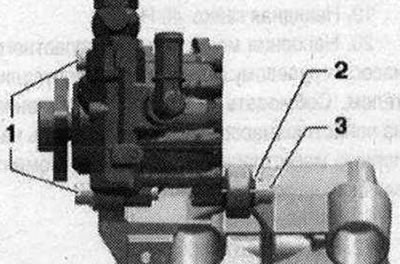
If available, release the wiring harness "2" on the vane pump. Unscrew bolts "1" (3 pcs.) and bolt "3". To install the vane pump, it is necessary to slightly move back the sleeve "2" of bolt "3" in the bracket. Remove the vane pump.
Installation
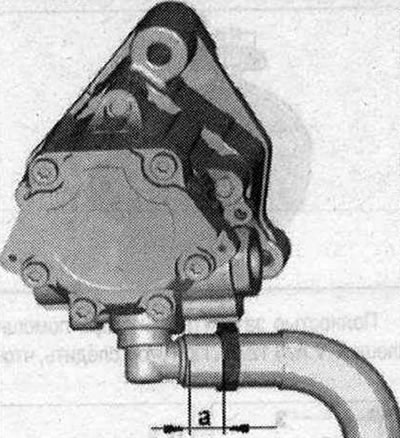
Install in reverse order. In doing so, observe the tightening torques. Replace seals and O-rings. Before installing the new vane pump, fill the suction side with hydraulic oil and turn by hand so that the oil comes out on the discharge side. Secure all hose connections with new clamps. Observe the installation position of the suction hose on the vane pump. Pay attention to the installation size of the clamp. Dimension "a" must be 4 mm.
Turn the hub by hand until oil emerges from the discharge side. Insert the vane pump into the bracket. Sleeve "2" is pushed back slightly. Do not fully tighten the front bolts "1" (3 pcs.) beforehand. Then tighten the rear bolt "3". First tighten bolts "1", then bolt "3". Press the pressure line "4" into the vane pump "5" as far as it will go. Lastly, tighten the union nut "1". When installing the pressure line "4", ensure that the angle between the line connection and the vane pump axis is approx. 90°. Place the suction hose on the connection and install a new clamp "3". Clean any oily areas in the engine compartment. Align the "arrow" marking on the belt pulley with the marking on the hub. Tighten the "arrow" bolts of the belt pulley. Install the poly V-belt of the vane pump. Check the level of the working fluid in the hydraulic system. Bleed the air from the steering. Check the tightness of the steering. Install noise insulation. Install the poly V-belt and check the alignment of the poly V-belt. When installing the poly V-belt, ensure that it is correctly seated in the pulleys.
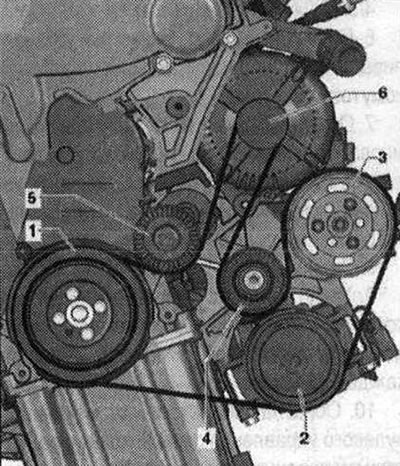
- 1. Vibration damper
- 2. Air conditioning compressor 3. Vane pump pulley
- 4. Guide roller
- 5. Tensioner element of the poly V-belt
- 6. Generator
Turn on the engine and check the running of the poly V-belt.