



Table of contents: Mounted parts of an autonomous heater ↓ View "1" ↓ Autonomous heater bracket ↓ Checking the glow plug of the heater… ↓
Request coding and adaptation of the additional heater control unit "J364" via the "Replace control unit" function in the guided fault finding. Ignition (and an autonomous heater) switched off. Release the pressure in the coolant circuit by opening the cap of the expansion tank of the cooling system. Remove the front right fender liner. Remove the front sound insulation.
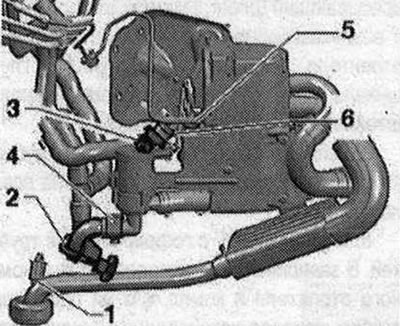
Remove nut "1". Clamp coolant hoses at position "2" (coolant supply to the autonomous heater) and "3" (supply of coolant to the heat exchanger in the climate control system, installation), for example, with 25 mm diameter hose clamps "3094". Loosen the clamps on the coolant pipes of the independent heater "4" and "6" and remove the coolant hoses. In this case, take into account that the coolant can only flow out of the independent heater, and the coolant circulation circuit of other units (engine, heat exchanger, climate, settings) remains filled so that after installation only the air needs to be removed from the independent heater. Loosen the clamp "5", disconnect and plug the fuel line. Unlock the 6-pin connector "A" and the 2-pin connector "B" (press it to the left side of the car and with the connector pressed, remove the lock) and remove.

Depending on the vehicle version, both connectors are accessible through the opening for the removed fog lamp trim. Since 10.2010, the gradual use of independent heaters with part number 4xx xxx xxx has begun. This version of the independent heater can be installed in a service center on a vehicle originally equipped with an independent heater with part number 8R0 xxx xxx or 8K0 xxx xxx. Since individual components differ in different versions of the independent heater (e.g. 2-pin plug connector of the power supply circuit of the additional heater control unit "J364" "B"), take into account the correct correspondence when replacing individual components of the independent heater. Unscrew the mounting nuts "2" and the mounting bolt "3" and remove the independent heater with the bracket, it is additionally secured to the side member with a second bolt "3".
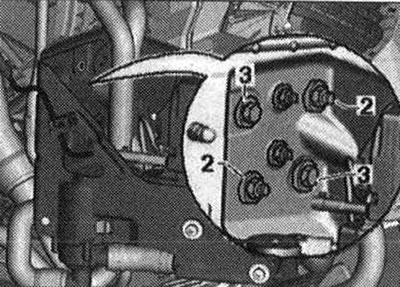
Mounted parts of an autonomous heater
Note: When replacing, pay attention to the correct design of the independent heater (different versions for cars with petrol and diesel engines). Various models of cars are equipped with such an autonomous heater; when installed on a new model of car, the part number of this autonomous heater changes (for example, from 8K0 xxx xxx to 8R0 xxx xxx with the appearance of the Audi Q5 model and later to 4xx xxx xxx, etc.), therefore, take into account the correct match. Also take into account that an old-style autonomous heater cannot be installed in a car equipped with a newer version of the autonomous heater.
View "1"
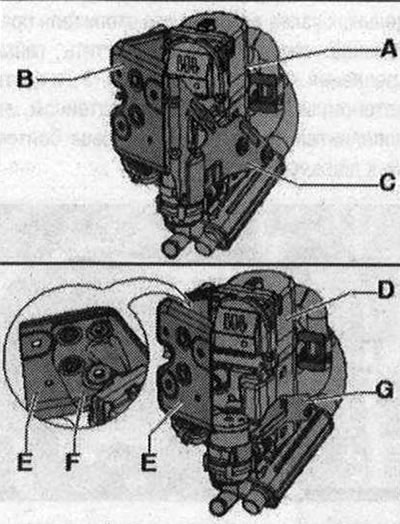
Since the 2009 model year, equipped with a modified bracket for the independent heater, take into account the correct correspondence when replacing the independent heater and bracket. At the beginning of production, the independent heater "A" was fixed on the bracket "B" and "C". Since the 2009 model year, the use of modified independent heaters "D" has gradually begun (improved acoustic performance, invisible from the outside). These independent heaters are mounted on bracket "D" (with additional stiffening element "E") and "F". If the independent heater is mounted at the factory using brackets "B" and "C". When replacing the independent heater, it is necessary to fix it using brackets "D" (with additional stiffening element "E") and "F".
The following figure shows the independent heater with bracket "2", installed at the beginning of production in model year 2009. All the units that did not work, see in figure "2".
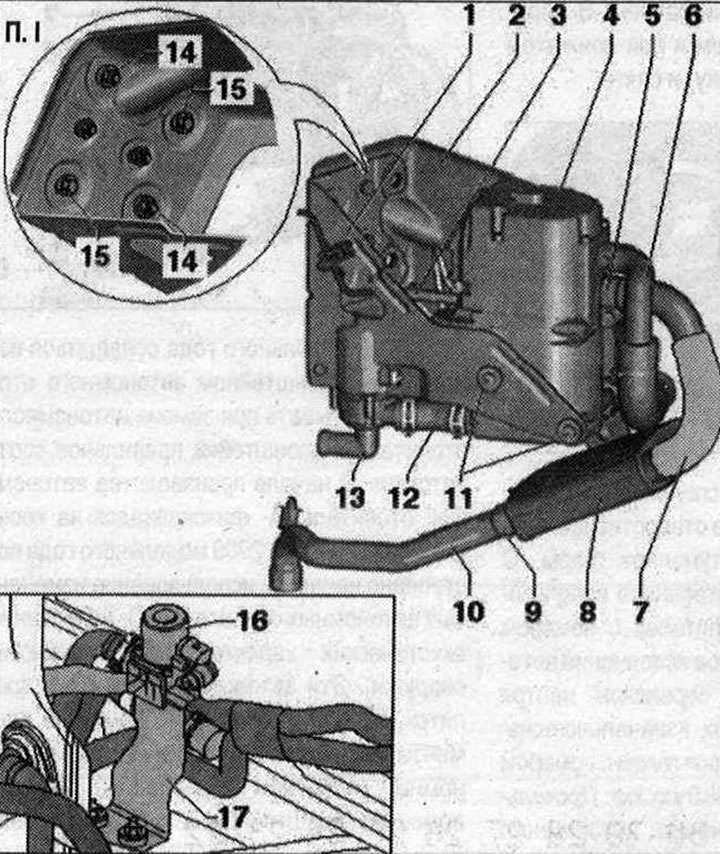
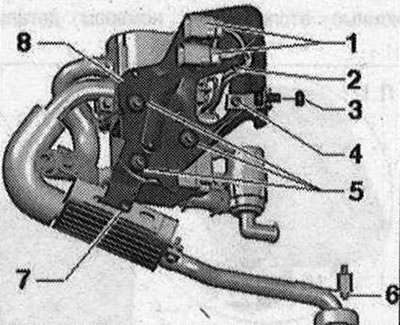
I 1. Bracket 1. Bracket "1" and bracket "2" are screwed together. They have different designs depending on the production period; 2. Bracket "2"; 3. Fuel line branch pipe; 4. Autonomous heater. Various designs, it is not possible to install autonomous heaters with part number 8K0.xxx.xxx. In addition, various designs are provided depending on the production period and type of fuel (for petrol and diesel engines, certain functions are configured differently); 5. Clamp. Bolt tightening torque 6 Nm. For corrugated tube to exhaust silencer; 6. Air intake muffler. Attached with holders and cable ties to bracket "2". Secure the intake hose with a clamp to prevent it from slipping off the air intake pipe of the independent heater. Additionally secure the intake muffler with clamps on the bracket of the independent heater; 7. Thermal insulation of the corrugated tube to the exhaust silencer (not available on all versions); 8. Exhaust silencer with corrugated pipe. Depending on the design of the independent heater and the vehicle assembly, thermal insulation is installed on the intake pipe, which is installed between the independent heater and the exhaust silencer (to protect surrounding parts); 9. Exhaust pipe clamp. Tightening torque 6 Nm; 10. Exhaust pipe. The exhaust gas must flow freely from the exhaust pipe. After performing work on the independent/additional heater or on the muffler, it is necessary to check the neck of the exhaust pipe: when passing through the muffler module, it must be located at a right angle to the muffler module; 11. Bolt for bracket "1". Tightening torque 6 Nm. Self-tapping screw with coating, replace. A rubber bushing is installed between the bolt and the bracket for disconnection; 12. Cooling system hose between the circulation pump "V55" and the independent heater; 13. Circulation pump "V55"; 14. Nut, 2x. Tightening torque 20 Nm. Observe tightening sequence; 15. Bolt, 2x. Tightening torque 20 Nm. Observe tightening sequence; 16. Heater coolant supply shut-off valve "N₂79". Built into the water drain box on the right. Control signals to "N₂79" are only allowed at a certain engine speed (at the moment no higher than 1200 rpm.), therefore, take into account the correct execution, coding and adaptation of the autonomous heater; 17. Holder for the coolant shut-off valve of the heating system "N₂79". Tightening torques of bolts and nuts (for fastening the coolant shut-off valve of the heater "N₂79" to the holder and bracket in the car), respectively, 8 N·m.
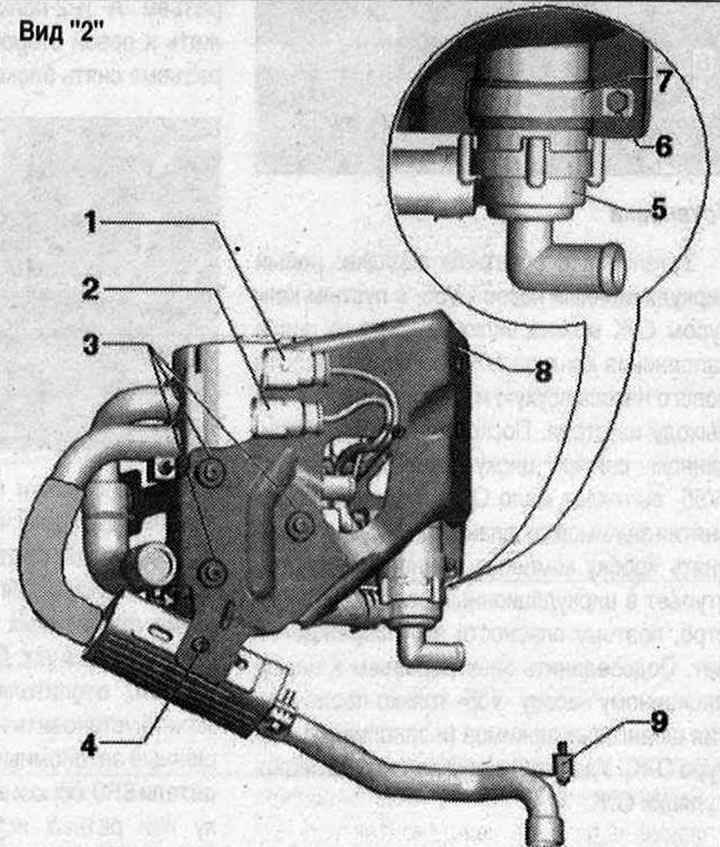
View "2" 1. Plug connection of the control wire. Secured with a clamp on the bracket "2"; 2. Plug-in power supply connection. Secured with a clamp on bracket "2"; 3. Bolt to the bracket of the circulation pump "V55". Tightening torque 6 Nm. Self-tapping screw with a coating, replace. A rubber bushing is installed between the bolt and the bracket for disconnection; 4. Exhaust silencer bolt. Tightening torque 6 Nm 5. Circulation pump "V55"; 6. Bolt for clamping the circulation pump "V55". Tightening torque 3.5 Nm; 7. Clamp for circulation pump "V55"; 8. Bracket "2". Bracket "1" and bracket "2" are screwed together; 9. Rubber-metal support.
Autonomous heater bracket
This picture shows the bracket for the independent heater installed at the start of production in model year 2009. It differs from the bracket, the installation of which gradually began after the change in model year 2009.
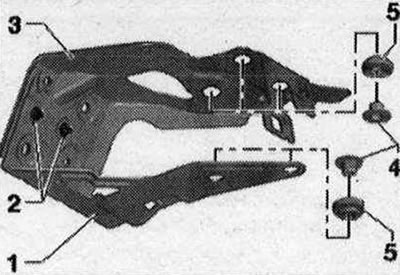
1. Bracket "1"; 2. Nut, tightening torque 8 Nm; 3. Bracket "2"; 4. Axle box; 5. Bushing.
Checking the glow plug of the heater "Q9"
Carry out work to prepare for checking the parts of the independent heater. Disconnect connector "2" from the independent heater.
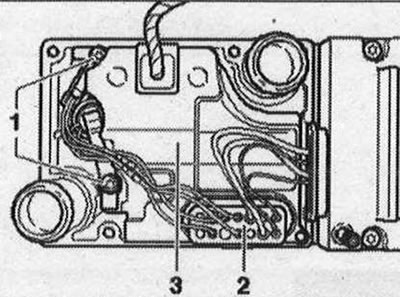
Measure the resistance on the connector between contact "3" and the heater body.
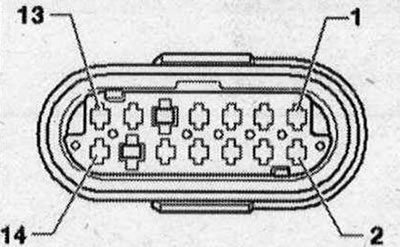
Specified value: Ω. Measure the resistance on the connector between terminals "3" and "6". Specified value: less than 1 Ω. Nominal value: 0.42-0.63 Ω (at 20±2°C).
Note: It is not possible to measure resistances below 1 Ω with sufficient accuracy using conventional measuring instruments, so this test can only detect significant component damage. When applying 9 V to the heater glow plug 09-, the current consumption should be 9-20 A.
The article was copied from the website AUDIMANUAL.RU