
Repair Chevrolet Repair Toyota Repair Honda Repair AvtoVAZ Repair Mercedes-Benz Repair BMW Repair Opel
Home  |  Contacts  |  Sitemap  |    
English Русский
Български
Беларускі
Український
Српски
Hrvatski
Română
Polski
Slovenský
Magyar
AudiManual.ru


  • AUDI 80
  • AUDI 100
  • AUDI A3
  • AUDI A4
  • AUDI A6
  • AUDI A8
  • AUDI Q
  • OTHER
  • ARTICLES
C5 Allroad (1999-2005) C5 (1997-2004) C4 (1994-1997)

Fuel injectors — removal and installation (Audi A6 C5)

  • Home
  • Audi A6
  • C5 Allroad (1999-2005)
  • Power unit
  • Fuel system (diesel)
  • Fuel injectors — removal and installation
            0
Table of contents: Removal ↓ Installation ↓
Faulty injectors can cause loud knocking in the engine, which usually suggests a bearing defect. In case of such malfunctions, start the engine and at idle speed, loosen the union nuts of the high-pressure fuel lines one by one. If the knocking disappears after loosening the next nut, then this is evidence of a faulty injector.

The injectors can also be checked using a special pressure gauge (in the workshop).

The first signs of injector malfunctions are:
  • engine power loss;
  • too much black smoke from the exhaust pipe;
  • significant blue emissions when starting a cold engine;
  • increased fuel consumption;
  • engine overheating;
  • knocking in one or more cylinders;
  • misfires.

Removal


1. Clean the high pressure fuel lines from the outside with a cold cleaner.

2. Remove the high-pressure fuel lines. To do this, use a socket or spanner to unscrew the union nuts securing the lines.

Attention! Do not change the bend shape of the fuel lines. All high-pressure fuel lines must be removed as a complete set.


3. Disconnect the fuel return hoses from the injectors.

4. Remove the cylinder head cover.

5. Unscrew the bolts securing the fuel injector pressure plates (see arrows in the illustration) and unscrew the injectors themselves.
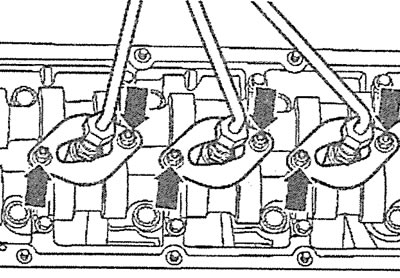
4.5. Unscrew the bolts securing the fuel injector pressure plates (see arrows) and unscrew the…

4.5. Unscrew the bolts securing the fuel injector pressure plates (see arrows) and unscrew the injectors yourself


6. Vehicles with manual transmission. Engage 4th gear if the camshaft lobe interferes with the injector removal. Move the vehicle to rotate the engine and displace the camshaft lobe away from the injector.

7. Cars with automatic transmission. Attach pressure plates to all injectors if one of the camshaft lobes interferes with the removal of the injector. Disconnect the multi-pin plug from the fuel injection pump. Turn on the starter so that the engine turns over and the cam does not interfere.

8. Operate the starter only after securing all injectors with plates and after disconnecting the multi-pin plug from the high-pressure fuel pump.

9. Remove the heat shield from the removed injector.

Installation


10. Be sure to install a new heat shield gasket between the cylinder head and the injector.

11. Install the nozzle back into place.

12. Secure the injector with the pressure plate. The tightening torque of the injector pressure plate nuts is 10 Nm.

13. Install the cylinder head cover and secure it with bolts to a tightening torque of 10 Nm.

14. Install the return fuel lines between the injectors.

15. Tighten the union nuts of the high-pressure fuel lines. The tightening torque is 30 Nm.

16. To remove the injector with the needle lift sensor (see illustration 4.0), which is installed in the third cylinder, follow these steps.
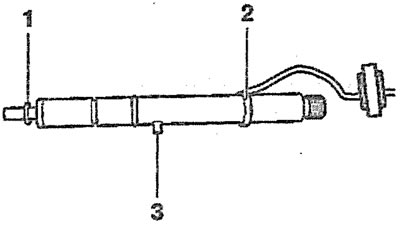
4.0. Fuel injector with needle lift sensor:

4.0. Fuel injector with needle lift sensor:
1 - heat-protective gasket
2 - bushing
3 - mounting pin(when installing, the pin must enter the corresponding groove in the cylinder head)


17. Disconnect brown connector 1 from the fuel injector needle lift sensor (see illustration).
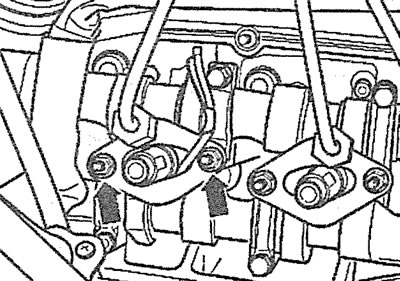
4.17. Disconnect brown connector 1 from the fuel injector needle lift sensor

4.17. Disconnect brown connector 1 from the fuel injector needle lift sensor


18. Unscrew the bolts (see arrows in illustration 4.17) fuel injector pressure plate mounts and carefully remove the injector.
The article was checked by auto expert Alexey Ivanov
This article is available at russian, bulgarian, belarusian, ukrainian, serbian, croatian, romanian, polish, slovak, hungarian

Share information:
Previous articles
Audi A6 C5 Allroad: Fuel system (diesel)
Next articles

Intake manifold — removal and installation
High pressure fuel pump (HPFP) — removal and installation
Operation of a diesel engine in winter conditions
Sensors and actuators for diesel engine power supply
Engine Control Unit — Removal and Installation
Glow Plugs — Removal and Installation


Similar articles on other Audi car models:
Fuel level sensor — removal and installation Audi 80 B3 (1986-1991, petrol)
Removal and installation of fuel injectors Audi 100 C3 (1982-1990)
Removal and installation of fuel lines and injectors (petrol) Audi A3 Type 8L (1996-2003)
Removal and installation of fuel distribution line and injectors Audi A4 B7 (2004-2008)
Removal and installation the engine Audi A8 D2 (1994-2002)
Removal and installation of injectors and fuel lines Audi Q7 Typ 4L (2005-2015, diesel)
Removal and installation the fuel cooler Audi A2 (1999-2005)
Link to this page in different formats


Visitor comments

No comments yet


How much will 45 + 36 =


A6(C5 AR, 1999-2005) 
  • General information
  • User manual
  • Maintenance
  • Troubleshooting
  • Power unit
  • V6 petrol engines
  • V8 petrol engines
  • Diesel engines
  • Cooling and heating system
  • Injection system (gasoline)
  • Fuel system (diesel)
  • Supply system
  • Exhaust system
  • Ignition system
  • Transmission
  • Clutch
  • Mechanical gearbox
  • Automatic gearbox
  • Chassis
  • Brake system
  • Car suspension
  • Steering
  • Body
  • Body elements
  • Doors, locks and windows
  • Electrical equipment
  • Equipment and devices
  • Power devices
  • Electrical circuits
  • Schemes (petrol engine 2.7 l)
  • Schemes (petrol engine 4.2 l)
  • Schemes (diesel engine 2.5 l)
 
A6(C5, 1997-2004) 
  • General information
  • User manual
  • Maintenance
  • Power unit
  • Engine repair
  • Cooling system
  • Fuel system
  • Engine management
  • Fuel system (diesel)
  • Exhaust system
  • Transmission
  • Clutch
  • Car gearbox
  • Chassis
  • Front suspension
  • Rear suspension
  • Steering
  • Wheels and tires
  • Brake system
  • Body
  • Exterior
  • Interior
  • Electrical equipment
  • Air conditioner
  • Equipment and devices
  • Electrical circuits
 
A6(C4, 1994-1997) 
  • General information
  • User manual
  • Maintenance (gasoline)
  • Maintenance (Diesel)
  • Gasoline engines
  • 4 cylinder engines
  • 5 cylinder engines
  • 6 cylinder engines
  • Diesel engines
  • 4 cylinder engines
  • 5 cylinder engines
  • Engine repair
  • Removal and reassembly
  • Cooling system
  • Single point injection system
  • Multipoint injection system
  • MPI/MPFI injection system
  • Fuel system (diesel)
  • Exhaust system
  • Ignition system
  • Transmission
  • Clutch
  • Manual transmission
  • Automatic transmission
  • Drive shafts
  • Chassis
  • Brake system
  • Front suspension
  • Rear suspension
  • Steering
  • Body
  • Exterior (external elements)
  • Interior (internal elements)
  • Electrical equipment
  • Power devices
  • Lighting and appliances
  • Electrical circuits
 
AudiManual.ru © 2017-2026 · Mobile version · Feedback · Sitemap: EN BG BY UA RS HR RO PL SK HU · Site search · News and articles
80 B2 · 80 B3 petrol · 80 B3 · 80 B4 · 100 C3 diesel · 100 C3 petrol · 100 C3 · 100 C4 petrol · 100 C4 · A3 Type 8L · A4 B5 petrol · A4 B5 · A4 B6 petrol · A4 B6 · A4 B7 · A4 B8 · A6 C4 · A6 C5 · A6 C5 Allroad · A8 D2 · Q5 Type 8R · Q7 Typ 4L · Audi A2 ·
This site uses cookies 🍪. Click the button to accept this fact.