



Table of contents: Coolant level control ↓ Coolant leak ↓ Topping up the coolant ↓ Cooling system fan ↓
At the factory, the system is filled with a coolant designed for long-term operation and does not require replacement. The liquid consists of water with a 40% (50% for the V8 engine) share of the additive G 011 A8C. This mixture not only ensures the necessary frost resistance down to -25°C (-35°C for the V8 engine), but also protects primarily the light-alloy components from corrosion. In addition, scale deposits are prevented and the boiling point of the liquid is significantly increased. Therefore, even in the warm season or in countries with a warm climate, the concentration of the mixture must not be reduced by adding water. The share of the additive must be at least 40% (50% for the V8 engine).
If a higher degree of frost resistance is required, the proportion of G 011 A8C can be increased, but only to 60% or 54% for a V8 engine (frost resistance to approximately -40°C), since further increase in concentration leads to a decrease in frost resistance and a deterioration in the cooling effect. Exported to countries with cold climates (for example, Sweden, Norway, Finland) cars are already filled with antifreeze at the factory, based on the calculation for operation at temperatures down to -35°C. As an additive to the coolant, use (in accordance with the instructions on the packaging) only G 011 A8C or additive to specification TL-WV 774 C. These additives are available from Audi. Other additives to the fluid can significantly impair its properties, especially its corrosion protection effect. The resulting corrosion damage can cause coolant leaks and subsequently lead to serious engine damage.
Coolant level control
The expansion tank is located on the left side of the engine compartment.
When the fluid level drops, the control lamp lights up. Despite this, it is recommended to check it from time to time. The level can only be reliably checked when the engine is not running.
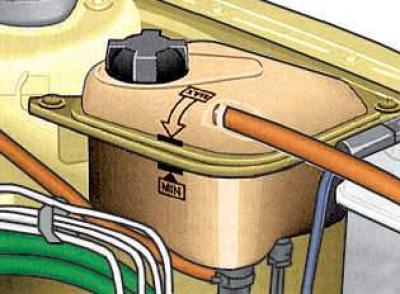
When the engine is cold, the level should be between the "max" and "min" marks on the tank; when warmed up, the level may slightly exceed the "max" mark.
Coolant leak
A coolant leak suggests, first of all, the presence of leaks in the cooling system. In this case, have the system checked urgently at an Audi facility. You cannot limit yourself to just adding fluid. If the seal is intact, a leak can only occur when the coolant boils due to overheating and being forced out of the cooling system.
Topping up the coolant
First, turn off the engine and let it cool down. Then cover the expansion tank cap with a cloth and carefully unscrew it one turn to the left, thus releasing excess pressure. Then unscrew the cap completely.
Warning: The cooling system is under pressure!
If, due to extreme circumstances, you have to add only water, then at the first opportunity restore the standard concentration of the solution by adding the component specified in the instructions.
If there is a significant coolant leak, it can only be added after the engine has cooled down, to avoid damaging the engine.
Do not pour liquid above the "max" mark: excess liquid, when heated, is forced out of the system through the safety valve in the expansion tank cap!
Screw the cap on tightly.
Cooling system fan
On 4- and 6-cylinder engines, the fan is driven by an electric drive controlled by a thermal switch depending on the coolant temperature.
On 5- and 8-cylinder engines, the fan is driven by a ribbed V-belt from the engine. The fan is equipped with a viscous clutch that regulates its rotation frequency depending on the temperature. An additional electric fan with step-by-step speed control is automatically connected during engine operation, depending on the coolant temperature.