



Table of contents: Setting key (D) for… ↓ Turning the independent heater on… ↓ Programming the heater on time ↓ Cancelling/confirming the programmed… ↓ Typical setup options ↓
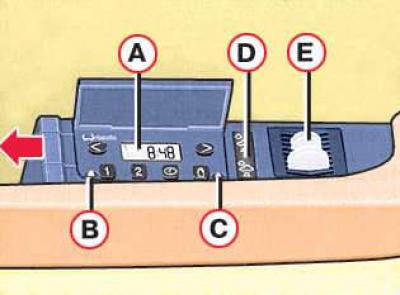
- A - display
- B - yellow indicator light indicating readiness for programming the switch-on time
- C - green heater indicator light
- D - heating/ventilation key
- E - coin acceptor
 — first switch-on time programming key
 — second switch-on time programming key
 - key for reading real time
 - quick switching on and off of the heater or fan to supply fresh air
 - setting real time with countdown
 - setting real time with direct countdown
Real time reading
Press and hold the key
 . The display remains lit as long as the key is pressed. When the key is released, it goes out. However, if a switch-on time has been programmed before, it will remain on the display for about 2 seconds.
Setting real time
Press and hold the key
 .
.
With keys
 (countdown) and
  (direct countdown) set the clock to the actual correct time.
Setting key (D) for heating/ventilation mode
 - operation in autonomous fan mode
Typical setup for the summer season:
When the key is pressed, the device operates only as a fan to supply fresh air, and the heater does not turn on. The control lamp (C) for turning on the heater does not light when operating in fan mode.
Switching the unit on and off, as well as programming the start time in the independent fan mode, is performed in the same way as described below for the heating mode.
 - operation in autonomous heater mode
Typical setup for the winter season:
When the key is not pressed, the device operates as a heater.
Turning the independent heater on and off
Before switching on, configure the heating and ventilation system.
Set the D key to the autonomous heater mode.
Switching on is done by pressing the key
 . The heater will start working immediately. When it is switched on, the control lamp (C) lights up.
Switching off is done by pressing the key
 . The control lamp (C) goes out.
Warning: After 60 minutes of operation in the autonomous heating mode, the device automatically switches off.
Programming the heater on time
With keys
 and
and  it is possible to program two different heating switching times within one day.
Press the key
 or
or  . The display shows the corresponding key. The control lamp (B) lights up, confirming that the programming device is ready for operation.
The required time for switching on the heater is set by the time setting keys with direct and reverse countdown. The longer you hold these keys, the faster the time countdown.
Approximately 20 seconds after this setting is made, the programmed time indication goes out. However, the number of the setting key remains on the display
 or
or  , confirming the programming.
Set the key (D) to the independent heater mode.
Adjust heating and ventilation.
Cancelling/confirming the programmed switch-on time
To cancel, press the key
 or
or 
At the same time, the key number on the display and the control lamp (B) will go out, confirming the readiness of the programmable device.
Confirmation of the programmed switching on is performed by pressing the keys
 or
or  . In this case, the control lamp (B) lights up.
Typical setup options
Cars with conventional ventilation and heating systems
To operate in the autonomous heater and fan mode, the following system setup operations must be performed:
To warm up the interior, turn the temperature control clockwise until it stops.
Set the air distributor to the glass defrosting or footwell heating mode, or between the positions
 and
and  .
.
Set the fan mode switch to position II. On vehicles with a conventional heating and ventilation system, this switch must not be set to position 0, as this will block the supply of fresh air.
Cars with automatic air conditioning
No special settings are required. Air is supplied automatically to defrost the glass.
[The original text of the material can be found on the website: AUDIMANUAL.ru]