



2. Run your fingers along the entire length of the belt, feeling for cracks and delamination (see illustrations). Also check for abrasions and polished areas on the belt. The belt should be inspected from both sides, which means it needs to be twisted. At the same time, make sure there is no rust, cracks or burrs on the pulleys. Shallow perpendicular cracks are allowed on the working surface of the belt. If these cracks do not extend beyond the boundaries of one rib and are not very deep, there is no need to replace the belt.
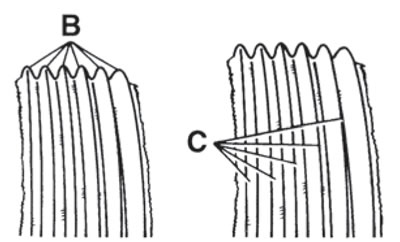
18.2a. Wear of the edges of the drive belt ribs
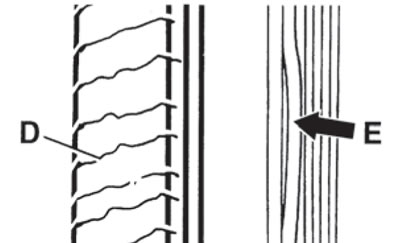
18.2b. Transverse cracks (D) on the back side of the belt and delamination of the ribs (E)
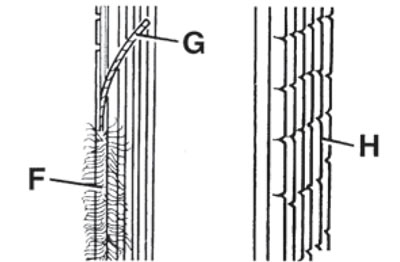
18.2c. Fraying of side ribs (F), cracks (H) and delamination of side ribs (G)
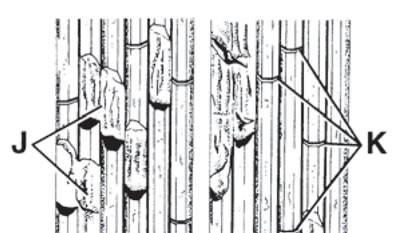
18.2d. Rib separation (J), cracks (K)
3. Make sure the belt is positioned correctly on the pulleys.
4. If necessary, replace the drive belt (see Chapter 2).
5. The tension is checked using a special device.
[Content source: the specified website: AUDIMANUAL.RU]