
Repair Chevrolet Repair Toyota Repair Honda Repair AvtoVAZ Repair Mercedes-Benz Repair BMW Repair Opel
Home  |  Contacts  |  Sitemap  |    
English Русский
Български
Беларускі
Український
Српски
Hrvatski
Română
Polski
Slovenský
Magyar
AudiManual.ru


  • AUDI 80
  • AUDI 100
  • AUDI A3
  • AUDI A4
  • AUDI A6
  • AUDI A8
  • AUDI Q
  • OTHER
  • ARTICLES
B8 (2007-2015) B7 (2004-2008) B6 (2000-2006) B6 (2000-2006, petrol) B5 (1994-2001) B5 (1994-2001, petrol)

When does the combustion of the fuel-air mixture occur? (Audi A4 B5)

  • Home
  • Audi A4
  • B5 (1994-2001, petrol)
  • Power unit
  • Ignition system
  • When does the combustion of the fuel-air mixture occur?
            0
Table of contents: Top dead center and ignition timing ↓ Setting the ignition with delay ↓
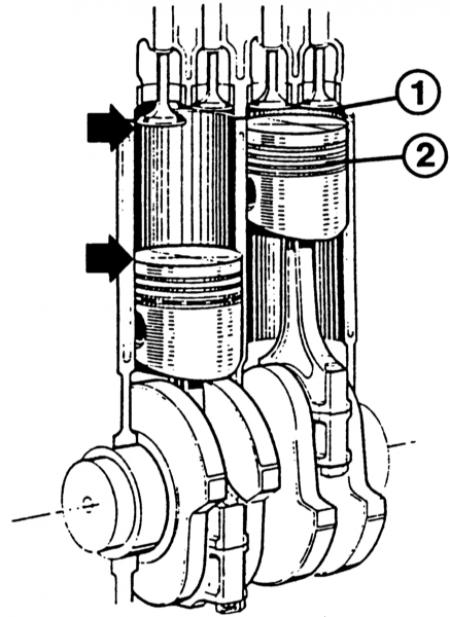
When does the combustion of the fuel-air mixture occur?


The figure illustrates the concept of "Top Dead Center" and "Bottom Dead Center". The space between them is the working volume of the cylinder. On the contrary, between the highest position of the piston (2) and the lower edge of the cylinder head (1) the combustion chamber is shown.
The figure illustrates the concept of «Top Dead Center» and «Bottom Dead Center». The space between…


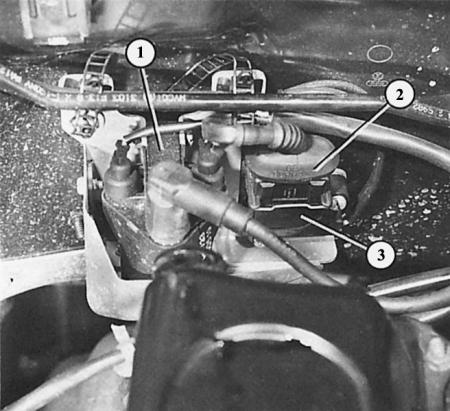
The main element of the ignition system of a four-cylinder engine with a working volume of 1.6 liters is a separate ignition coil (1) and a final stage (3) with a connector (2). The ignition voltage is distributed among the cylinders here by the ignition distributor.
The main element of the ignition system of a four-cylinder engine with a working volume of 1.6…


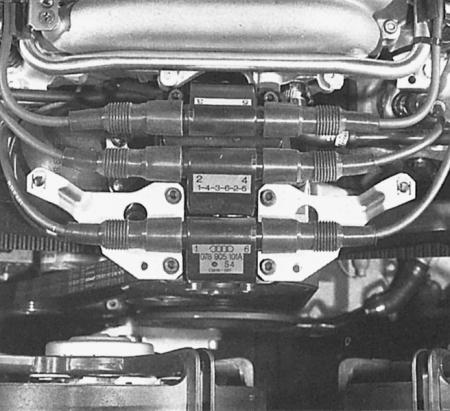
Ignition coil pack of a six cylinder engine with the engine cover removed (static ignition distribution). The numbers on the high voltage connectors indicate which cylinder the wire goes to.


Ignition coil pack of a six cylinder engine with the engine cover removed (static ignition…


In the 1.8 l 92 kW engine, the ignition coil on cylinder 3 also serves cylinder 1, and the ignition coil on cylinder 4 also serves cylinder 2. The final stage is mounted on top of the ignition coils.
In the 1.8 l 92 kW engine, the ignition coil on cylinder 3 also serves cylinder 1, and the ignition…


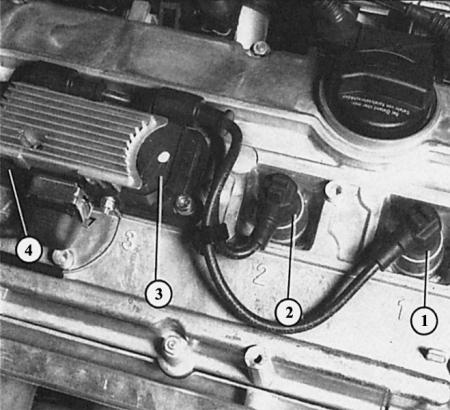
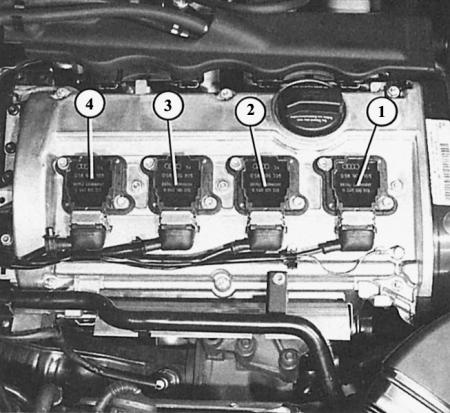
Ignition of the 1.8 l 110 kW turbo engine: each cylinder has its own ignition coil (1–4).

The spark must jump into the combustion chamber at the right moment. The combustion of the fuel-air mixture occurs most efficiently when it is compressed to its minimum volume. This maximum compression is achieved at the moment when the piston, at the end of the compression stroke, wants to switch from forward motion to the reverse motion of the power stroke. Before the piston switches to reverse motion, it spends a fraction of an instant at the highest point of its trajectory. This point is called the "top dead center" (TDC).


So, the ideal ignition moment is when the piston is just beginning its return movement. Compression is at its maximum, and the piston can be pushed back against the engine block with force.

Despite this, it would be wrong to set the ignition timing exactly at top dead center. Since the fuel-air mixture requires a certain amount of time (about 1/3000 sec) before it ignites and develops full combustion pressure. Therefore, the ignition timing is set earlier. We speak of "ignition advance". Therefore, the starting shot for the spark sounds while the piston is still moving up, and the combustion pressure develops immediately after TDC.

Top dead center and ignition timing


As the engine speed increases, the ignition spark must jump earlier and earlier, because – as already mentioned – the fuel-air mixture always needs the same time to ignite. Only in this way can the combustion process occur at exactly the right time, namely when the piston is just beginning to move back again. The combustion of the fuel-air mixture also depends on its composition. When the gas pedal is slightly depressed (at "partial load"), the mixture in the combustion chambers has a reduced ability to ignite, so it burns more slowly and for this reason the ignition must also work with a greater lead.

Setting the ignition with delay


In other situations, it is necessary to shift the ignition timing in the direction of "retardation". Ignition occurs when the piston has long passed the top dead center. That is, ignition occurs almost on the exhaust stroke, which improves the composition of the exhaust gases, but worsens engine power. Consequently, late ignition can be correct when the engine is running without load in the rolling mode of the car (for example, downhill without gas).

[The article is a reprint of material from AudiManual.ru]
The article was checked by auto expert Georgy Rodionov
This article is available at russian, bulgarian, belarusian, ukrainian, serbian, croatian, romanian, polish, slovak, hungarian

Share information:
Previous articles
Audi A4 B5: Ignition system
Next articles

Ignition system — general description
Different ignition systems
This is how the ignition spark is created
Ignition system actuator
Ignition system control unit


Similar articles on other Audi car models:
Fuel injection system — idle speed and mixture adjustment Audi 80 B3 (1986-1991, petrol)
Fuel injection with controlled knock combustion Audi 100 C3 (1982-1990)
Refueling and emergency release of the fuel filler flap Audi A3 Type 8L (1996-2003)
Fuel filter for TDI diesel engines Audi A6 C5 (1997-2004)
Draining water from the fuel filter of a V6 TDI diesel engine Audi A8 D2 (1994-2002)
Fuel and refueling Audi Q5 Type 8R (2008-2017)
Fuel filter — replacement Audi A2 (1999-2005)
Link to this page in different formats


Visitor comments

No comments yet


How much will 30 + 43 =


A4(B8, 2007-2015) 
  • General information
  • Operating instructions
  • Power unit
  • Petrol engines 1.8 l
  • Petrol engines 1.8/2.0 l
  • Petrol engines 3.0 l
  • Petrol engines 3.2 l
  • Fuel system (petrol)
  • Diesel engines 2.0 l (CA*)
  • Diesel engines 2.0 l (CJCB)
  • Diesel engines 2.7/3.0 l
  • Diesel engines 3.0 l
  • Fuel system (diesel)
  • Transmission
  • Manual gearbox 0B1
  • Manual gearbox 0B2
  • Manual gearbox 0B3
  • Manual gearbox 0B4
  • Automatic transmission 0B5
  • Automatic transmission 0B6
  • Automatic transmission 0AW
  • All-wheel drive system
  • Chassis
  • Front suspension
  • Rear suspension
  • Brake system
  • Steering system
  • Body
  • Exterior
  • Interior
  • Seats
  • Doors, locks and windows
  • Security system
  • Heating and air conditioning
  • Electrical equipment
  • Audio system
  • Power devices
  • Equipment and devices
  • Lighting and lamps
  • Electrical circuits
 
A4(B7, 2004-2008) 
  • General information
  • Introduction to manual
  • Troubleshooting
  • Operating instructions
  • Maintenance
  • Power unit
  • Petrol engines 2.0 (ALT)
  • Petrol engines 2.0 (TFSI)
  • Petrol engines 1.8 (MPI)
  • Diesel engines
  • Cooling system
  • Air conditioner
  • Fuel and exhaust system
  • Ignition system
  • Starting and charging
  • Transmission
  • Clutch
  • Manual gearbox
  • Automatic gearbox
  • Drive shafts
  • Chassis
  • Brake system
  • Front suspension
  • Rear suspension
  • Steering
  • Body
  • Exterior
  • Interior
  • Electrical equipment
  • Equipment and devices
  • Lighting and signaling
  • Windscreen wipers and washers
  • Electrical diagrams
  • Electrical diagrams (since 2007)
 
A4(B6, 2000-2006) 
  • General information
  • Vehicle Description
  • User manual
  • Maintenance
  • Power unit
  • Gasoline engine
  • Diesel engine
  • Lubrication system
  • Cooling system
  • Supply system
  • Injection system
  • Exhaust system
  • Ignition and control
  • Transmission
  • Gear box
  • Clutch and drive shafts
  • Chassis
  • Brake system
  • Car suspension
  • Steering
  • Body
  • Heating and ventilation
  • Exterior (external elements)
  • Interior (internal elements)
  • Electrical equipment
  • Power devices
  • Lighting and appliances
  • Electrical circuits
 
A4(B6, 2000-2006, petrol) 
  • General information
  • Introduction to the guide
  • Car care
  • Power unit
  • Engine repair
  • Lubrication system
  • Cooling system
  • Injection and control system
  • Ignition system
  • Power and exhaust system
  • Transmission
  • Clutch and drive shafts
  • Car gearbox
  • Chassis
  • Suspension and wheels
  • Steering
  • Brake system
  • Body
  • Interior
  • Exterior
  • Electrical equipment
  • Equipment and devices
  • Lighting and signaling
  • Power devices
  • Electrical circuits
 
A4(B5, 1994-2001) 
  • General information
  • Introduction to the guide
  • Car care
  • Maintenance (gasoline)
  • Maintenance (diesel)
  • Power unit
  • Gasoline engines
  • Diesel engines
  • Engine overhaul
  • Cooling system
  • Fuel injection (gasoline)
  • Fuel system (diesel)
  • Exhaust system
  • Ignition system
  • Transmission
  • Clutch
  • Mechanical gearbox
  • Automatic gearbox
  • Drive shafts
  • Chassis
  • Brake system
  • Car suspension
  • Steering
  • Body
  • Exterior
  • Interior
  • Doors, locks and windows
  • Heating and ventilation
  • Electrical equipment
  • Power devices
  • Equipment and devices
  • Electrical circuits
 
A4(B5, 1994-2001, petrol) 
  • General information
  • Vehicle description
  • Maintenance
  • Power unit
  • Engine repair
  • Turbocharging
  • Exhaust system
  • Cooling system
  • Ignition system
  • Fuel system
  • Motronic injection system
  • MPI and MPFI injection system
  • Transmission
  • Clutch
  • Gearbox and shafts
  • Chassis
  • Steering
  • Car suspension
  • Brake system
  • Wheels and tires
  • Body
  • Heating and ventilation
  • Body parts
  • Electrical equipment
  • Fuses and relays
  • Power devices
  • Lighting and lamps
  • Tools and devices
  • Electrical circuits
 
AudiManual.ru © 2017-2026 · Mobile version · Feedback · Sitemap: EN BG BY UA RS HR RO PL SK HU · Site search · News and articles
80 B2 · 80 B3 petrol · 80 B3 · 80 B4 · 100 C3 diesel · 100 C3 petrol · 100 C3 · 100 C4 petrol · 100 C4 · A3 Type 8L · A4 B5 petrol · A4 B5 · A4 B6 petrol · A4 B6 · A4 B7 · A4 B8 · A6 C4 · A6 C5 · A6 C5 Allroad · A8 D2 · Q5 Type 8R · Q7 Typ 4L · Audi A2 ·
This site uses cookies 🍪. Click the button to accept this fact.