



Table of contents: Four-cylinder engine ↓ Six-cylinder engine ↓
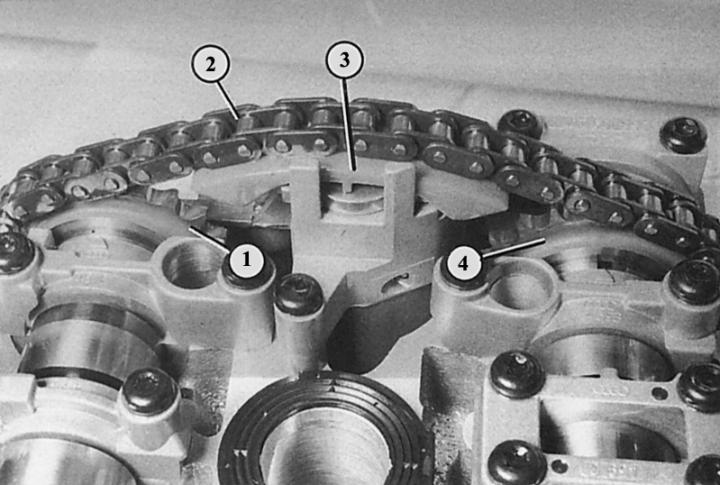
In the five-valve cylinder head of the 1.8-liter engine, the chain wheel (4) of the exhaust camshaft transmits its rotation speed to the double-row chain (2) on the chain wheel (4) of the intake camshaft. A hydraulic chain tensioner (3) is used to eliminate noise from the operation of the chains.
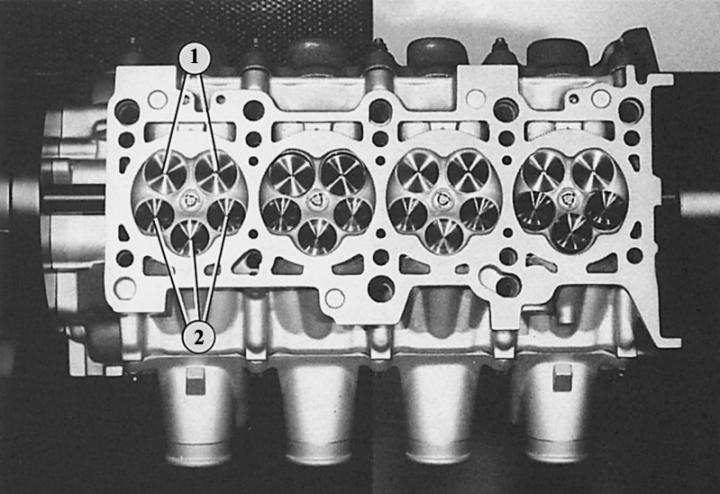
A view of a five-valve cylinder head from below: the photograph shows what a large cross-section of flow can be created by opening the exhaust (1) and intake (2) valves.
Four-cylinder engine
Our four-cylinder engine traces its roots back to 1972, when Audi laid the foundation for its current market position with the new Audi 80. Professionals were fascinated not only by the body and chassis, but also by the new engine. Its most important design features: a four-cylinder engine with an overhead camshaft, the valves are actuated by plate tappets. The oil pump and distributor are driven by the intermediate shaft. The camshaft and intermediate shaft are driven by a toothed belt.
Little remains of the previous engine, but the main features of the crank mechanism remain the same. Fundamental changes were made to the cylinder head specifically for use in the Audi A4: the 1.6-liter engine received a so-called cross-flow head to improve gas exchange. Fresh gases enter from the left side of the engine, and exhaust gases are released from the right side. In addition, the new 1.6-liter engine received very long intake manifolds to ensure maximum traction (maximum torque) in the lower rev range.
A similar goal was pursued in the design of five-valve heads. Here, due to the larger flow cross-section that five valves allow, gas exchange is also improved in a wide range of engine speeds.
The 1.8 T turbocharger produces powerful torque at very low revs. Power is generated that is usually only expected in significantly higher displacement classes.
Overall, all four-cylinder engines provide the conditions for a relaxing drive, the power spectrum is extremely convincing across the entire rev range. At the same time, fuel consumption remains pleasantly low due to the small displacement.
Six-cylinder engine
The new six-cylinder engine, developed in 1991 to introduce the latest generation of the Audi 100, is a very compact power unit and is ideally suited for the typical Audi installation along the front axle. Two overhead camshafts with toothed belt drives operate the valves via plate tappets. The space between the cylinder heads houses the intake manifold. The 2.8-litre version has a switchable intake manifold, which changes the active length of the intake runners depending on the engine speed range. This ensures optimum engine torque in all speed ranges.
For the Audi A4, the six-cylinder engine was equipped with a new oil circulation system and a new, three-section crankcase. The oil circulation system is designed in such a way that the oil pressure is regulated after the oil filter and oil cooler.
Thanks to this, the lubrication points create exactly the pressure that the control valve creates.