



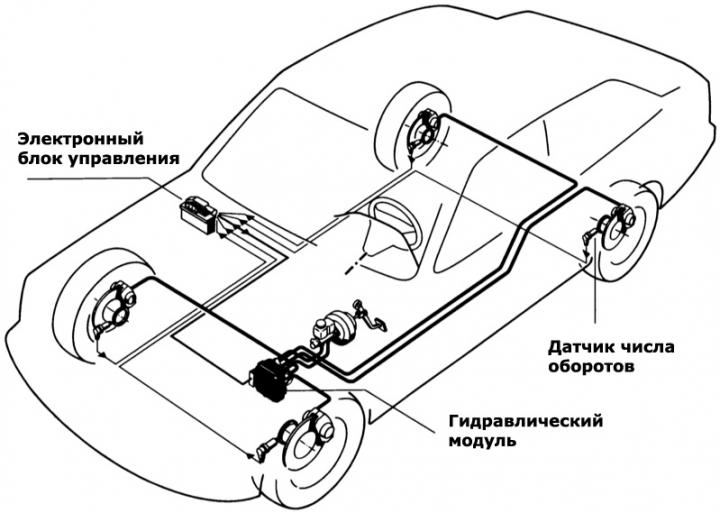
The figure shows the basic design of the anti-lock system in the Audi A4.
ABS cannot create the braking miracle that is often assumed; the braking distance does not become significantly shorter under all conditions.
To a greater extent, ABS helps maintain control of the car under strong braking. But this requires a much stronger turn of the steering wheel than usual. This is only one of the points, the rest are the same as with a conventional braking system:
- Therefore, practice full braking with steering wheel turn in a remote parking area.
- At the same time, fully depress the brake pedal. ABS takes over the dosage of braking force for you.
- This applies to braking both when driving straight ahead and when turning the steering wheel.
- Don't be surprised if the brake pedal pulsates. When the ABS regulates braking, this pedal vibration is normal.
- In extreme cases, even with ABS, you must release the brake pedal to save the sticky situation by turning.
What does ABS do?
ABS always provides optimal "intermittent braking", so pure locking braking is no longer possible. The wheels on smooth ice, even under full braking, still rotate a little in order to keep the car in the track.
The original text of the material can be found on the website: AUDImanual