



The multi-engine compartment cover, trunk lid. doors and front fenders are bolted on and are easy to replace. When installing, air gaps must be observed, otherwise, for example, the door will knock or increased wind noise will be observed when driving. The air gap must be at least parallel along its length, that is, the distance between the body parts must be maintained constant along the entire length of the gap.
For better protection against rust, the body is galvanized. At the same time, the external parts of the body, such as the lid, side parts, wings, roof and doors are galvanized on both sides using an electrolytic method. Invisible parts, such as the bottom, door pillars, sheet stiffeners are galvanized on both sides using a thermal method.
In electrolytic galvanizing, zinc is dissolved by electric current and applied to steel plates. A very uniform and thin zinc layer is created, which can be processed further without problems. Due to the very smooth surface, these parts are suitable for external varnishing.
Thermal varnishing involves immersing the plates in a zinc bath at a temperature of +450°C. This creates an extremely thin layer of iron-zinc alloy, which serves as a bond for a 10 µm (1/100 mm) layer of pure zinc.
If welding work is necessary, use only spot welding. Only where the electrode holder does not enter, can electric welding be used in a protective gas environment. The following points must be observed:
Increase the welding current (amperes) by 10%, maximum by 30%.
Use electrodes made of hard-drawn copper with high heat resistance (above +400°C).
Clean the electrodes frequently, working from the side up to a diameter of 4 mm.
Increase the pressure applied to the electrodes.
Extend the welding time. The welding time is correct if the welding spots are obtained without spatter.
Caution: When welding galvanized parts, toxic zinc oxide is released, so ensure good ventilation of the workplace.
Then cover the welding points with cold galvanizing and prime.
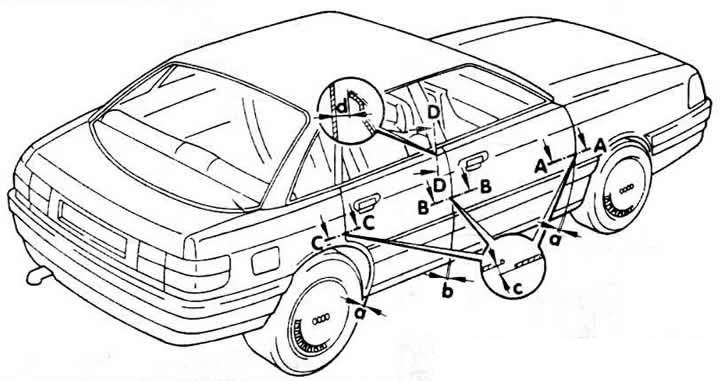
Dimensions of clearances
adjustment by moving doors with hinges
a = 5+1 mm
b = 5.5+1 mm
Elimination of wind noise
adjustment of longitudinal clearances in hinges (fastening - door hinge); at the back of the doors, near the locking bolt.
Sections A-A, B-B, C-C: c = 0.5+0.5 mm
Section DD: d = 14.5 mm