Repair Chevrolet Repair Toyota Repair Honda Repair AvtoVAZ Repair Mercedes-Benz Repair BMW Repair Opel
Home  |  Contacts  |  Sitemap  |    
English Русский
Български
Беларускі
Український
Српски
Hrvatski
Română
Polski
Slovenský
Magyar
AudiManual.ru


  • AUDI 80
  • AUDI 100
  • AUDI A3
  • AUDI A4
  • AUDI A6
  • AUDI A8
  • AUDI Q
  • OTHER
  • ARTICLES
C5 Allroad (1999-2005) C5 (1997-2004) C4 (1994-1997)

Checking the transmission fluid level and filling (Audi A6 C5)

  • Home
  • Audi A6
  • C5 Allroad (1999-2005)
  • Transmission
  • Automatic gearbox
  • Checking the transmission fluid level and filling
            0
Table of contents: Checking the oil level ↓ Filling the transmission fluid ↓ Checking the condition of the… ↓
Attention! The level of transmission fluid in the automatic transmission depends on its temperature. Diagnostic equipment is required to accurately measure the temperature, so it is recommended to perform this work at a service station. Usually, the level of transmission fluid in the automatic transmission remains constant and, if no leaks are detected during visual inspection, there is no need to check the level.


When checking the level, the temperature of the transmission oil in the box should not be higher than 30-45°C. To determine the temperature, a tester is connected to the diagnostic connector in specialized workshops. Otherwise, the temperature of the fluid in the automatic transmission can only be determined approximately.

Checking the oil level


The oil level in the automatic transmission should be checked with the car parked horizontally. The transmission fluid should be warmed up to a temperature of 30°C, and the control lever should be in the P position.

Filling the transmission fluid


1. Unscrew plug 1 of the drain hole and drain the oil from the gearbox, heating it to approximately 30° (see illustration).
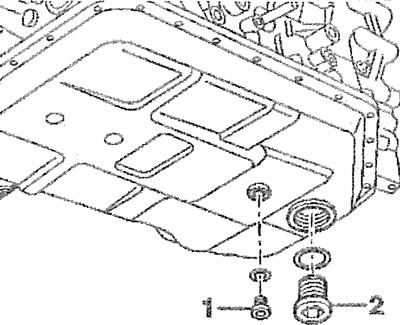
5.1. Unscrew plug 1 of the drain hole and drain the oil from the gearbox

5.1. Unscrew plug 1 of the drain hole and drain the oil from the gearbox


2. Screw plug 1 back into place with a new gasket and tighten it to a torque of 40 Nm.

3. Unscrew plug 2 of the oil filler/inspection hole (see illustration 5.1).
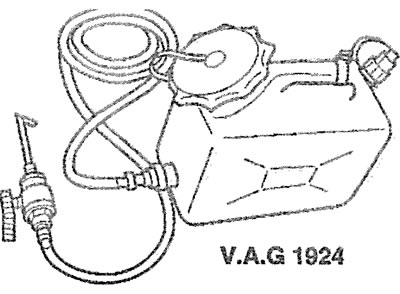
4. Secure the VAG 1924 container with transmission oil G 052 162A above the gearbox, for example on the radiator grille.

5. Fill transmission oil from container VAG 1924 flush with the lower edge of the oil filler hole by inserting the end of the hose into hole 4 (see illustrations 5.5 and 5.5a).
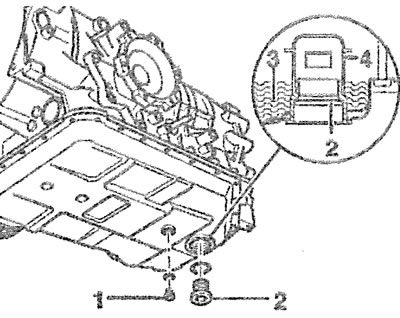
5.5. Fill the transmission oil from the VAG 1924 container flush with the lower edge of the oil…

5.5. Fill the transmission oil from the VAG 1924 container flush with the lower edge of the oil filler hole by inserting the hose tip into hole 4
5.5a. VAG 1924 device

5.5a. VAG 1924 device


6. Start the engine and let it idle, then check the transmission fluid level and add more.


7. Remove the VAG 1924 container, screw the plug into the oil filler hole and tighten it by hand.

8. Start the engine, depress the brake pedal and move the automatic transmission control lever alternately to all positions, holding in each position for approximately 2-3 seconds.

9. Turn off the engine, turn off the ignition and check the oil level in the automatic transmission, allowing the fluid to cool down. The temperature can be checked with the VAG 1551 diagnostic tester.

When the automatic transmission temperature is +35-40°C, unscrew the threaded plug 2 of the oil filler hole (see illustration 5.1). The oil level is normal if, after unscrewing the plug, oil flows out of the box in small quantities.

If the level is insufficient, add oil.

Checking the condition of the transmission fluid


When checking the automatic transmission fluid level, also check its condition. Compare it with fresh fluid by color, smell, and viscosity. If the transmission fluid is dark or almost black with a burnt smell, the friction linings are worn out.

If the fluid in the gearbox is milky in color, it means that coolant has gotten into it.

If dirt particles or metal shavings are found in the oil when checking the oil level or replacing it, the automatic transmission should be taken to a specialized workshop for repair.
The article was checked by auto expert Alexey Ivanov
This article is available at russian, bulgarian, belarusian, ukrainian, serbian, croatian, romanian, polish, slovak, hungarian

Share information:
Previous articles
Audi A6 C5 Allroad: Automatic gearbox
Next articles

Cardan shaft — removal and installation
Cardan shaft elements
Gearbox control mechanism — removal and installation
Gearbox control mechanism — design description


Similar articles on other Audi car models:
Manual transmission — checking the oil level Audi 80 B4 (1991-1996)
Transmission Fluid — Draining and Filling Audi 100 C3 (1982-1990, diesel)
Checking the automatic transmission final drive fluid level Audi A3 Type 8L (1996-2003)
Checking the fluid level in the servo control system Audi A4 B5 (1994-2001, petrol)
Checking the oil level in a manual transmission Audi A8 D2 (1994-2002)
Checking the transmission oil level in the manual transmission Audi Q5 Type 8R (2008-2017)
Engine — Checking Oil Level Audi A2 (1999-2005)
Link to this page in different formats


Visitor comments

No comments yet


How much will 10 + 41 =


A6(C5 AR, 1999-2005) 
  • General information
  • User manual
  • Maintenance
  • Troubleshooting
  • Power unit
  • V6 petrol engines
  • V8 petrol engines
  • Diesel engines
  • Cooling and heating system
  • Injection system (gasoline)
  • Fuel system (diesel)
  • Supply system
  • Exhaust system
  • Ignition system
  • Transmission
  • Clutch
  • Mechanical gearbox
  • Automatic gearbox
  • Chassis
  • Brake system
  • Car suspension
  • Steering
  • Body
  • Body elements
  • Doors, locks and windows
  • Electrical equipment
  • Equipment and devices
  • Power devices
  • Electrical circuits
  • Schemes (petrol engine 2.7 l)
  • Schemes (petrol engine 4.2 l)
  • Schemes (diesel engine 2.5 l)
 
A6(C5, 1997-2004) 
  • General information
  • User manual
  • Maintenance
  • Power unit
  • Engine repair
  • Cooling system
  • Fuel system
  • Engine management
  • Fuel system (diesel)
  • Exhaust system
  • Transmission
  • Clutch
  • Car gearbox
  • Chassis
  • Front suspension
  • Rear suspension
  • Steering
  • Wheels and tires
  • Brake system
  • Body
  • Exterior
  • Interior
  • Electrical equipment
  • Air conditioner
  • Equipment and devices
  • Electrical circuits
 
A6(C4, 1994-1997) 
  • General information
  • User manual
  • Maintenance (gasoline)
  • Maintenance (Diesel)
  • Gasoline engines
  • 4 cylinder engines
  • 5 cylinder engines
  • 6 cylinder engines
  • Diesel engines
  • 4 cylinder engines
  • 5 cylinder engines
  • Engine repair
  • Removal and reassembly
  • Cooling system
  • Single point injection system
  • Multipoint injection system
  • MPI/MPFI injection system
  • Fuel system (diesel)
  • Exhaust system
  • Ignition system
  • Transmission
  • Clutch
  • Manual transmission
  • Automatic transmission
  • Drive shafts
  • Chassis
  • Brake system
  • Front suspension
  • Rear suspension
  • Steering
  • Body
  • Exterior (external elements)
  • Interior (internal elements)
  • Electrical equipment
  • Power devices
  • Lighting and appliances
  • Electrical circuits
 
AudiManual.ru © 2017-2026 · Mobile version · Feedback · Sitemap: EN BG BY UA RS HR RO PL SK HU · Site search · News and articles
80 B2 · 80 B3 petrol · 80 B3 · 80 B4 · 100 C3 diesel · 100 C3 petrol · 100 C3 · 100 C4 petrol · 100 C4 · A3 Type 8L · A4 B5 petrol · A4 B5 · A4 B6 petrol · A4 B6 · A4 B7 · A4 B8 · A6 C4 · A6 C5 · A6 C5 Allroad · A8 D2 · Q5 Type 8R · Q7 Typ 4L · Audi A2 ·
This site uses cookies 🍪. Click the button to accept this fact.