



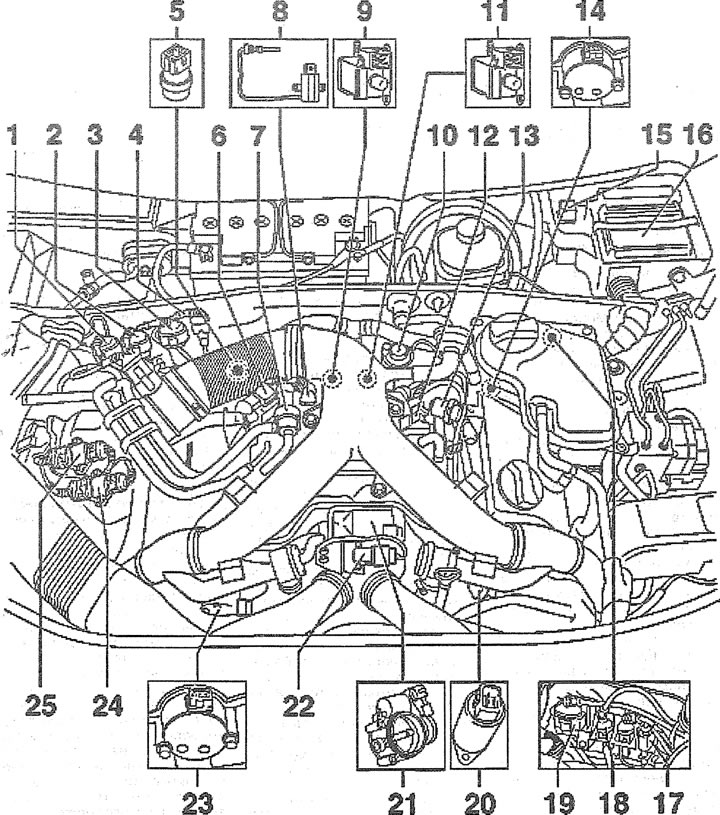
1.0. Sensors and actuators of the injection system:
1 - 4-pin plug of the main lambda probe 1 (green color)
2 - 4-pin plug of the main lambda probe 2 (brown color)
3 - 4-pin plug of additional lambda probe 1 (black color)
4 - 3-pin plug of the knock sensor 1
5 - coolant temperature sensor
6 - boost air pressure reducing valve
7 - electromagnetic valve for purging the adsorber
8 - sensor 1 and sensor 2 of the exhaust gas temperature
9 - not used
10 - electric motor of the afterburning system pump
11 - valve for supplying fresh air to the exhaust valves
12 - Turbocharger bypass valve
13- fuel pressure regulator
14 - camshaft position sensor (hall sensor)
15 - afterburner pump relay
16 - Engine control unit
17 - 3-pin plug for crankshaft position/engine speed sensor
18 - 3-pin plug of the knock sensor 2
19 - 4-pin plug of additional lambda probe 2 (black color)
20 - camshaft position regulator valve
21 - throttle valve
22 - boost air pressure sensor
23 - camshaft position sensor (hall sensor)
24 - ignition coil with output stage (cylinder head 1)
25 - ignition coil with output stage (cylinder head 2)
Fuel is sucked from the fuel tank by an electric fuel pump and supplied to the fuel injectors through a fuel filter mounted on the bottom. A pressure reducing valve ensures constant pressure in the fuel system.
The fuel is supplied via electronically controlled valve injectors, i.e. intermittently injected into the corresponding pipe of the intake manifold directly in front of the engine intake valves. The engine control unit regulates the injection duration and, thus, the amount of fuel injected.
Air is sucked in by the engine through the air filter and through the throttle valve and intake manifold to the intake valves.
The amount of incoming air, measured by the air mass meter, which uses a film as a heating element, determines the volume of fuel that the injectors must inject.
The air mass flow meter body contains a thin sensitive film that functions as a filament. The air taken in by the engine cools it as it passes near this film. The control unit regulates the heating of the film in such a way as to keep it constant, reacting to the volume (mass) of incoming air by increasing the filament current. By changing the filament current, the control unit determines the load on the engine and regulates the volume of injected fuel accordingly.
The information received by the control unit from other sensors, as well as the commands sent by the control unit to the actuators or control mechanisms, ensure optimal engine operation at any current load. If one or more main sensors fail, the control unit executes an emergency program to prevent engine damage and ensure continued movement. Do not immediately suspect sensor failure when engine operation deteriorates. The corresponding conclusions can only be made when performing a CO check or after receiving information about faults in the injection system.
The throttle valve is part of the fuel injection control mechanism.
The main task of the injection control mechanism is to maintain stable engine idle speed under all operating conditions and engine loads.
The idle speed sensor transmits information to the control unit about the throttle valve opening angle at idle speed. The control unit opens or closes the throttle valve via the actuator motor, thus maintaining the nominal idle speed value.
The coolant temperature sensor and the intake air temperature sensor record and report current temperature information to the unit by decreasing their resistance as the temperature increases.
The fuel tank is ventilated using a container with activated carbon and a magnetic valve. The activated carbon absorbs fuel vapors that form in the tank. When the engine is running, the fuel absorbed by the carbon is released and enters the engine for combustion.
Lambda probe (oxygen sensor) determines the oxygen content in the exhaust gas and transmits the corresponding information to the control unit by changing its resistance.
The knock sensor is used to determine and maintain the optimal ignition timing.
The duration of opening and closing of the intake valves is adjusted depending on the engine speed. For this purpose, the intake camshaft has a regulator that changes the moment of rotation of the shaft relative to the exhaust camshaft, ensuring later closing of the intake valves. This ensures smoother engine running at idle speed and an increase in its power when operating at high speeds. To increase the engine torque when operating at low and medium speeds, the camshaft position regulator is activated and the intake valves close earlier, ensuring improved filling of the cylinders.
All ignition and fuel injection system components are designed for long service life and require virtually no repairs. Maintenance only requires replacing the removable air filter element and spark plugs.
Basic adjustment and repair work can only be performed using expensive control and measuring devices. For this reason, repair and adjustment should be entrusted to specialized workshops that have the necessary devices and equipment.
Adjustment of idle speed and CO content is not required as part of maintenance.