



A densimeter is needed to check (see illustration 9.0a), which can be purchased in specialized stores.
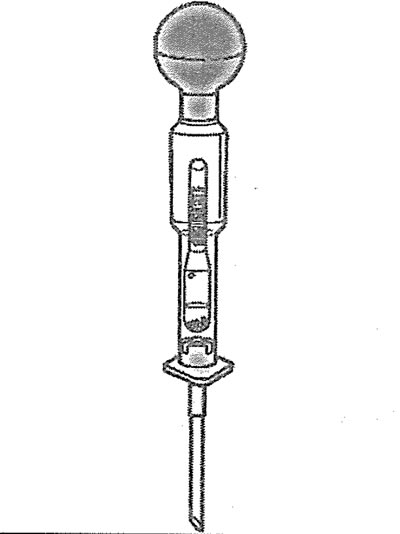
9.0a. Densimeter
The temperature of the electrolyte of the battery being tested must be at least +10°C.
10. Turn off the ignition.
11. Unscrew all the plugs from the cells. Before this, if necessary, remove the plug strip.
12. Lower the densimeter into the battery cell and remove enough electrolyte so that the densimeter float floats freely (see illustration).
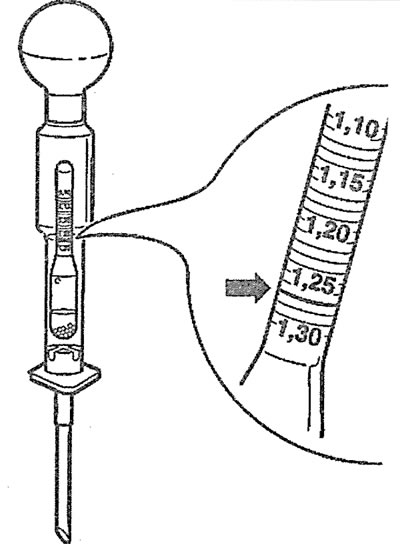
9.12. Lower the densimeter into the battery cell and take out enough electrolyte so that the densimeter float floats freely
The greater the specific gravity (electrolyte density), the higher the float rises. On the densimeter scale, the density of the electrolyte can be determined in specific gravity in g/ml or in degrees Baume (+°Be) (see illustration 9.12).
13. Charge the battery if the density of the filled electrolyte is low. The density of the electrolyte should be at least 1.24 g/ml.
14. Check all the battery cells one by one. They should all have approximately the same density (maximum difference ±0.04 g/ml). If the density of the electrolyte in the cells varies greatly, then it is possible that the battery is faulty.
| Battery charge level | +°Be | g/ml |
| Discharged | 16 | 1,12 |
| Half discharged | 24 | 1,20 |
| Well charged | 30 | 1,28 |
(Content source: the specified website: AUDIMANUAL.RU)